 blog
5 Learning Strategies That Speed Up Skill Acquisition
Quick Summary
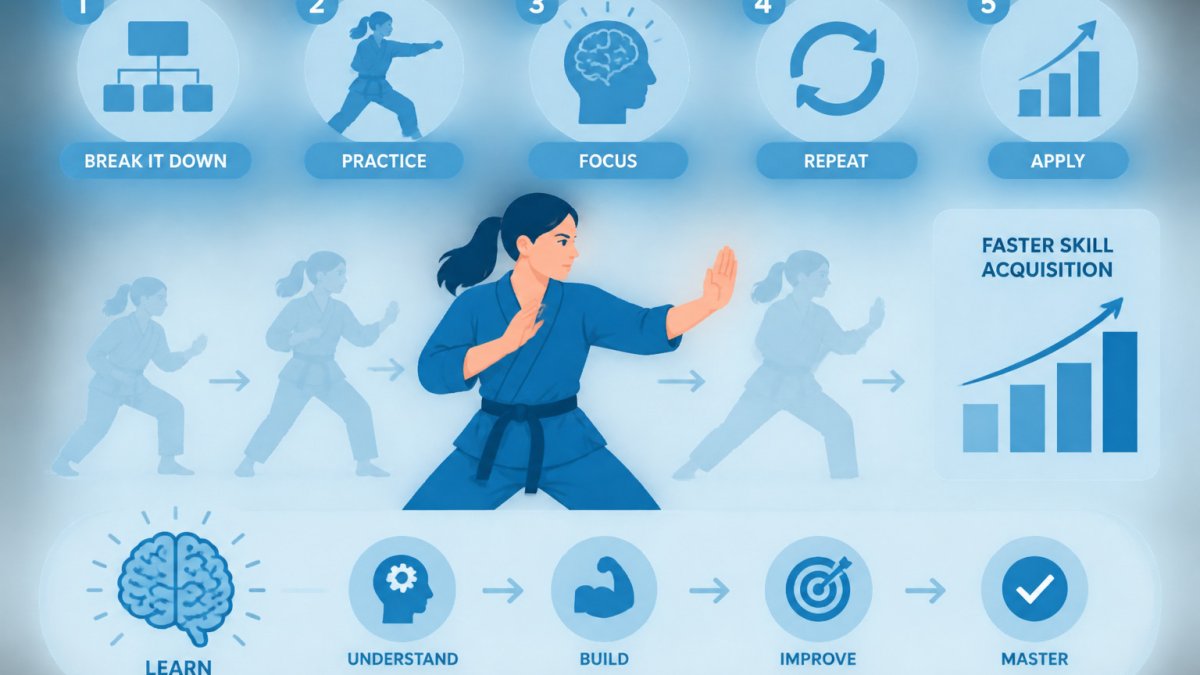
The best learning strategies for skill acquisition are retrieval practice, spaced practice, deliberate practice, motor learning, and feedback with self-assessment. These methods work better than rereading or repetitive drilling because they test recall, spread sessions over time, and target one specific weakness at a time.
- Pull a technique from memory before watching it again, instead of rereading or re-watching.
- Practice for 10 minutes, three times a week, and return to each technique after two days, then one week.
- Isolate one limiting sub-skill and set a measurable success criterion, such as 10 consecutive correct reps.
- Give one specific, observable correction per session and apply it immediately in the same session.
- Judge progress by accuracy, speed, retention, and transfer, not by how practice feels.
Table of Contents
- Why Most Practice Stalls and What Research Says Fixes It
- Strategy 1: Retrieval Practice Techniques Over Rereading
- Strategy 2: Spaced Practice for Skill Acquisition
- Strategy 3: Deliberate Practice Examples You Can Copy
- Strategy 4: Motor Learning Strategies for Physical Skills
- Strategy 5: Feedback and Self-Assessment to Measure Progress
- Building a Weekly Practice Plan You Can Keep
- Frequently Asked Questions
5 Learning Strategies That Speed Up Skill Acquisition
Last Updated: November 21, 2026
Why Most Practice Stalls and What Research Says Fixes It
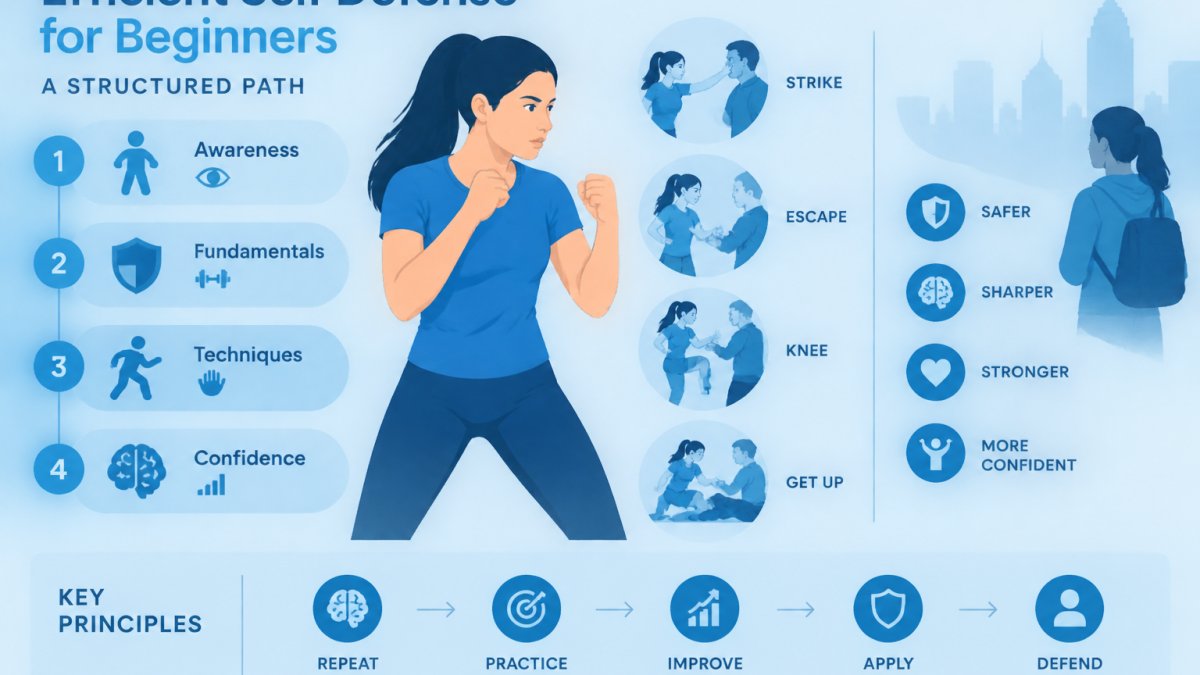
Most people who train a skill, including self-defense, hit a plateau. They keep drilling the same moves and feel busy without getting better. The research on learning explains part of why this happens.
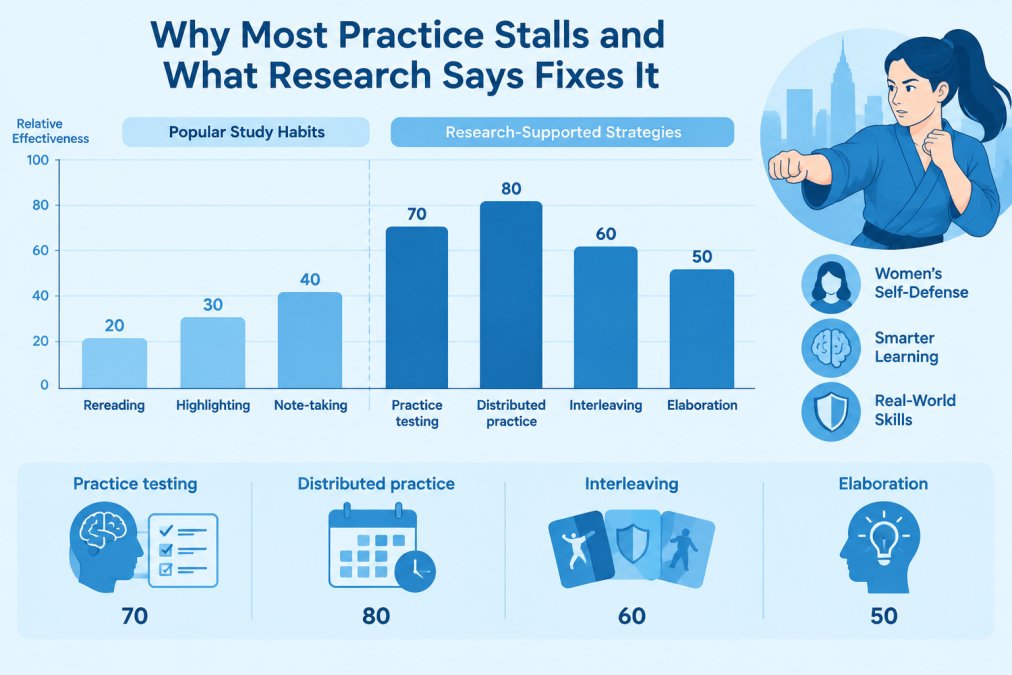
A review of learning research rated practice testing and distributed practice as highly effective. Interleaved practice, elaborative interrogation, and self-explanation were rated moderately effective (Digital Promise summary of evidence on learning strategies). Those ratings matter because the study habits people reach for most are often not the ones the evidence supports.
A 2025 study found that rereading, highlighting, and note-taking were the most popular strategies among students. Explaining, spacing, interleaving, and generating examples were among the strategies it examined as research-supported alternatives (A closer look at students' knowledge of effective learning strategies). In plain terms, comfortable habits and effective habits are often different.
The fix is a shift in how you practice, not more hours of it. The five strategies below move you from repeating moves to testing, spacing, and correcting them.
Strategy 1: Retrieval Practice Techniques Over Rereading
Retrieval practice means pulling a technique out of memory instead of looking at it again. Rereading feels productive, but it builds familiarity more than recall.
Try this in your next session:
- Demonstrate a sequence from memory before watching it again
- Name the next step aloud before you move
- Run the drill with your instructor calling out random entry points
A student survey found that rereading was among the most common study habits, even though it is not among the techniques rated highly effective (survey of secondary students on research-supported learning techniques). Swap rereading for recall, and the difference shows up under pressure.
Strategy 2: Spaced Practice for Skill Acquisition
Spaced practice means spreading sessions over time instead of cramming them into one long block. Distributed practice was rated highly effective in the Digital Promise review (Digital Promise evidence summary).
A simple schedule works well for busy schedules:
- Practice a technique for 10 minutes, three times a week
- Return to it after two days, then after one week
- Mix older techniques into new sessions
Short, repeated sessions also fit into a work week far better than one marathon class.
Strategy 3: Deliberate Practice Examples You Can Copy
Deliberate practice is not the same as repetition. It means isolating the specific sub-skill that is limiting your performance, working on it at the edge of your current ability, and getting immediate feedback on each attempt.
The mechanism has three parts. First, you break the skill into a component small enough to correct in one session. Second, you practice that component with full attention and a clear success criterion. Third, you get feedback quickly enough to adjust on the next rep. Skip any of the three and you are back to ordinary drilling.
Examples you can copy:
- Footwork only: Run the entry step 20 times, checking your base each time. Success criterion: heel stays down and weight stays centered on all 20 reps.
- Slow motion: Perform the full sequence at half speed, stopping at each transition. Success criterion: no pause longer than one second at any transition.
- Single error focus: Choose one flaw, such as dropping your guard, and correct only that. Success criterion: guard stays up for 10 consecutive reps.
- Constraint drill: Practice the technique with one hand behind your back or from a fixed stance to force the weak component to work.
Set one measurable goal per session. "Hold my guard for all 10 reps" is trackable. "Get better at blocking" is not.
Sequencing matters as much as the drill. A practical progression runs in four stages: instruction and demonstration, isolated component practice, integrated practice at controlled speed, then increasingly realistic tasks with a resisting or unpredictable partner. Most people jump from demonstration straight to realistic sparring, which is why the weak component never gets fixed. Stay at each stage until the success criterion is met twice in a row before adding difficulty. The same progression applies to retention work: keep each component controlled until it holds under pressure, then build toward unpredictable movement with Lindahl Holsters.
Watch out: practicing at full speed before the component is stable under slow conditions usually ingrains the error rather than correcting it, and the error becomes harder to unlearn later.
Strategy 4: Motor Learning Strategies for Physical Skills
Physical skills need different practice than knowledge does. Motor learning research favors varied practice and clear, limited cues over constant correction.
Apply these to self-defense training:
- Vary the attacker's angle and distance, so the skill transfers to unpredictable situations
- Give one cue at a time, such as "elbow down," not five corrections at once
- Practice at speed gradually, so technique stays intact under load
Strategy 5: Feedback and Self-Assessment to Measure Progress
Feedback only helps if it is specific, timely, and tied to something you can change on the next rep. "Good job" and "that was sloppy" are both useless because neither tells you what to adjust. The useful form is a single observable correction: "your rear foot lifts before the pivot," not "your footwork needs work."
When you seek feedback, ask for one correction per session and ask the instructor to name the observable cue, not the general impression. Then apply it immediately in the same session, because feedback that arrives a week later is much harder to connect to the movement that caused it.
Self-assessment works the same way. A simple routine:
- Record one short clip of a technique each week
- Score it on two or three observable points, such as posture, timing, and distance
- Compare this month's scores to last month's, not to how you feel
- Note one correction to carry into the next session
Measuring progress needs more than a feeling. Four indicators tell you whether learning is working: accuracy (how often the technique lands or meets the criterion), speed (how quickly it is performed correctly), retention (whether it still holds after a week away), and transfer (whether it works against a new angle, distance, or partner). A skill that is accurate but does not transfer is not yet learned; it is memorized under one condition.
Transfer is the indicator most people skip. Test it deliberately by changing one variable at a time: a different attacker angle, a different distance, a different speed. If performance collapses when the variable changes, return to the component drill rather than adding more pressure.
Watch out: video review can create overconfidence when you watch the clip once and move on; score it against written criteria the same day, or the footage becomes entertainment rather than assessment.
Building a Weekly Practice Plan You Can Keep
A plan works only if you can keep it. Here is a sample week for a busy professional:
| Day | Session | Strategy Used |
|---|---|---|
| Monday | 10-minute technique recall | Retrieval practice |
| Tuesday | Class or structured drill | Motor learning |
| Thursday | 10-minute footwork focus | Deliberate practice |
| Saturday | Review of last week's technique, filmed | Spaced practice and self-assessment |
Start with two sessions a week if your schedule is tight. Add a third only after two weeks of consistency. Kajukenbo and Filipino Martial Arts Club offers structured programs for busy professionals in Midtown Manhattan.
Ready to put these strategies into practice? Book a Trial Class with Kajukenbo and Filipino Martial Arts Club and start building skills you can measure.
Frequently Asked Questions
What are the five best learning strategies for skill acquisition?
The five strategies covered here are retrieval practice, spaced practice, deliberate practice, motor learning strategies, and structured feedback with self-assessment. Research summarized by Digital Promise rates practice testing and distributed practice among the most effective learning techniques, while interleaved practice and elaborative interrogation are rated moderately effective. Start with the strategy that fits your current bottleneck: if you can recall a move in class but not under pressure, begin with retrieval practice; if your progress plateaus between sessions, adjust your spacing first.
How does spaced practice help with skill acquisition?
Spaced practice spreads repetitions across several shorter sessions instead of one long block. Each return to a skill requires the brain to reconstruct it from memory, which strengthens retention more than repeated drilling in a single session. For busy professionals training two or three times a week, spacing sessions evenly and reviewing earlier material at the start of each class keeps techniques from fading between sessions.
What is the difference between blocked practice and random practice?
Blocked practice repeats one technique many times in a row, which produces fast improvement within a session but weaker recall later. Random or interleaved practice mixes several techniques within a session, which feels harder and produces slower early gains but better transfer when you must choose the right response under pressure. Many learners benefit from starting with blocked practice to build the basic movement, then moving to mixed sequences once the form is stable.
How can you retain a skill and perform it under pressure?
Retention under pressure depends on practicing retrieval in conditions that resemble the real situation. Run drills where you start from a neutral stance and must produce the technique without a cue, then add mild time pressure or an unexpected partner movement. Pair this with regular review of earlier material so the skill is recalled rather than reconstructed from scratch when stress rises.