 blog
How to Tell Cognitive Load From Mental Fatigue
Quick Summary
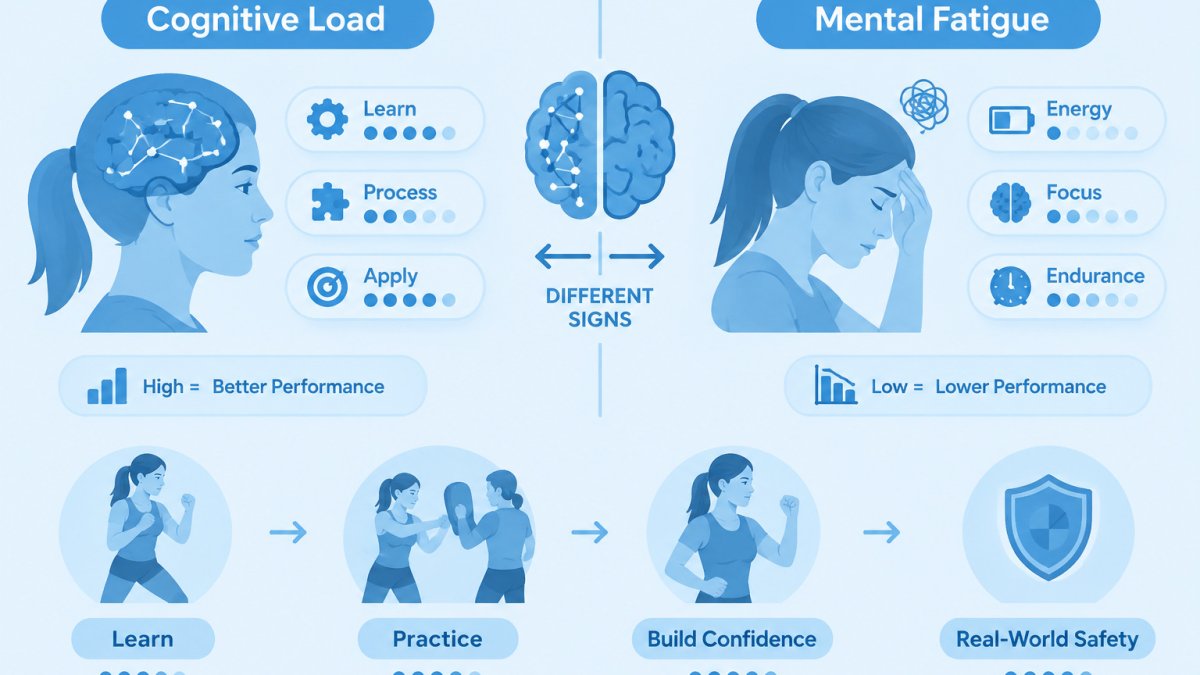
Cognitive load is the amount of mental effort a task demands from working memory at a given moment, while mental fatigue is the tiredness that builds after prolonged demanding effort. Cognitive load rises and falls within a task, whereas fatigue accumulates over hours and days and can linger after the demand stops.
- Cognitive load describes how hard a task is right now; mental fatigue describes how worn out you are.
- Check whether difficulty appears within one task or persists across several sessions or days.
- Take a short break and retry the task: a noticeable improvement suggests load, while no change suggests fatigue.
- Reduce extraneous load with clear, sequenced instruction, and break long sessions into shorter phases.
- Rising errors on familiar skills plus lower focus ratings can signal that load is turning into fatigue.
Table of Contents
- Why Cognitive Load and Mental Fatigue Get Confused
- Defining Cognitive Load and Mental Fatigue
- What Are the Three Types of Cognitive Load?
- Side-by-Side: State, Cause, and Outcome
- Mental Fatigue Symptoms to Watch For
- How Cognitive Load Can Lead to Mental Fatigue
- Mental Fatigue Treatment and Recovery Strategies
- Applying the Distinction to Your Own Training and Work Week
- Frequently Asked Questions
How to Tell Cognitive Load From Mental Fatigue
Last Updated: November 14, 2026
Cognitive load and mental fatigue are often used as if they mean the same thing. They do not. Cognitive load describes the demand a task places on your thinking, while mental fatigue describes a state of tiredness that can develop after sustained demanding effort.
Keeping the two apart matters. A class that overloads a beginner is a different problem from a student who has been training hard all week and is running low. The fix for one is not the fix for the other.
Why Cognitive Load and Mental Fatigue Get Confused
The two terms show up together in research, workplace advice and training discussions, so people often blend them. A hard task feels tiring, and a tired person finds hard tasks harder, which makes the link easy to assume.
Research treats them as related but separate. One review defines mental fatigue as a psychobiological state of tiredness caused by prolonged performance of demanding tasks that induce cognitive load (review on mental fatigue and its detection). In that definition, load is the cause and fatigue is the state.
Defining Cognitive Load and Mental Fatigue
Cognitive load is the amount of mental effort a task demands from working memory at a given moment. A new skill, a dense set of instructions or a fast-changing situation all raise it.
Mental fatigue is the tiredness that can follow prolonged mental effort. It builds over time, and it can lower your ability to keep focusing.
A simple way to hold the difference: load is how hard the task is right now, and fatigue is how worn out you are after working on it for a while.
What Are the Three Types of Cognitive Load?
Cognitive load theory splits the load of a task into three types. Each one affects how a learner spends limited working memory.
- Intrinsic load: the difficulty built into the material itself
- Extraneous load: effort wasted on poor design, clutter or confusing instructions
- Germane load: effort that goes into building lasting understanding
Intrinsic, Extraneous, and Germane Load
Intrinsic load depends on how many elements you must hold together at once. Learning a single strike is lighter than learning a full sequence of footwork, a block and a counter.
Extraneous load is the one you can often reduce. Cramming five new ideas into one explanation adds effort without adding learning. Clear, phased instruction cuts this load.
Germane load is the productive effort. It is the work of connecting new movements to what you already know, and it is where retention comes from.
Side-by-Side: State, Cause, and Outcome
The table below separates the two ideas by what they are, what drives them and what they look like in practice.
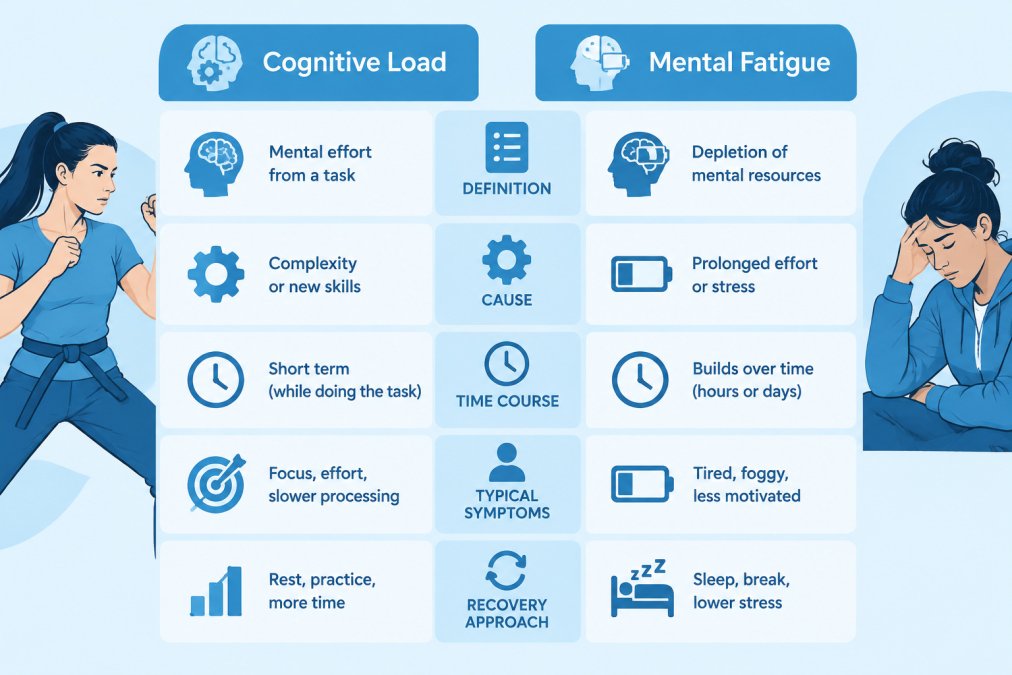
| Feature | Cognitive Load | Mental Fatigue |
|---|---|---|
| What it is | A demand on working memory | A state of tiredness |
| Main cause | How many elements a task requires at once | Prolonged demanding effort over time |
| Time course | Rises and falls within a task | Builds gradually and can linger |
| Typical effect | Slower processing, more errors during a hard step | Lower focus, reduced motivation, more avoidance |
| Common response | Simplify, break down or sequence the task | Rest, recovery and reduced demand |
Mental Fatigue Symptoms to Watch For
Mental fatigue shows up in ways you can notice and, to some degree, count. The signs below are grouped by what they affect, because a single symptom is weak evidence while a cluster that persists across a session or a week is stronger.
Attention and focus
- Difficulty staying on one task for more than a few minutes
- Mind wandering that you catch and correct repeatedly
- Needing to reread the same instruction or re-watch the same demonstration
Performance and accuracy
- More mistakes than usual on work you already know well
- Slower reaction time, especially on fast decisions
- Skipping steps in a familiar sequence
Motivation and choice
- Choosing easier options over harder ones when both are available
- Lower willingness to start a task you would normally begin without friction
- Feeling emotionally flat or more irritable than usual
Research supports the idea that fatigued people may avoid higher effort. One neuroscience study reported that cognitively fatigued participants were more likely to forgo higher rewards when those rewards required more effort (Journal of Neuroscience study on cognitive fatigue and effort-based decisions).
A Practical Self-Assessment: Load or Fatigue?
The comparison query is easier to answer with a short decision guide than with a symptom list alone. Use the three checks below.
- Duration. Did the difficulty appear within a single task and fade when the task changed? That points to cognitive load. Has the dullness persisted across several sessions or days? That points to mental fatigue.
- Response to a break. Take a short break, then retry the same task. If performance improves noticeably, the problem was likely load or a temporary demand spike. If performance stays flat or drops, fatigue is more likely.
- Scope. Is the difficulty limited to one hard task, or does it spill into tasks you normally find easy? Narrow difficulty suggests load; broad difficulty suggests fatigue.
A common pattern is that high load and fatigue coexist: a demanding week raises load, and the accumulated effort produces fatigue. The checks above help you decide which one to address first, not whether the other exists.
How Cognitive Load Can Lead to Mental Fatigue
Load does not automatically cause fatigue. A short, well-designed task at high load can be finished without much lasting tiredness. Sustained load over long periods is different, and the difference is mostly about time course and recovery. Because recovery depends on how long effort is sustained, small changes that make demanding work easier to manage can help keep mental fatigue from accumulating, as Clarity Flow Tools suggests.
Time Course: Load Changes Fast, Fatigue Accumulates
Cognitive load rises and falls within a task. A new sequence, a dense set of instructions, or a fast-changing situation can spike load in seconds, and simplifying the task can drop it just as quickly. Mental fatigue moves on a slower clock.
That mismatch is why the two get confused. A person can be in a high-load moment and not be fatigued, or be fatigued and facing a low-load task that still feels hard.
The Mechanism, Stated Carefully
A widely cited review defines mental fatigue as a psychobiological state of tiredness caused by prolonged performance of demanding tasks that induce cognitive load (review on mental fatigue and its detection).
One 2023 study found that anxiety fully mediated the relationship between cognitive overload and cognitive fatigue, which suggests that how demanding work is interpreted and experienced matters, not just how much work there is (2023 study on cognitive overload, anxiety and cognitive fatigue).
Measurement: What You Can Actually Track
Fatigue is usually assessed through performance measures and subjective ratings rather than a single biological marker. Performance measures include reaction time, error rate, and accuracy on vigilance tasks. Subjective measures include self-report scales that ask people to rate their perceived tiredness and effort. Neither is perfect, and researchers often combine them.
For your own training, the practical version is to track two things: error rate on familiar skills and your own rating of focus before and after a session. A rising error rate on work you know well, paired with a lower focus rating, is a reasonable signal that load is turning into fatigue.
Evidence Limitations and Causal Nuance
Most of what is known comes from controlled studies of prolonged demanding tasks, which establish association more firmly than causation in everyday settings. High cognitive load can contribute to fatigue, but it does not inevitably cause it, and individual factors such as sleep, health, task familiarity, and stress alter both the load a task imposes and how quickly fatigue accumulates.
Watch out: assuming that a hard week must produce fatigue can lead you to under-train, and assuming that fatigue is only a mindset can lead you to ignore the recovery signals that prevent it.
Mental Fatigue Treatment and Recovery Strategies
There is no single medical treatment for ordinary mental fatigue. The main approach is to reduce demand and allow recovery.
- Schedule demanding practice early, when focus is highest
- Break long sessions into shorter phases with rest between them
- Reduce extraneous load by using clear, sequenced instruction
- Protect sleep, since tiredness compounds across days
- Stop and rest when mistakes rise sharply
If fatigue is severe or lasts, talk to a qualified healthcare professional rather than trying to solve it through training alone.
Applying the Distinction to Your Own Training and Work Week
Start by asking which problem you have. If a new skill feels impossible, the load is probably too high, so break it into smaller pieces. If you are sharp at the start of the week and dull by Thursday, fatigue is more likely, so build in recovery.
For skill training, a deliberate approach helps. Our guide on how to apply deliberate practice to martial arts explains how to structure practice so new movements stick. Readers who want to avoid common setbacks can review 7 self-defense training mistakes that stall skill progress. For a program built around a busy schedule, see structured self defense training programs: a 2026 guide.
Matching the training to your actual state, rather than pushing through every session at full intensity, is what keeps progress steady.
Frequently Asked Questions
How to tell if fatigue is mental or physical?
Mental fatigue usually shows up as trouble concentrating, slower reaction time, more careless errors, and a drop in motivation, even when the body feels fine. Physical fatigue tends to show up as muscle heaviness, breathlessness, or soreness after exertion. Mental fatigue often follows hours of demanding attention work, such as reviewing complex documents or managing several tasks at once. If rest improves the mental symptoms but a physical workout still feels draining, the cause is likely physical. Persistent or worsening symptoms warrant a conversation with a doctor.
What are the three types of cognitive load?
Cognital load theory describes three types of cognitive load. Intrinsic load comes from the inherent difficulty of the material itself. Extraneous load comes from how information is presented, such as cluttered instructions or unnecessary steps that add effort without adding learning. Germane load is the productive effort spent building understanding and organizing information into memory. Intrinsic and extraneous load compete for limited working memory, so reducing extraneous load frees capacity for productive germane effort. Recognizing which type dominates helps in redesigning a task or a lesson.
Can prolonged cognitive load cause mental fatigue?
Yes, sustained high cognitive demand is one of the main pathways to mental fatigue. A review defines mental fatigue as a psychobiological state of tiredness caused by prolonged performance of demanding tasks that induce cognitive load. The state develops over time rather than instantly, which is why a brief hard task rarely causes fatigue but a long, demanding session often does. Research also shows that cognitively fatigued people become more likely to avoid effortful rewards, which helps explain why fatigue can lower motivation as well as accuracy.
What is the difference between cognitive load and mental fatigue?
Cognitive load describes the mental demand a task places on working memory and attention at a given moment. Mental fatigue is the resulting state of tiredness that can develop after prolonged, demanding effort. Load is the cause and fatigue is one possible outcome. A task can be high in cognitive load without producing fatigue if it is brief, and fatigue can persist after the load has ended. Research is still refining how the two interact, and some studies suggest factors such as anxiety may help explain the relationship.