 blog
How to Choose a Martial Arts Alternative as an Adult
Table of Contents
- Why Adults Look Beyond Traditional Martial Arts Classes
- What Counts as a Traditional Martial Arts Class
- Boxing Classes for Adults as a Striking-Focused Option
- Self-Defense Training for Adults Without a Belt System
- Martial Arts Training at Home and Online Options
- Choosing Options for Older Adults and Varied Fitness Levels
- Comparing Cost, Time, and Equipment Across Options
- Booking a Trial Class to Test Your Fit
- Frequently Asked Questions
Last Updated: November 1, 2026
Adults who skip traditional martial arts classes often have good reasons. A class can run two or more nights a week, start with a belt system that feels like school, and demand a lot of time before any skill feels usable. For many busy adults, that schedule is the real obstacle.
This guide covers the main alternatives to traditional classes and how to pick one. It breaks down what counts as a traditional class, what the options look like, and how to test a fit before you commit. As you weigh which option fits your routine, consider whether martial arts for stress relief is part of what you want from training.
Why Adults Look Beyond Traditional Martial Arts Classes
Many adults want the benefits of martial arts without the full commitment. They want fitness, confidence and basic self-defense skills that hold up under stress.
A common reason to look elsewhere is schedule. Fixed class times are hard to keep when work runs late or travel is frequent. Another reason is that some adults want a clear skill path rather than years of ranking up.
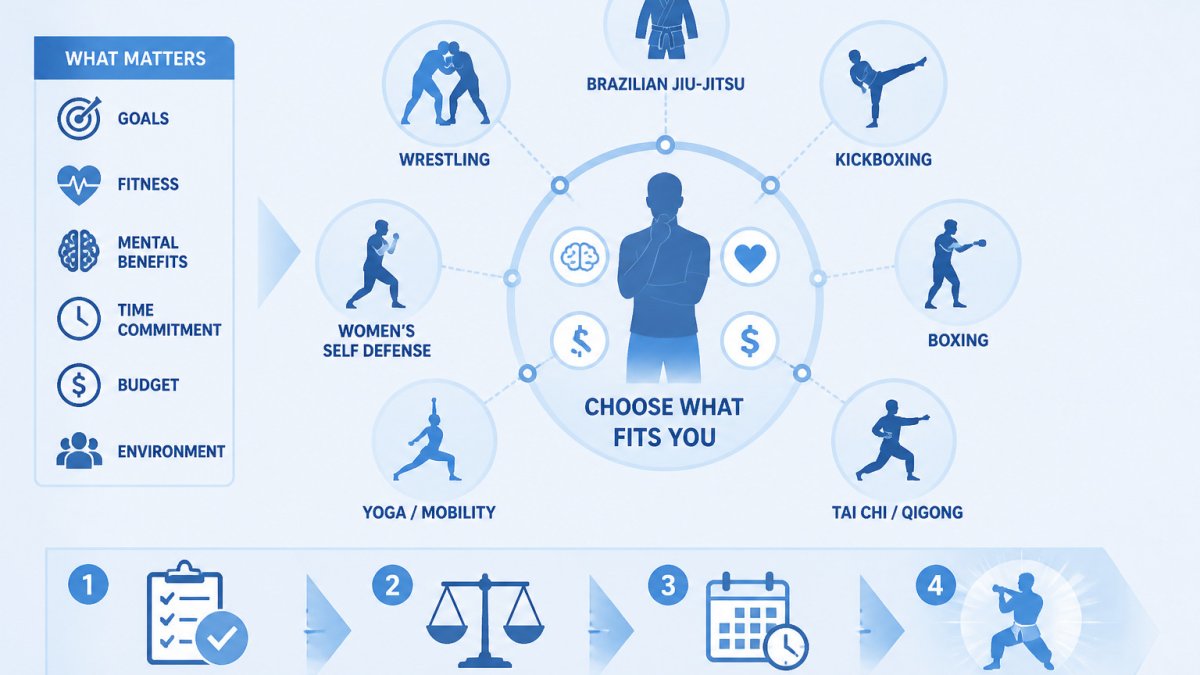
We recommend starting with your goal. Are you after fitness, stress relief, self-defense or a social outlet? The answer narrows your options fast.
What Counts as a Traditional Martial Arts Class
A traditional martial arts class usually means a dojo or school teaching a set style, such as karate, judo, tae kwon do or Kajukenbo. These classes often follow a belt or rank system, repeat forms and techniques in sequence, and meet on a fixed weekly schedule.
That structure has real value. It builds discipline and gives you a long-term curriculum. The trade-off is time, since progress often depends on steady attendance over months.
Knowing this baseline makes it easier to judge alternatives. Anything that drops the fixed schedule, the belt ladder or the long curriculum is an alternative.
Boxing Classes for Adults as a Striking-Focused Option
Boxing is the most common entry point for adults who want striking skills without a belt system. The category splits into two very different products, and knowing which one you are signing up for matters more than the gym's branding.
Boxing fitness classes are group workouts built around heavy bags, shadowboxing, and bodyweight conditioning. You will rarely touch a partner or take a hit. The draw is calorie burn, footwork, and hand speed in a 45- to 60-minute session. Many gyms and studios run these, and they are often beginner-friendly.
Combat boxing classes add partner drills, pad work, and controlled sparring. These build timing, distance management, and reaction under pressure, the skills that actually transfer to a confrontation. Gloves, hand wraps, and a mouthguard are commonly needed for this type of class.
A practical middle path is a class that pairs bag work with pad rounds. Pad work is where most of the learning happens: a coach or partner feeds punches and you respond, which trains the read-and-react loop that bag cardio cannot replicate. Ask any gym how much pad work a beginner gets in the first month.
Boxing's limits are worth stating plainly. See how boxing-style skills hold up in real street situations before deciding. It is a stand-up system with almost no ground game, no weapons defense, and limited work against grabs and clinches. Adults who want a complete self-defense picture usually pair boxing with a grappling art or a short self-defense course.
For adults who want striking without the rank ladder, boxing delivers real skill fast. For adults who want a full self-defense toolkit, treat it as one component rather than the whole answer.
Self-Defense Training for Adults Without a Belt System
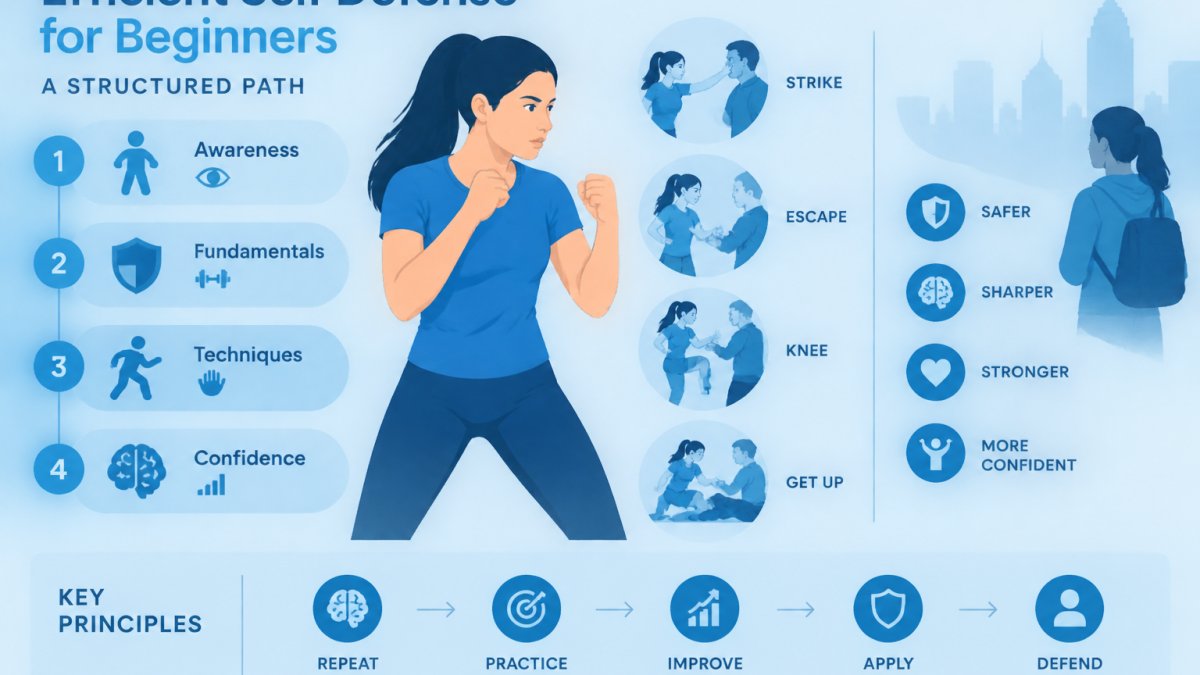
Self-defense programs built for adults often skip the belt system and focus on practical skills: awareness, escapes, strikes and how to get to safety. Many run as short courses or workshops.
Structured self-defense programs are a strong fit for busy schedules. They usually have clear phases, so you know what you will learn and when. Ask how the program measures progress, and whether skills are tested under pressure, not just repeated in a calm room.
Watch out: a short course is not a substitute for ongoing practice. Skills fade without regular repetition, so plan on periodic refreshers.
Martial Arts Training at Home and Online Options
Home and online training has grown fast. Live-streamed classes, recorded programs and hybrid schedules let you train without a commute. They suit people who travel or work odd hours.
Online training has limits. Without a partner, it is hard to practice contact drills, timing or distance. It works best for conditioning, footwork, form and concepts, with in-person sessions added when you can fit them.
If you train at home, set a fixed weekly time and track what you practice. Efficient workouts can fill short sessions. Consistency matters more than session length.
Choosing Options for Older Adults and Varied Fitness Levels
Most adult beginners are not 22-year-old athletes. They are people with desk jobs, old knee injuries, shoulder issues, or a decade away from any structured exercise. The right program adapts to that body, not the other way around.
Low-impact and adaptive formats are the most under-covered category in this space. They include:
- Tai chi and qigong, slow, balance-focused movement with a strong evidence base for fall prevention in older adults. Often taught in community centers and senior programs.
- Chair-based and seated martial arts, modified karate and self-defense drills performed from a chair, used in adaptive programs for people with limited mobility.
- Boxing fitness without contact, bag and shadowboxing work scaled to a standing or seated position, with no sparring.
- Functional training and mobility classes, not martial arts, but they build the strength, balance, and range of motion that make any self-defense skill usable.
Adapting a standard class is often possible. Good instructors offer modifications for knees, shoulders, and backs, and will let you swap a jump for a step or a kick for a knee strike. Ask before you enroll: How do you modify drills for someone with a bad knee or shoulder? Do you offer a seated or low-impact version? A vague answer is a red flag.
Prior injuries and returning after a break deserve a slower ramp. Gradual progress that starts with technique and joint-friendly conditioning is generally a sensible approach after an injury. Tell the instructor about any injury before your trial class, not after.
Disability and accessibility are rarely addressed in mainstream martial arts marketing. If you use a wheelchair, have limited grip strength, or are deaf or hard of hearing, call ahead and ask how the class handles communication, floor access, and partner work. Some schools handle this well; others may not have been asked before.
The bottom line: the best option for an older or less-fit adult is usually one that scales intensity, offers clear modifications, and does not treat a slower pace as a failure. That combination is more important than the style on the sign.
Comparing Cost, Time, and Equipment Across Options
Each option asks something different from you. Here is how the main choices compare in general terms:
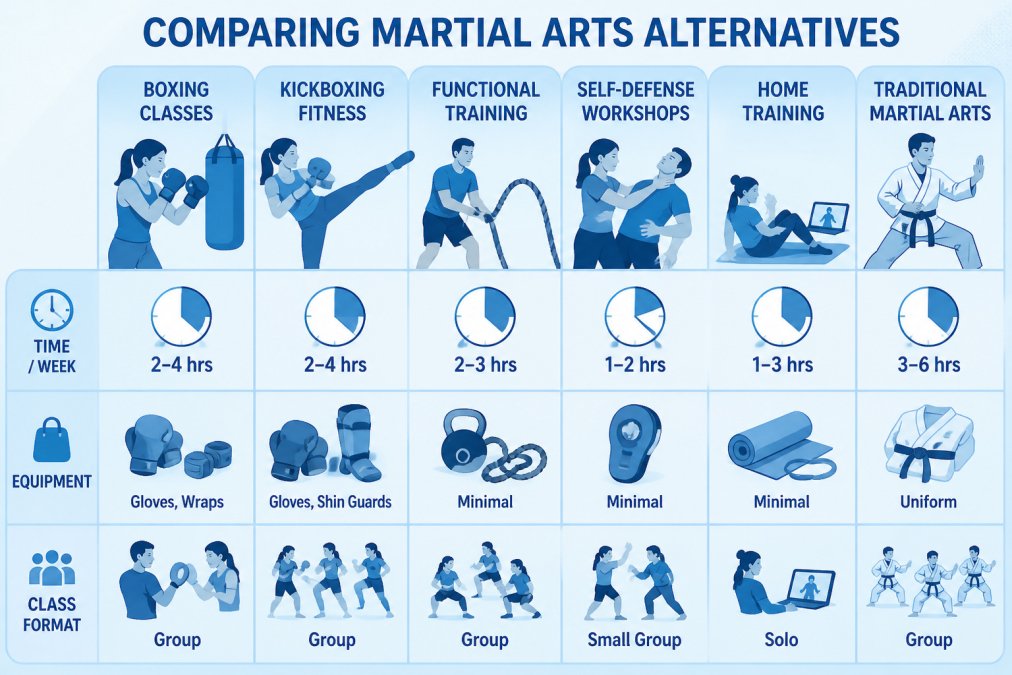
| Option | Typical Time Commitment | Equipment Needed | Best For |
|---|---|---|---|
| Traditional martial arts class | 2+ sessions per week, ongoing | Uniform, sometimes gear | Long-term skill and rank |
| Boxing class | 1-3 sessions per week | Gloves, wraps | Striking and fitness |
| Self-defense course | Short, fixed program | Minimal | Practical skills fast |
| Home or online training | Flexible, self-scheduled | Mat, space, device | Busy or traveling adults |
Pricing depends on the program and format, so check each program directly for current rates. Ask about cancellation, pausing and makeup policies before you sign up. Those terms can matter for a busy schedule.
Booking a Trial Class to Test Your Fit
The best way to judge an option is to try it. Most schools offer a trial class or intro session. Use it to see how the class is run, how the instructor explains skills and how you feel afterward.
Before you go, write down your goal and two or three questions. Ask how beginners are supported, how progress is measured and what a typical week of training looks like.
If you want to see how a structured, time-efficient program works, you can book a trial class with Kajukenbo and Filipino Martial Arts Club. The club's approach breaks complex techniques into clear, progressive phases, which suits adults with demanding schedules.
Frequently Asked Questions
How can adults practice martial arts at home alone?
Adults can practice martial arts training at home by focusing on the fundamentals that need no partner: stance work, footwork, shadow boxing, bodyweight conditioning, and solo drills for striking combinations. A small, clear floor space and a mirror help with form. Home practice builds conditioning and movement habits well, but it cannot replace partner work for timing, distance, and resisting an opponent. Many adults combine home drills with a weekly partner or class session. Set a fixed schedule of 20 to 30 minutes, track your sessions, and add one partner-based practice each week when you can.
What are good alternatives to traditional martial arts classes for adults?
Good alternatives include boxing classes for adults, kickboxing fitness classes, functional training, and short self-defense workshops. Boxing and kickboxing fitness emphasize striking, conditioning, and pad work without the belt progression many traditional schools use. Functional training builds strength and mobility that carry over to grappling and falls. Self-defense workshops teach practical responses to common threats in a few sessions. Choose based on your goal: fitness, practical self-defense, or a long-term skill. Check each class format, instructor background, and whether sparring is optional.
Is it normal to start martial arts as an adult?
Yes. Many adults start martial arts in their 30s, 40s, 50s, and later. Adult beginners often bring stronger discipline and clearer goals than younger students, though they may need more time to build flexibility and coordination. Most schools and instructors work with mixed-age classes. Start with a trial class, tell the instructor about any injuries or limitations, and choose a format that matches your current fitness level. Progress tends to be steady when training is consistent rather than intense and occasional.
What martial arts training is best for busy professionals?
The best option for busy professionals is usually one with a predictable schedule, short sessions, and a clear progression. Options such as boxing classes for adults, kickboxing fitness, and short self-defense workshops often fit into a lunch hour or evening slot. Look for classes that let you attend once or twice a week and still make measurable progress, and confirm the attendance expectations before signing up. Pair in-person sessions with at-home drills to keep skills active between classes.