
 blog
blog
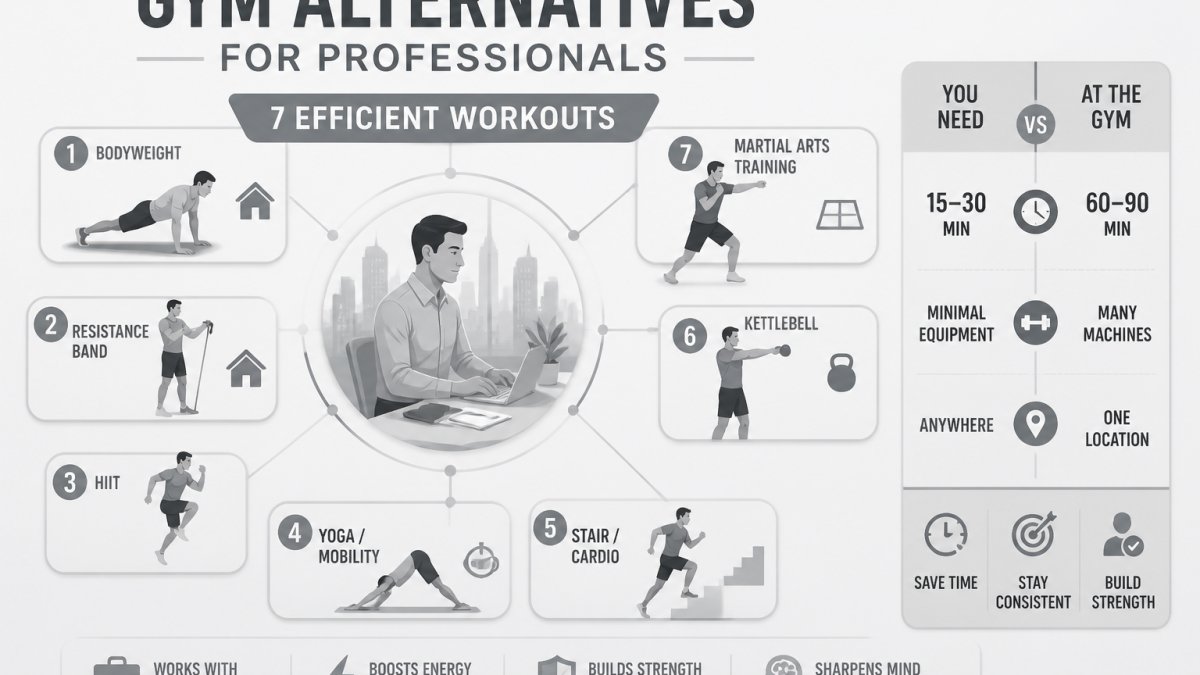
Gym Alternatives for Professionals: 7 Efficient Workouts
Table of Contents
- Why Professionals Skip Traditional Gyms
- Martial Arts for Busy Professionals
- Self-Defense Classes for Adults
- Time-Efficient Workouts for Professionals
- Bodyweight Workouts Without a Gym
- Group Fitness Classes and Yoga
- Comparison: Which Alternative Fits Your Schedule
- Measuring Progress and Staying Consistent
- Frequently Asked Questions
Last Updated: October 5, 2026
Why Professionals Skip Traditional Gyms
Busy professionals often find that traditional gym memberships don't fit their schedules, which is why gym alternatives for professionals have become increasingly popular. Long commutes to a fixed location, rigid class times, and the need to plan workouts around demanding work calendars make conventional fitness routines impractical.
The real problem isn't motivation, it's logistics. A professional who travels frequently, stays late at the office, or manages variable hours can't commit to a 6 AM spin class or a 90-minute strength session three times a week. They need alternatives to traditional gym workouts for professionals that fit into their actual lives, not their ideal lives.
That's where unconventional fitness approaches come in. From martial arts to bodyweight training to group fitness classes, there are proven ways to build strength, cardiovascular fitness, and functional ability without ever stepping foot in a traditional gym.
The alternatives we cover below offer something most gyms don't: measurable progress in specific competencies, not just rep counts. Whether you're looking to build core stability, develop functional strength, or master self-defense, these options deliver concrete outcomes in less time.
Martial Arts for Busy Professionals
Martial arts training stands out as one of the most time-efficient alternatives to traditional gym workouts for professionals. Unlike open-ended gym sessions, martial arts classes follow a structured progression. You learn specific techniques, practice them under controlled conditions, and measure your advancement through belt ranks or skill milestones.
Self-defense training through martial arts serves a dual purpose: it builds functional strength while teaching you practical skills you can use under pressure. This dual benefit means every minute in the dojo counts toward two goals simultaneously, physical conditioning and technical competency.
For professionals with limited availability, martial arts offers several advantages. Classes are typically 45-60 minutes, fitting neatly into a lunch break or evening slot. The structured curriculum means you don't waste time deciding what to do that day, the instructor guides your workout. Progression is clear and measurable, which keeps motivation high when you're juggling work demands.
The neuroscience-based methodology used in programs like those at Kajukenbo and Filipino Martial Arts Club breaks complex techniques into progressive phases, making skills easier to retain and recall. This approach optimizes how your brain acquires movement patterns.
Self-Defense Classes for Adults
Self-defense classes specifically designed for adults address a common gap in fitness options. These classes teach practical techniques for real-world scenarios while building the strength, balance, and conditioning you'd develop in any serious workout.
Most adult self-defense programs focus on situational awareness, de-escalation, and physical techniques that use use body mechanics over raw strength. This means smaller individuals and those without prior athletic experience can master effective techniques. The emphasis on technique efficiency rather than brute force makes these classes accessible to many fitness levels.
Adults benefit from the confidence boost that comes with competency. Unlike general fitness, where progress is abstract (one more rep, one more pound), self-defense training gives you concrete, applicable skills. You learn to recognize threats, respond decisively, and execute techniques under simulated pressure.
Classes typically run 50-75 minutes and can be scheduled around professional calendars. Many programs offer flexible drop-in options or short-term courses, making them ideal for professionals who can't commit to long-term memberships. The intensity is adjustable, beginners work at their own pace while advanced students tackle more complex scenarios.
Time-Efficient Workouts for Professionals
High-Intensity Interval Training (HIIT)
High-intensity interval training delivers maximum cardiovascular benefit and strength conditioning in minimal time. A typical HIIT session lasts 20-30 minutes but produces fitness gains comparable to 60-minute steady-state workouts.
The principle is straightforward: alternate short bursts of maximum effort with recovery periods. This pattern elevates your heart rate, builds anaerobic capacity, and triggers metabolic effects that continue after you finish. For professionals, this efficiency is transformative. A 25-minute HIIT session fits into a lunch break and requires no equipment or travel time.
HIIT works for all fitness levels because intensity is relative to your current capacity. You work at your maximum effort during the work intervals, not against an absolute standard. This means a beginner and an advanced athlete can do the same workout and both get significant benefit.
Rock Climbing and Bouldering
Rock climbing and bouldering combine strength training, problem-solving, and cardiovascular conditioning in one activity. Every climb demands full-body engagement, your legs drive the movement, your core stabilizes, and your upper body pulls. The mental component is equally demanding: you must read the route, plan your sequence, and execute under fatigue.
Bouldering (climbing walls 10-15 feet high without ropes) is particularly suited to professionals because sessions are flexible. You arrive, warm up, work on problems at your level, and leave whenever your schedule permits. No class time, no fixed schedule, no long commute.
The strength gains from climbing are functional and balanced. You develop grip strength, shoulder stability, leg power, and core endurance, all essential for real-world movement patterns. Unlike isolated weight training, climbing requires you to integrate these strengths into coordinated movement. This holistic approach to physical conditioning mirrors the broader functional training benefits that help busy professionals maintain peak performance throughout their demanding work weeks.
Roller Skating and Rollerblading
Roller skating and rollerblading provide cardiovascular fitness and lower-body conditioning while building balance and ankle stability. These activities are often overlooked as serious workout options, but they deliver legitimate fitness benefits when pursued with intensity.
A 45-minute skating session at moderate to high intensity elevates your heart rate into the cardio zone and works your glutes, quads, and calves. The balance component engages your core continuously. Many professionals find skating enjoyable enough to maintain consistency, which is the single biggest factor in fitness success.
Skating also requires minimal equipment investment and can be done outdoors in most climates. This removes barriers that prevent gym attendance, no membership fee, no travel time, no indoor facility needed.
Bodyweight Workouts Without a Gym
Core and Stability Exercises
Core and stability training builds the foundation for functional movement. A strong core prevents injury, improves posture, and enhances performance in any physical activity. The best part: core work requires zero equipment and minimal space.
Planks, dead bugs, bird dogs, and pallof presses target deep stabilizer muscles that traditional crunches miss. These exercises teach your core to resist movement rather than create it, which is how your core actually functions in real life. A 15-minute core session three times per week produces visible strength gains within 4-6 weeks.
Professionals can do core work at home, in a hotel room, or during a work break. The time investment is small but the payoff is substantial. Core strength improves your posture during long work days, reduces lower back pain, and enhances stability in any sport or activity you pursue.
Functional Training for Real-World Strength
Functional training mimics movement patterns you use in daily life and work. Squats, lunges, carries, and rotational movements build strength that transfers directly to how your body actually moves.
Unlike isolated weight training that targets single muscles, functional training demands coordination across multiple muscle groups. A goblet squat works your legs, core, and upper back simultaneously. A farmer's carry builds grip strength, core stability, and postural endurance. These patterns are more efficient than traditional gym splits because every exercise teaches your body to work as an integrated system.
Bodyweight versions of functional exercises are surprisingly effective. Pistol squats (single-leg squats) build tremendous leg strength and balance. Push-up variations target chest, shoulders, triceps, and core. Bodyweight rows develop back strength and pulling power. Progressive versions allow you to scale difficulty as you improve.
Group Fitness Classes and Yoga
Group fitness classes provide structure, accountability, and community, three factors that drive consistency. Whether it's hip-hop yoga, body pump, or circuit training, group classes keep you motivated through social energy and instructor guidance.
Yoga deserves specific mention because it addresses mobility, flexibility, and balance, areas that traditional gym training often neglects. Regular yoga practice improves posture, reduces injury risk, and enhances recovery. For professionals sitting at desks all day, yoga counteracts postural stress and builds functional mobility.
The group format creates accountability. You're more likely to show up when others are counting on you. Classes also eliminate decision-making, the instructor designs the workout, so you don't waste mental energy planning what to do.
Many studios offer flexible class schedules and drop-in options. This removes the commitment barrier that prevents professionals from joining traditional gyms.
Comparison: Which Alternative Fits Your Schedule
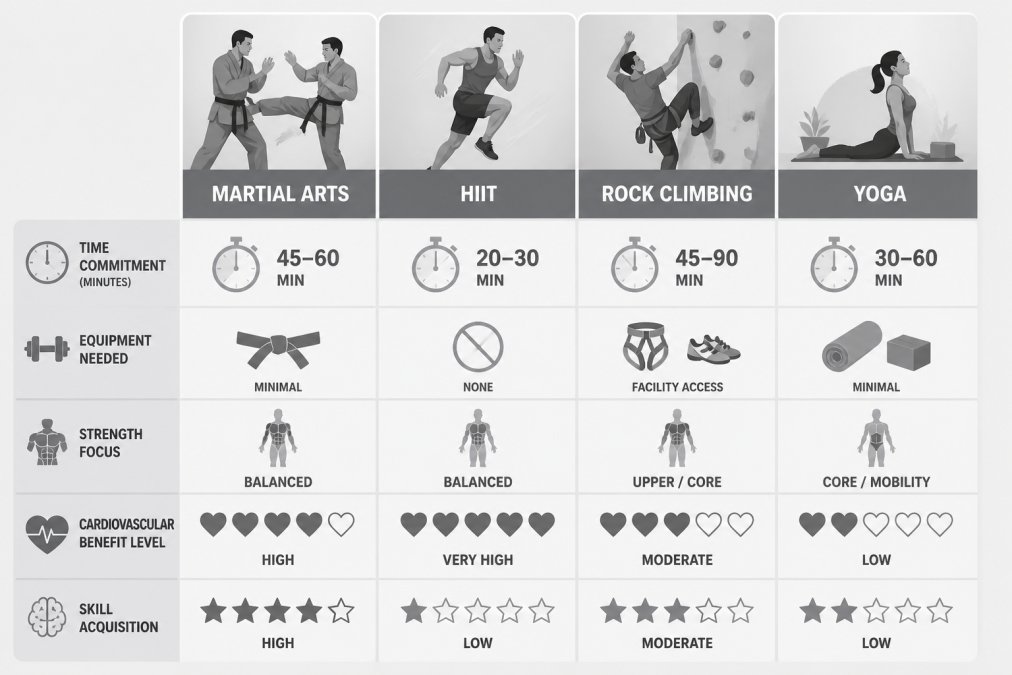
| Workout Type | Time per Session | Equipment | Best For | Strength Focus |
|---|---|---|---|---|
| Martial Arts | 45-60 min | Minimal | Skill acquisition, confidence | Balanced |
| HIIT | 20-30 min | None | Time efficiency | Balanced + cardio |
| Rock Climbing | 45-90 min | Facility access | Upper body, problem-solving | Grip, shoulders, core |
| Roller Skating | 45-60 min | Skates | Lower body, balance | Legs, glutes, core |
| Bodyweight Training | 20-45 min | None | Flexibility, home workouts | Varies by exercise |
| Group Fitness | 45-60 min | Facility/mat | Accountability, community | Varies by class |
| Yoga | 45-90 min | Mat | Mobility, recovery, flexibility | Core, stability |
The right choice depends on three factors: your available time, your fitness goals, and your learning style. Professionals with 30 minutes or less should prioritize HIIT or bodyweight training. Those with 45-60 minutes can commit to martial arts, group fitness, or rock climbing. If you value skill acquisition and measurable progression, martial arts and climbing stand out.
Measuring Progress and Staying Consistent
Progress tracking keeps motivation high when you're juggling work and fitness. Unlike traditional gyms where you might track weight lifted or reps completed, many gym alternatives for professionals offer different metrics.
In martial arts, progression is built in, you advance through belt ranks or skill levels. This external structure provides clear milestones and motivation.
Consistency beats perfection. A professional who completes three 30-minute sessions per week will see better results than one who attempts two 90-minute sessions and skips them half the time.
Kajukenbo and Filipino Martial Arts Club emphasizes measurable skill acquisition through structured progression. This approach keeps professionals engaged because they see tangible advancement in specific competencies, not just general fitness metrics.
Track what matters to your chosen activity. In martial arts, note which techniques you've mastered and which need work. In climbing, track the routes you've completed. In HIIT, note your work-to-recovery ratio.
Traditional gyms work for some people, but busy professionals often need something different.
If you're looking for an approach that combines time efficiency with skill acquisition and measurable progress, martial arts training designed for professionals offers a clear advantage.
Frequently Asked Questions
What are effective alternatives to traditional gym workouts for busy professionals?
Martial arts, bodyweight training, high-intensity interval training, rock climbing, and group fitness classes all offer time-efficient workouts. Martial arts specifically combines strength, cardiovascular conditioning, and functional training in structured sessions designed for skill progression. For professionals with limited time, these alternatives eliminate commute time to a gym facility and deliver measurable results in 45-60 minutes per session.
Can martial arts provide a full-body workout?
Yes. Martial arts training engages upper body (punches, blocks), lower body (kicks, stances, lunges), core stability, and cardiovascular conditioning simultaneously. Disciplines like Kajukenbo incorporate functional strength patterns that build practical fitness applicable to real-world scenarios. Progressive training phases ensure balanced development across all muscle groups while improving balance, mobility, and coordination, elements traditional gym workouts often address separately.
How can I stay fit when I have a demanding work schedule?
Choose workouts that eliminate travel time: home-based bodyweight training, nearby martial arts studios, or group fitness classes within walking distance of your workplace. Time-efficient formats like HIIT or structured martial arts classes maximize results in 30-60 minutes. Consistency matters more than duration, two focused sessions per week outperform sporadic longer workouts. Self-defense classes for adults often offer flexible scheduling around professional commitments.
What is the advantage of structured martial arts over general fitness training?
Structured martial arts programs use progressive phases and measurable skill milestones, unlike open-ended gym routines. Neuroscience-based teaching methods break complex techniques into digestible components, improving retention and recall. This methodology ensures that fitness gains translate into reliable self-defense capability, providing both physical conditioning and practical confidence.