 Ultimate guide
Making Complex Self-Defense Skills Easier to Remember Under Stress
Quick Summary
Complex self-defense skills become easier to remember under stress when they are broken into short phases, practiced with spaced repetition, and rehearsed with simple verbal cues. Stress inoculation then builds reliability by raising intensity one dial at a time, so the body learns that pressure is not a reason to freeze.
- Break each technique into three to five short phases and learn one phase at a time.
- Attach a short verbal cue such as "distance, strike, go" to each phase.
- Schedule three short sessions per week instead of one long class.
- Scale intensity along speed, resistance, unpredictability and environment, changing one dial at a time.
- Judge progress by faster decisions to create distance or leave, not by cleaner technique alone.
Table of Contents
- Why Women Freeze Under Pressure and How Training Helps
- Self-Defense Techniques for Beginners: Start With Simple Moves
- How to Remember Self-Defense Moves: A Step-by-Step Learning System
- Evidence-Based Motor Learning for Complex Skills
- Self-Defense Drills for Real-Life Situations
- Training Under Stress Safely: Scaling Intensity and Realism
- Adapting Self-Defense Training to Your Body, Schedule and Goals
- Booking Your First Class at Kajukenbo and Filipino Martial Arts Club
- Frequently Asked Questions
Self-defense for women is a topic where the most useful thing a guide can do is explain why skills fail under pressure and how structured training helps them hold.
Most people who take a self-defense class never face a real threat, and that is the point of the training. The aim is not to win a fight.
Why Women Freeze Under Pressure and How Training Helps
Freezing is a normal stress response, not a personal failing. Under sudden threat, the body prioritizes survival functions, and fine motor recall often drops off first.
Research on complex motor learning in high-pressure work, including a review in Frontiers in Psychology indexed by the Complex Motor Learning and Police Training, connects scientific findings about skill acquisition with applied training practice.
Self-Defense Techniques for Beginners: Start With Simple Moves
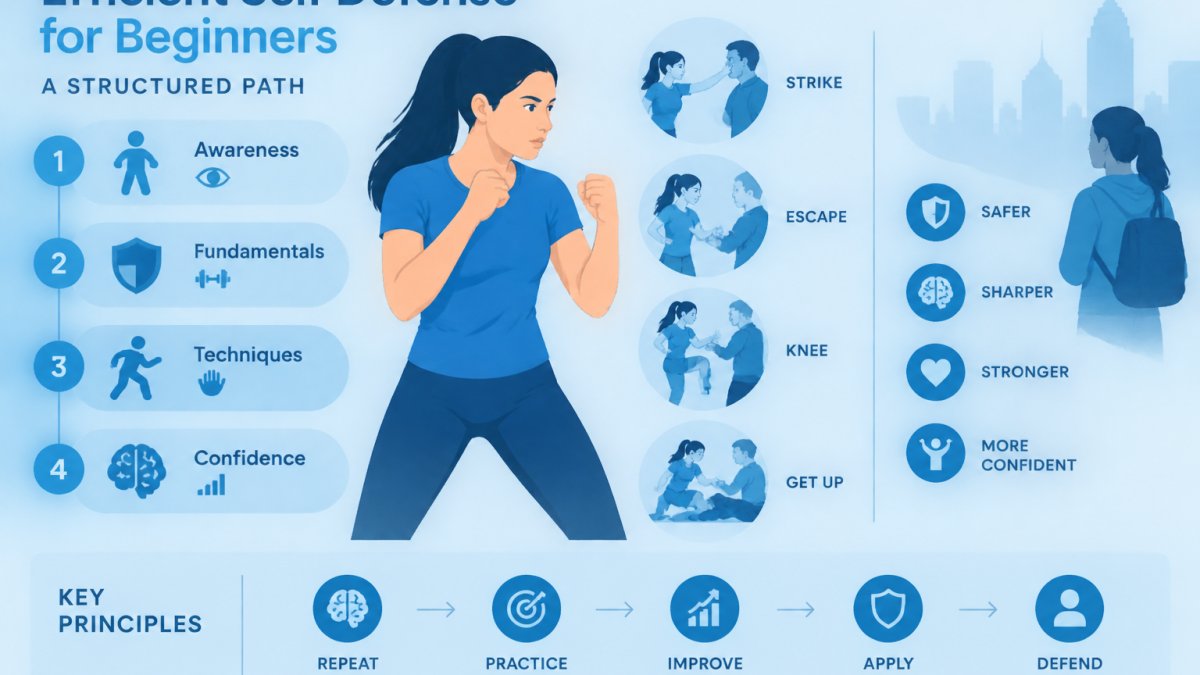
Beginners do best with a short list of techniques they can perform without thinking. Complexity can come later, once the basics are reliable under light pressure.
Awareness and Avoidance Come First
Most effective self-defense starts before any physical contact. Noticing exits, watching how a situation is developing, and leaving early are the highest-value skills. Practice identifying the distance you want to keep from strangers and moving toward well-lit, populated spaces. Verbal assertiveness, such as a firm, loud instruction to back off, is part of this same toolkit and often resolves a situation before it escalates.
Basic Strikes and Escape Techniques
Simple strikes, such as a palm strike or an open-hand push to create distance, are designed to buy time for escape rather than to end a confrontation. Escape techniques for common grabs, such as wrist grabs, focus on using leverage and bodyweight to break contact. Students should practice these slowly first, then add speed only when control is consistent.
How to Remember Self-Defense Moves: A Step-by-Step Learning System
Memory under stress is the real challenge. A technique that cannot be recalled in the moment is useless, so the training method matters as much as the technique.
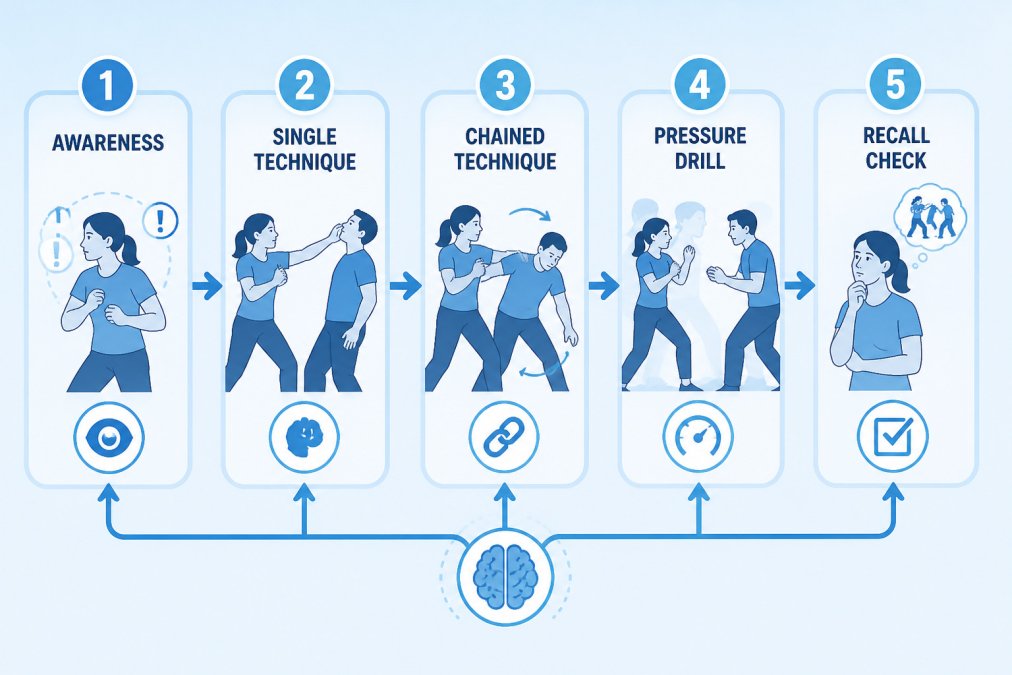
Chunking Skills Into Short Phases
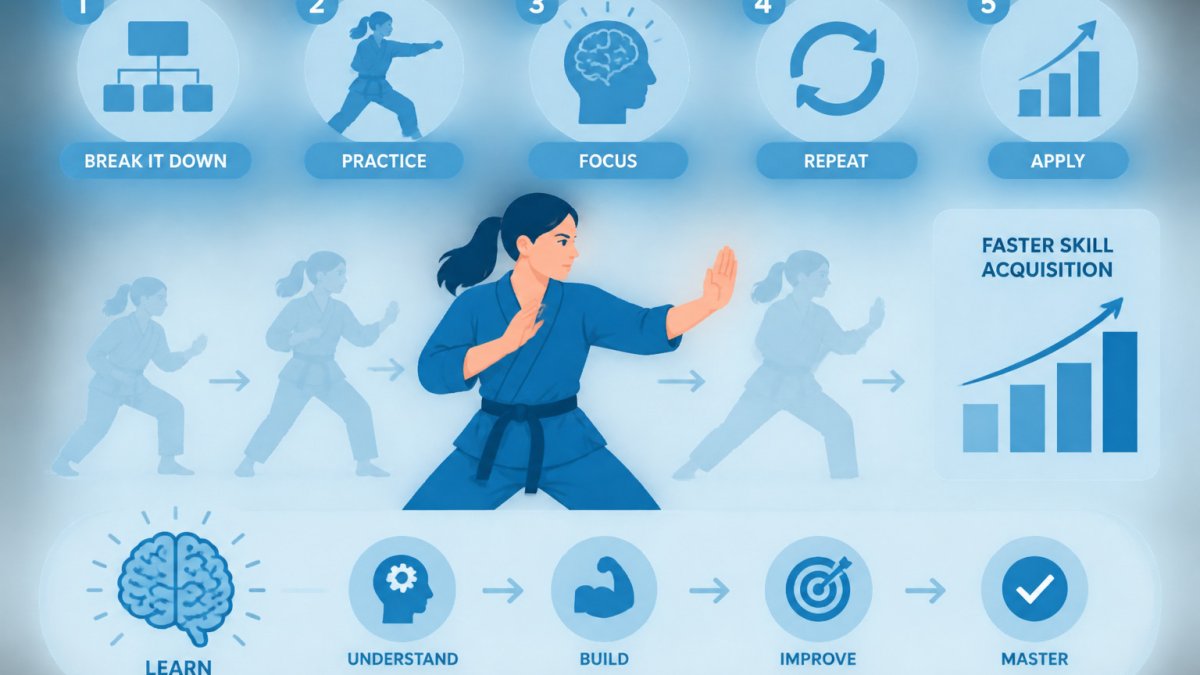
Break each technique into three to five short phases, such as recognize, create distance, strike, and exit. Learning one phase at a time and then linking them reduces the load on working memory. Once each phase feels stable, combine them into a complete sequence.
Using Repetition, Cues and Spaced Practice
Short, frequent sessions tend to build retention better than occasional long ones. Attach a simple verbal cue to each phase, such as "distance, strike, go," so the cue can trigger the sequence under pressure.
The article's core learning methods can be scanned at a glance in this summary of what to do and how often.
| Method | What to do | Frequency or timing |
|---|---|---|
| Chunking | Break each technique into 3-5 short phases | Learn one phase at a time |
| Verbal cue | Attach a short cue such as "distance, strike, go" | Use during each phase |
| Spaced practice | Short, frequent sessions with review of prior moves | Spread across days |
| Retrieval | Recall the sequence from memory before rehearsing | Before physical practice |
| Variable practice | Change one variable per repetition | One change at a time |
Evidence-Based Motor Learning for Complex Skills
Motor learning research consistently favors progressive difficulty, varied practice and feedback over rote drilling of a single pattern. But the useful question for a self-defense student is not whether those principles work, it is which specific mechanisms make a complex skill stick, and how to apply each one in a normal training week.
Retrieval practice beats rereading (Retrieval practice enhances learning in real primary school settings, whether distributed...)
Recall is a skill you train, not a test you pass. Instead of reviewing a technique by watching it again, close your eyes and walk through the sequence from memory, recognize, create distance, strike, exit, before you physically rehearse it. The effort of pulling the sequence out of memory is what strengthens it.
Spaced repetition schedules the review
Short, frequent sessions build retention better than occasional long ones because each session forces a partial forgetting and reconsolidation. A practical schedule for a beginner is three 20-minute sessions per week rather than one 60-minute class: Monday new technique, Wednesday recall of Monday plus one new phase, Friday recall of both plus a light pressure drill.
Variable practice builds transfer
Practicing the same strike from the same angle at the same speed produces a brittle skill that fails when the angle changes. Variable practice means changing one thing per repetition, the distance, the partner's height, the direction of the grab, the surface underfoot. The skill looks messier in the studio and holds up better outside it.
External focus and simple cues reduce cognitive load
Attention is limited under stress, so cues should point at the effect, not the body part. "Push the floor away" works better than "extend your rear leg" because it lets the motor system solve the movement without conscious monitoring. Keep the cue count to one per phase, for example "distance, strike, go", and retire a cue once the phase is reliable.
What this means for a training week
Training that moves from slow, controlled repetitions to realistic pressure follows these principles. The practical takeaway is to move forward only when the current phase is reliable, to schedule recall rather than rereading, and to vary one variable at a time. None of this requires special equipment, it requires a coach who sequences the phases and a student who practices recall between classes.
Self-Defense Drills for Real-Life Situations
Drills should mirror the situations students are most likely to face: a hand on the arm in a crowded space, a grab from behind at a doorway, or someone blocking a path. Start each drill at low intensity with a partner who can reset the scenario. Add realism gradually, and always set clear stop signals.
Training Under Stress Safely: Scaling Intensity and Realism
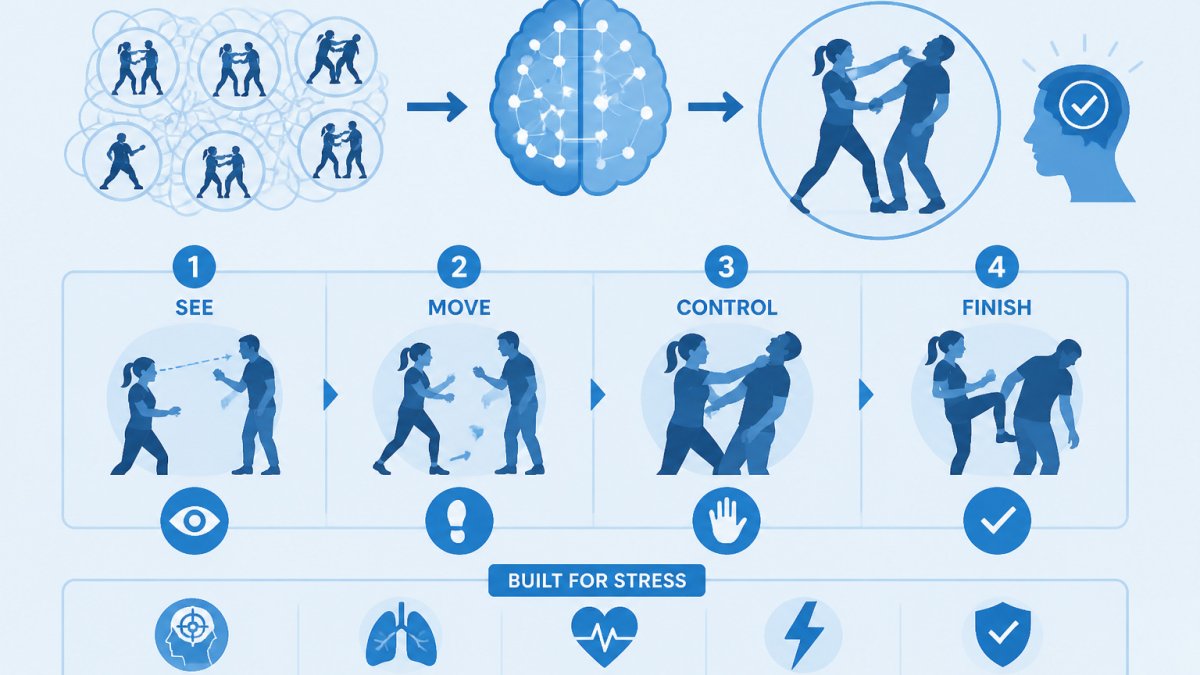
Stress inoculation means exposing students to pressure in controlled steps so the body learns that elevated heart rate is not a reason to freeze. The method only works if intensity is scaled deliberately and safety rules are non-negotiable. Scale intensity along four dials, speed, resistance, unpredictability, and environment, and change only one dial at a time.
The four intensity dials
- Speed: start at half speed with a cooperative partner, then move to three-quarter speed, then full speed only after the technique is reliable at the previous level.
- Resistance: begin with a partner who offers no resistance, then light resistance, then moderate resistance that still allows the technique to succeed. Full resistance is a sparring-level activity, not a beginner drill.
- Unpredictability: start with a known attack (a wrist grab from the front), then a choice of two attacks, then an attack the defender does not see coming. Add uncertainty only after the known version is automatic.
Safety rules that do not flex
Protective equipment, agreed boundaries, and frequent check-ins keep training productive. Set a verbal stop signal that halts the drill instantly, and a physical tap signal for when a partner cannot speak. Agree on a target zone before every drill, for example, strikes stop short of contact on the head and neck. Keep a coach or experienced partner watching rather than participating in early pressure drills.
A sample progression over eight weeks
A common pattern is to spend two weeks on each stage: week 1-2, slow cooperative repetition of a single technique; week 3-4, the same technique against light resistance with one variable changed; week 5-6, a choice of two attacks at three-quarter speed; week 7-8, a short scenario with an obstacle and an exit decision. The defender's job in every scenario is to decide whether to leave, not only to perform the technique. Refining these exit decisions through incremental pressure allows the defender to improve decision speed while maintaining the composure necessary for actual survival.
Measuring whether it is working
The signal that stress inoculation is working is not a cleaner technique; it is a faster decision. Track how quickly a student recognizes the attack and chooses to create distance or leave. If recognition time is dropping while technique quality holds, the progression is doing its job. If technique quality collapses the moment speed rises, drop back one dial and rebuild.
Adapting Self-Defense Training to Your Body, Schedule and Goals
Good self-defense training adapts to the student. Techniques can be modified for different heights, strength levels, mobility limits and previous injuries. Scheduling matters too: a steady routine of short sessions usually beats sporadic intensive classes. Students who want to go deeper on structured drills can read our guide to structured self-defense training programs and choose a pace that fits their week.
Booking Your First Class at Kajukenbo and Filipino Martial Arts Club
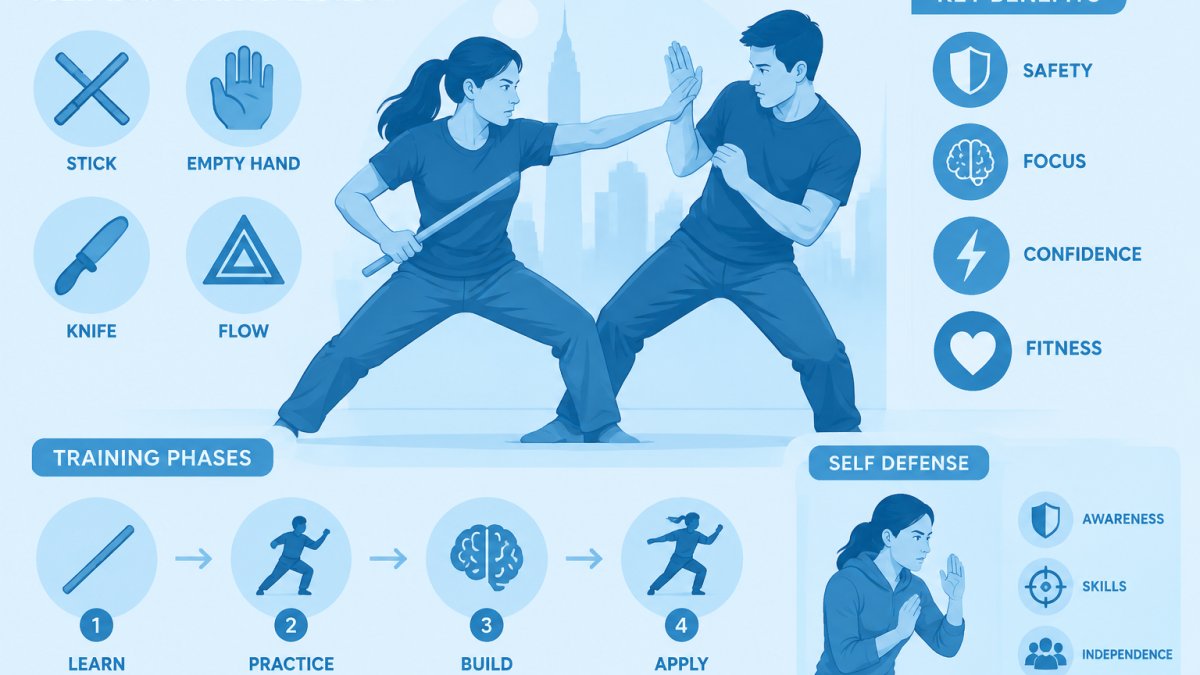
Kajukenbo and Filipino Martial Arts Club teaches self-defense through progressive, dated training phases built on motor learning principles, with a curriculum that includes Kajukenbo, Balintawak and Kalis Ilustrisimo. A trial class is a practical way to see how the phases work. Our step-by-step guide to book a martial arts trial class explains what to expect before your first visit.
Frequently Asked Questions
What is the best form of fighting to learn for self-defense?
The best starting point is a art that teaches simple, practical techniques you can recall under stress, such as Kajukenbo. Look for classes that emphasize awareness and escape first, use progressive drilling rather than open-ended sparring at the start, and let you practice the same core moves repeatedly. Compare instructors on how they teach, not just on the style name, and try a trial class before committing.
Is MMA or Krav Maga better for self-defense?
Neither is automatically better. MMA trains competition-style fighting with strong conditioning and realistic sparring, but its rules and techniques are not designed around street threats such as surprise grabs or multiple attackers. Krav Maga focuses on instinctive reactions to real attacks, which suits beginners, though quality varies widely between schools. Choose based on your goals, schedule and the instructor's teaching approach.
How can you remember self-defense techniques under stress?
Memory under stress improves when you practice in short, repeated sessions and link each technique to a single trigger, such as a wrist grab cueing a specific release. Training at gradually increasing speed and pressure, a method called stress inoculation, helps the movement become automatic. Reviewing the sequence briefly after each class and rehearsing it a few times a week, rather than in one long session, supports better retention over time.
How often should you train to retain self-defense skills?
Most people retain basic self-defense skills best with two to three practice sessions per week, even if they are short. Skills fade quickly without repetition, so a brief refresher of the core moves between classes matters more than occasional long sessions. If your schedule is unpredictable, prioritize a few fundamental techniques and practice them consistently rather than trying to learn a large curriculum at once.
Can you forget what you learned in self-defense training during a real confrontation?
Yes, many people experience a stress response that narrows attention and slows recall during a real threat. Training reduces this risk by making the first responses automatic and by practicing under mild pressure before full intensity. Realistic drills, clear escape priorities and regular practice make it more likely that your body will act on what you have learned, but no training can guarantee a specific outcome in every situation.
To try a class, book a trial with Kajukenbo and Filipino Martial Arts Club and see how structured, progressive training feels in practice.