 Ultimate guide
A Beginner's Guide to Filipino Martial Arts
Last Updated: November 15, 2026
Quick Summary
Filipino martial arts for beginners start with weapon-based training from day one, usually a pair of rattan sticks, because rattan is light and forgiving on impact. Kali, Arnis, and Eskrima are names for the same family of arts, and most beginners progress from empty-hand mechanics to one stick, then two.
- Beginners almost always start with a pair of rattan sticks, which lets you see the strike coming.
- Most FMA systems number the angles of attack, commonly twelve, and beginners drill them in sequence.
- A home plan needs one rattan stick and clear space roughly the size of a parking spot.
- Ask whether beginners are separated from advanced students for at least the first few months.
- Common beginner equipment includes a rattan stick, eye protection for some drills, and gloves.
Table of Contents
- What Filipino Martial Arts Are and What the Names Mean
- Kali for Beginners: Your First Weapons and Stances
- Beginner Filipino Martial Arts Drills You Can Start This Week
- Filipino Martial Arts at Home: A Realistic Training Plan
- How Long Does It Take to Learn Filipino Martial Arts?
- Self-Defense Applications for Women
- How to Choose a Qualified Instructor or School
- Book Your Trial Class and Start Training
- Frequently Asked Questions
What Filipino Martial Arts Are and What the Names Mean
Filipino martial arts for beginners start with a single idea: you learn to defend yourself with a weapon in your hand from day one. That is the defining feature of the Filipino systems, and it is why they feel different from almost every other martial art you can walk into as a novice.
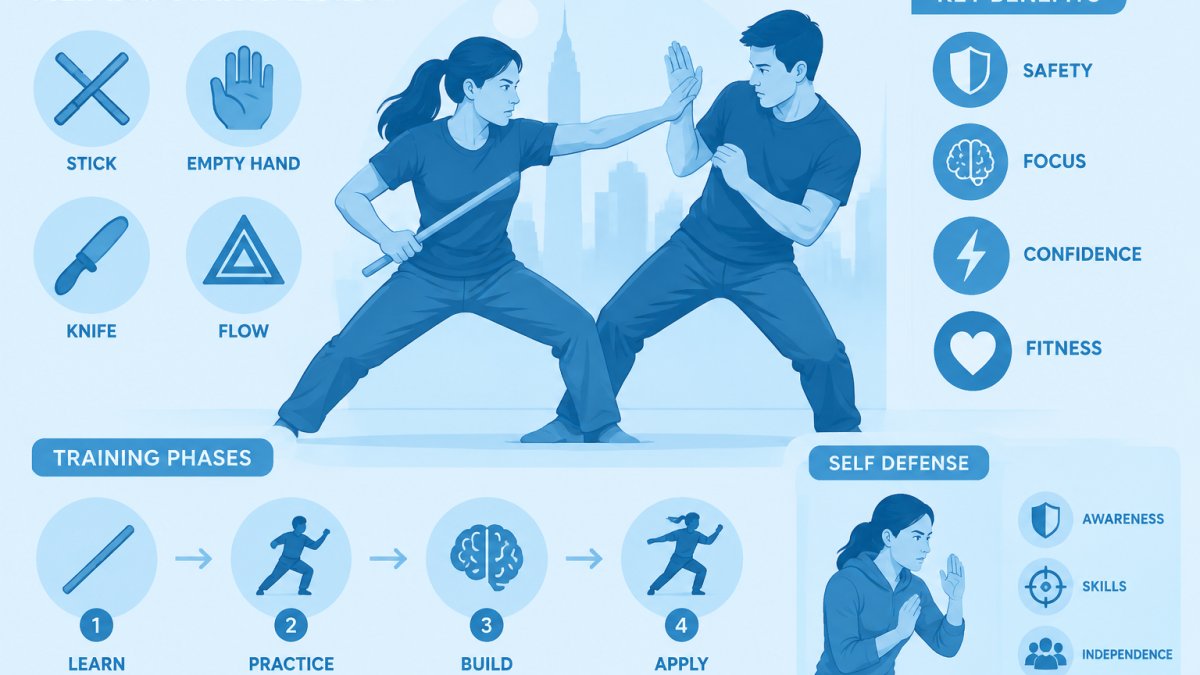
Filipino martial arts (FMA) is an umbrella term for the weapon-based fighting systems developed in the Philippines, most of which teach stick, blade, and empty-hand techniques as one connected curriculum rather than separate courses. The three names you will hear most often, Kali, Arnis, and Eskrima, refer broadly to the same family of arts. Regional tradition and instructor lineage determine which name a school uses, not a meaningful difference in what you will drill in your first month.
Beginners almost always start with a pair of rattan sticks, according to Kali America's beginner's guide to Filipino martial arts, because rattan is light, forgiving on impact, and lets you see the strike coming. If the naming still feels like a wall, our beginner's guide to stick fighting and Arnis untangles the vocabulary before your first class.
Kali for Beginners: Your First Weapons and Stances
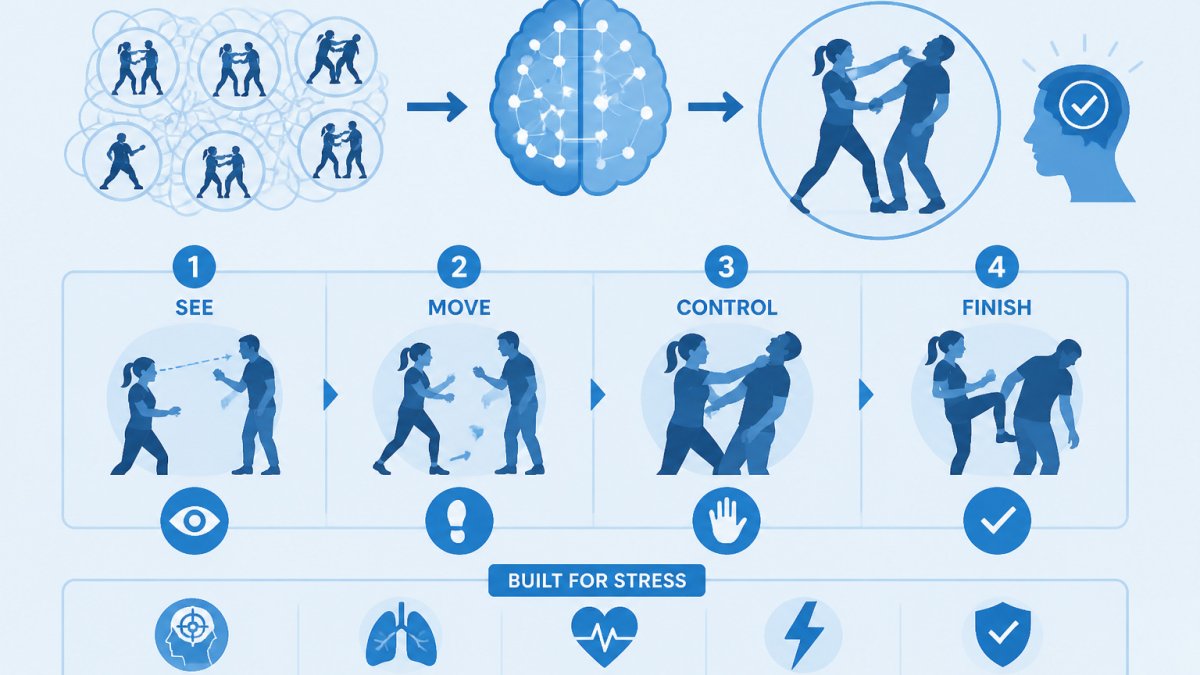
Most beginners assume the first class means picking up a stick and swinging. In a well-run program, the first weeks are a staged progression: empty-hand mechanics first, then a single stick, then two sticks, then controlled partner work. The weapon is introduced early, but the sequence matters more than the speed.
**
**
**
**
**
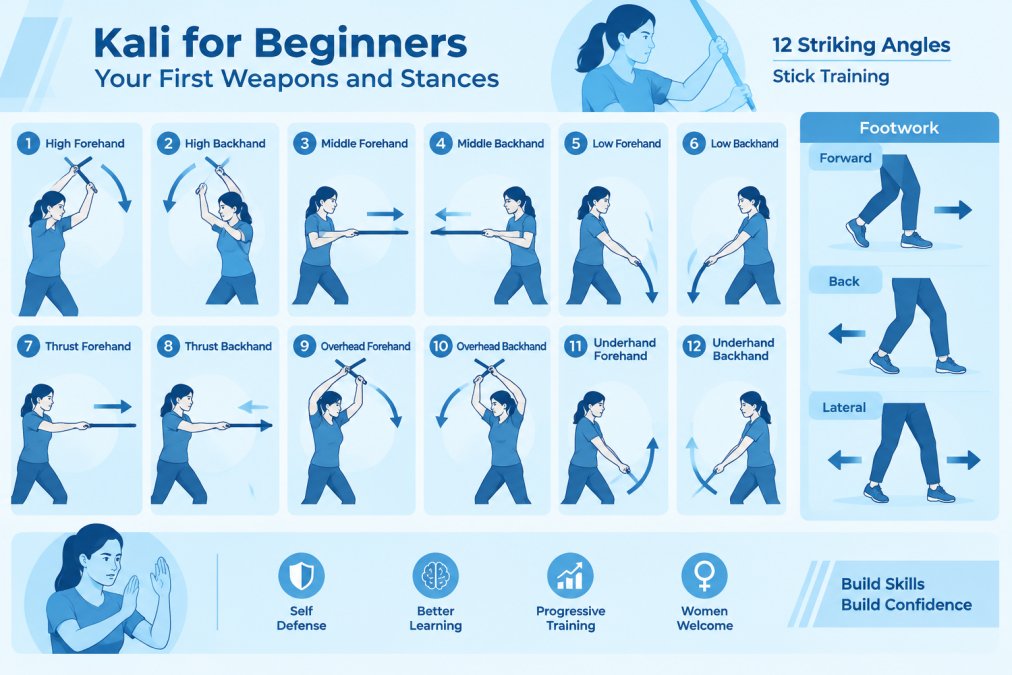
If you want a structured walkthrough of the first weapon and the first three stances to practice between classes, our step-by-step stick and blade guide for beginners covers exactly that sequence.
Beginner Filipino Martial Arts Drills You Can Start This Week
Beginner Filipino martial arts drills fall into two categories: solo patterns you can run alone, and partner work that requires a training partner or a class.
Most FMA systems number the angles of attack, commonly twelve, and beginners often drill them in sequence.
Then add the block-and-counter pattern. A partner feeds a slow forehand strike; you block, then counter on the same beat. Speed comes later. Accuracy first, always.
- Solo: 12 angles, 10 minutes, both hands
- Solo: footwork ladder, forward and back, 5 minutes
- Partner: block-and-counter, slow, 10 minutes
- Partner: single-stick sumbrada at walking pace, 5 minutes
Filipino Martial Arts at Home: A Realistic Training Plan
Training Filipino martial arts at home works if you treat it as a short, repeatable session rather than a long one you will skip.
| Session | Focus | Duration | Frequency |
|---|---|---|---|
| A | 12 striking angles, both hands | 20 min | 2x per week |
| B | Footwork and stance transitions | 20 min | 2x per week |
| C | Block-and-counter with a partner | 30 min | 1x per week |
| D | Video review and slow shadow work | 15 min | As needed |
Duration
You need one rattan stick and a clear space roughly the size of a parking spot. Structured online instruction exists for students who cannot attend weekly, and FMA365's step-by-step online curriculum is one example of a beginner-to-advanced path delivered remotely.
Watch out: practicing stick strikes in a room with low ceilings or a glass table is how beginners break things. Clear the space first.
How Long Does It Take to Learn Filipino Martial Arts?
How long it takes to learn Filipino martial arts depends on what you mean by learn.
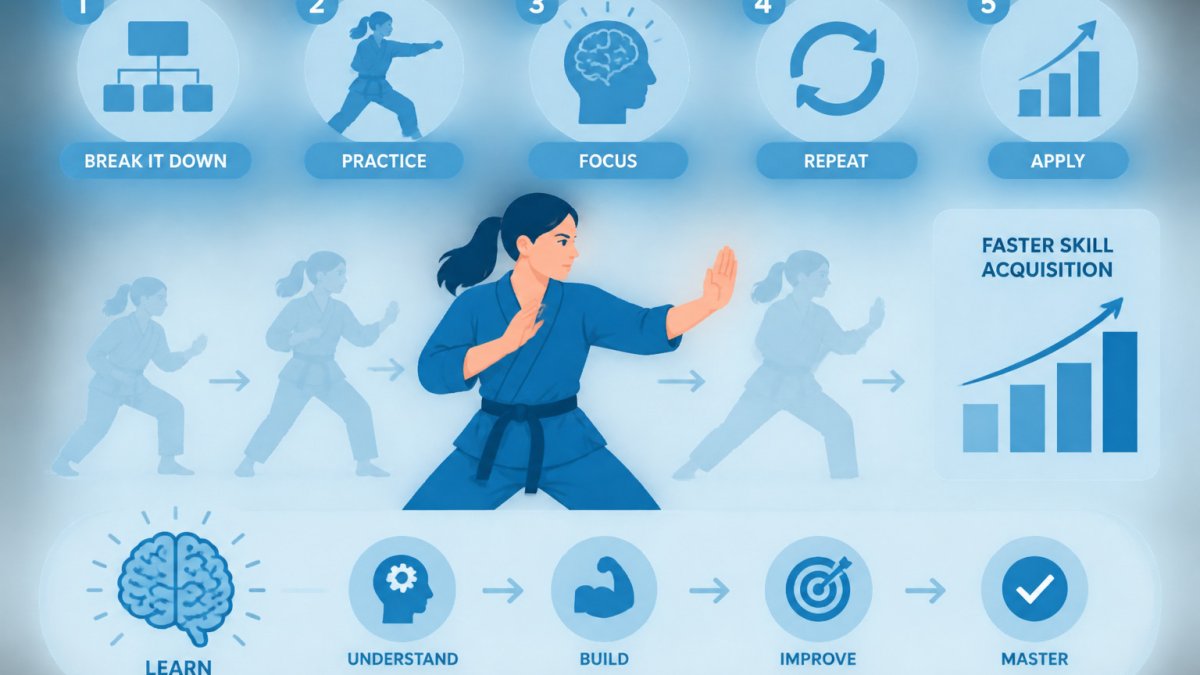
The variable that matters most is not talent. It is retention, how much of each class your brain actually keeps. That is where the teaching method matters more than the art itself. A 2026 study in the Journal of Ethnic and Cultural Studies on teaching the double sinawali examined how the pattern is taught and learned, and the pedagogical framing of a drill changes how quickly students absorb it.
At Kajukenbo and Filipino Martial Arts Club, our curriculum is built around dated, progressive phases rather than open-ended drilling, because measurable milestones tell you whether the training is sticking.
Self-Defense Applications for Women
Self-defense applications for women in FMA center on one advantage: reach. A stick, an umbrella, or a set of keys extends your defensive distance and gives you a tool to strike with rather than relying on size.
For practical, situational tips you can apply on your commute before your first class, our guide to practical self-defense tips for women commuting in NYC is worth reading alongside this section.
How to Choose a Qualified Instructor or School
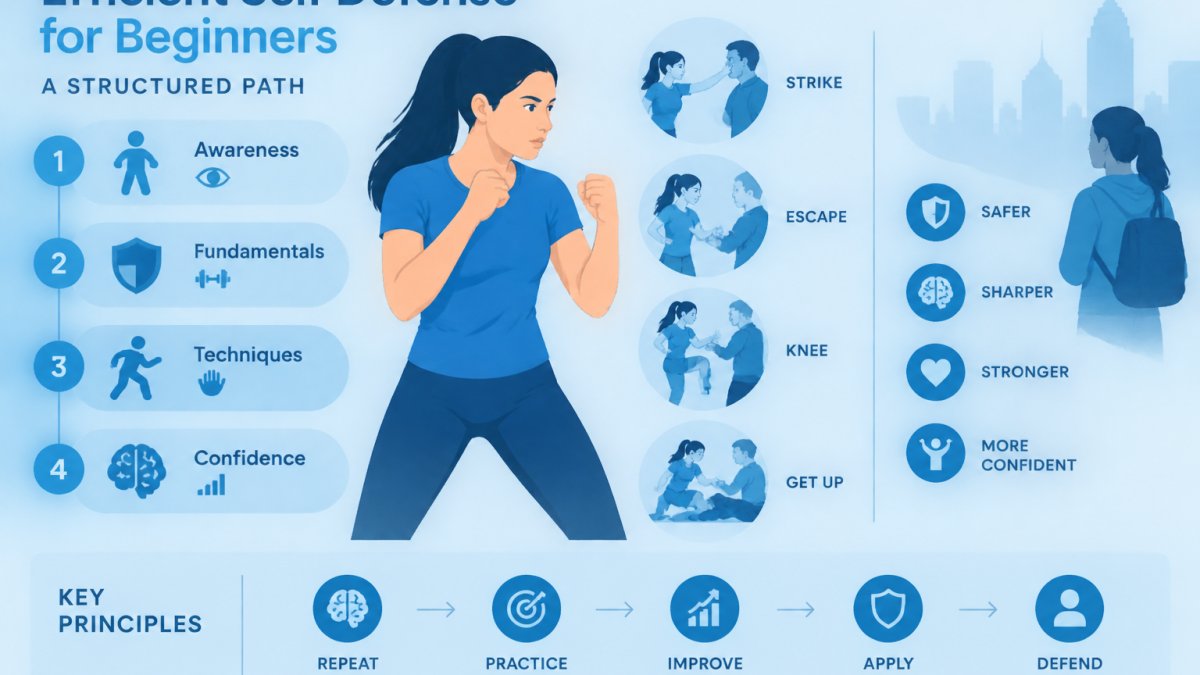
Choosing a qualified instructor comes down to a framework you can apply before you pay for anything. Lineage, class structure, safety culture, and progress measurement are the four areas that separate a good beginner program from a bad one.
Lineage and background. Ask who teaches the class and what their training background is. In the Filipino systems, lineage refers to the instructor's own teachers and the tradition they come from. A credible instructor can name their teachers and explain how their curriculum was passed down. Lineage is not a guarantee of teaching ability, but an unwillingness to discuss it is a warning sign.
Beginner separation. Ask whether beginners are separated from advanced students, at least for the first few months. Mixed classes can work, but a beginner needs slower feeds, more correction, and a partner who will not accidentally hurt them. A school that throws a novice into advanced sparring on day one is prioritizing its own convenience over your safety.
Safety culture. Ask what protective equipment is required and how partner work is supervised. Common beginner equipment includes a rattan stick, eye protection for some drills, and gloves for partner work. Ask about training distance, consent rules, and what happens when a partner wants to stop. A responsible school explains these before you ever pair up.
Progress measurement. Ask how progress is measured and whether you will be told when you have hit a milestone. A curriculum built around dated, progressive phases tells you whether the training is sticking; open-ended drilling with no checkpoints makes it hard to know if you are improving or just attending.
Watch a class first. Ask to observe a beginner class before joining. Watch how the instructor corrects students, how partners interact, and whether safety rules are stated out loud. A school that resists any of these questions is telling you something.
The method matters as much as the lineage. A 2013 University of Arkansas study developed an instrument for measuring cultural appreciation of martial arts, which is a reminder that how a school frames its art shapes what students take from it. If you are weighing a martial art against other options entirely, our framework for choosing a martial arts alternative as an adult gives you a comparison structure before you commit.
Book Your Trial Class and Start Training
The gap between reading about Filipino martial arts for beginners and actually training in them is one class. Everything above is preparation; none of it substitutes for holding a stick and moving through the angles with someone correcting your form.
At Kajukenbo and Filipino Martial Arts Club, we teach Kajukenbo, Balintawak, and Kalis Ilustrisimo in progressive, dated phases, led by an instructor holding a Master's degree in Neuroscience. Our Midtown Manhattan location serves busy professionals, and our method is built on dated, progressive phases.
If you are ready to stop reading and start moving, our guide on how to book a martial arts trial class walks you through the process step by step. Get started with Kajukenbo and Filipino Martial Arts Club and put a stick in your hand this month.
The hardest part of starting is not the technique. It is clearing two hours in a week that already feels full. Our trial class is designed to show you exactly what progress looks like in your first month, so you can decide with data instead of guesswork.
Frequently Asked Questions
Are Kali, Arnis, and Eskrima different martial arts?
They are three names for the same family of Filipino martial arts. Kali is the term used in some regions and by certain schools, Arnis is the official national sport and martial art of the Philippines, and Eskrima comes from the Spanish word for fencing. A beginner class may use any of these labels, and the core skills, stick work, footwork, and defenses, are largely the same. Do not let the terminology stop you from starting; the training method matters more than the name on the door.
Is Filipino martial arts effective in a street fight?
Filipino martial arts were built around practical weapon and empty-hand defense, and many systems emphasize simple strikes, blocks, and disarms that work under pressure. Effectiveness depends on how you train: partner drills with resistance, footwork under stress, and realistic scenarios matter more than memorizing techniques. No study proves street outcomes. Choose a school that tests skills against resisting partners rather than choreography alone.
What equipment does a beginner need for Filipino martial arts?
Most beginners start with a pair of rattan sticks, which are lightweight and designed to absorb impact. You will also want comfortable athletic clothing, a water bottle, and optionally a training knife for blade-awareness drills. Ask about equipment before buying. Avoid hardwood or metal sticks until your instructor confirms you are ready.
Can you learn Filipino martial arts at home?
Yes, with structure. Solo drills like striking angles, footwork patterns, and shadow stick work translate well to home practice. Pair home sessions with a qualified instructor for feedback and partner drills, since timing and range are hard to develop alone.
How long does it take to learn basic Filipino martial arts techniques?
Basic striking angles, stances, and simple blocks can be learned in a few weeks of consistent practice, but reliable execution under pressure takes months.
What should a beginner expect in a Filipino martial arts class?
Expect a warm-up, footwork drills, stick handling practice, and partner drills at a controlled pace. Beginner classes usually start with single-stick basics and simple striking angles before adding blocks, counters, and eventually double-stick work. Ask about class size and whether the curriculum is progressive.