
 how-to
How to Improve Focus Skills: A 2026 Step-by-Step Guide
Table of Contents
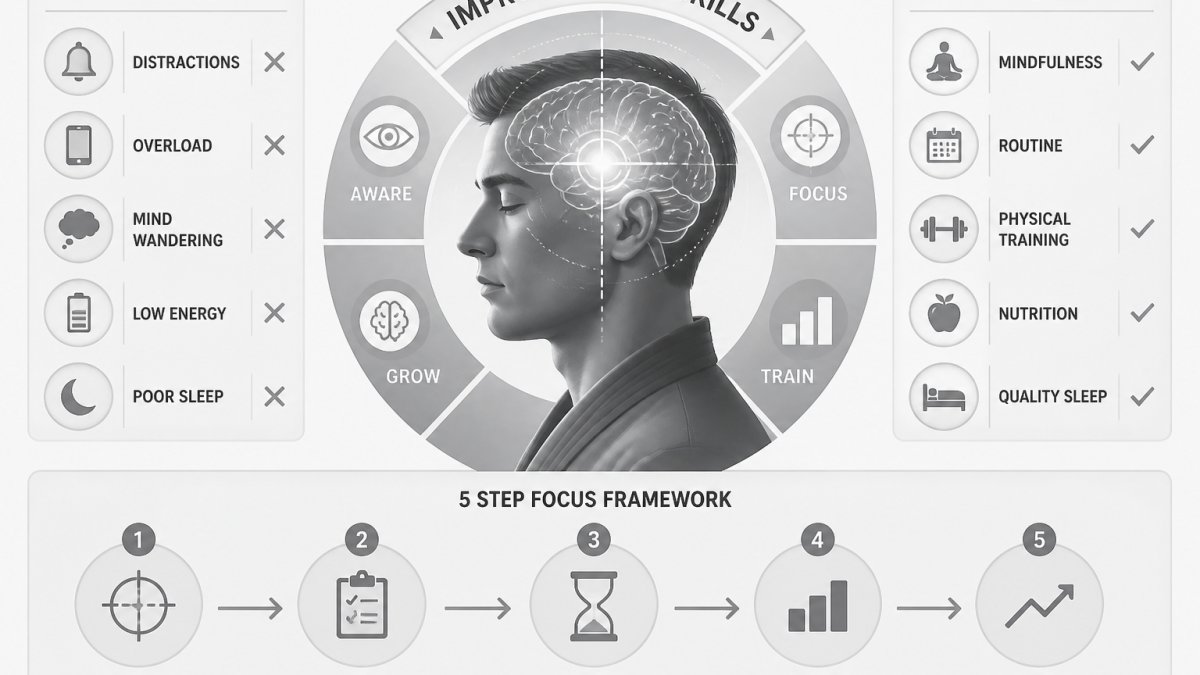
- Step 1: Identify the Causes of Lack of Focus in Your Day
- Step 2: Set Up Your Environment to Improve Focus Skills
- Step 3: Practice Focus Exercises That Train Attention
- Step 4: Learn How to Increase Attention Span With Timed Work Sessions
- Step 5: Use Ways to Stay Focused While Studying and Working
- Step 6: Build a Personal Focus Plan and Measure Your Progress
- Frequently Asked Questions
Last Updated: October 4, 2026
Step 1: Identify the Causes of Lack of Focus in Your Day
You cannot fix a focus problem you have not diagnosed, yet most people jump straight to productivity apps.
Attention works like a motor skill.
The causes of lack of focus split into two buckets: internal and external. Fix the external ones first, because they are easier to control.
Internal Causes: Sleep Debt, Stress, and Executive Functioning
Internal causes live inside your body and brain, and are harder to fix fast.
- Sleep debt: Short sleep narrows attention and slows reaction time. One late night rarely matters. Five in a row does.
- Stress: Chronic stress keeps your nervous system on alert, making deep concentration almost impossible.
- Executive functioning: Your brain's control system for planning, switching tasks, and holding information. It tires over the day, like a muscle.
A common mistake is blaming willpower for what is really a sleep or stress problem. No timer app fixes a six-hour sleep habit.
External Causes: Notifications, Clutter, and Multitasking
External causes are the low-hanging fruit: visible, measurable, removable today.
- Notifications: Every ping pulls your attention away. Even ignoring one costs recovery time.
- Clutter: A messy desk gives your eyes somewhere else to land.
- Multitasking: Switching tasks drains mental energy and slows you down.
Start here. Cutting distractions delivers faster wins than any brain training game.
Step 2: Set Up Your Environment to Improve Focus Skills
Your environment decides how much focus you need to supply. A well-designed space does half the work.
Try these changes in order of impact:
- Put your phone in another room, not just face-down
- Turn off all non-essential notifications
- Clear your desk to one task's worth of items
The phone rule matters most: out of the room beats out of sight.
Step 3: Practice Focus Exercises That Train Attention
Attention responds to training like a muscle. Focus exercises fall into two groups: calm-down practices and cognitive challenges. You need both.
Mindfulness, Meditation, and Breathing Exercises
Mindfulness means paying attention to the present moment on purpose, without judging what you notice. It builds the base layer of focus: noticing your mind wander and bringing it back.
Start small:
- Breathing exercises: Breathe in for four counts, hold for four, out for six. Repeat for two minutes.
- Grounding: Name five things you can see, four you can hear, three you can feel. This pulls you back into the room.
- Meditation: Sit for five minutes and follow your breath. When your mind drifts, return. That return is the rep.
The return is the whole exercise. Each time you catch a drift and come back, you strengthen the circuit you use to stay on task.
Cognitive Focus Exercises: Puzzles, Sudoku, Chess, and Reading
Cognitive exercises train attention under load: holding information, planning ahead, ignoring distractions.
- Puzzles and Sudoku: Build pattern recognition and sustained attention
- Chess and board games: Train planning, working memory, and self-control
- Reading: Long-form reading is one of the best attention workouts there is
Curiosity helps. Pick something you actually want to solve, and attention follows.
Do not stack these exercises into a two-hour block on day one. Most people quit by week two because they overtrained. Ten focused minutes daily beats a weekend marathon.
Step 4: Learn How to Increase Attention Span With Timed Work Sessions
The fastest way to increase attention span is short, timed blocks with real breaks, the core of the Pomodoro Technique, developed by Francesco Cirillo in the late 1980s and still the most widely used structured-focus method.
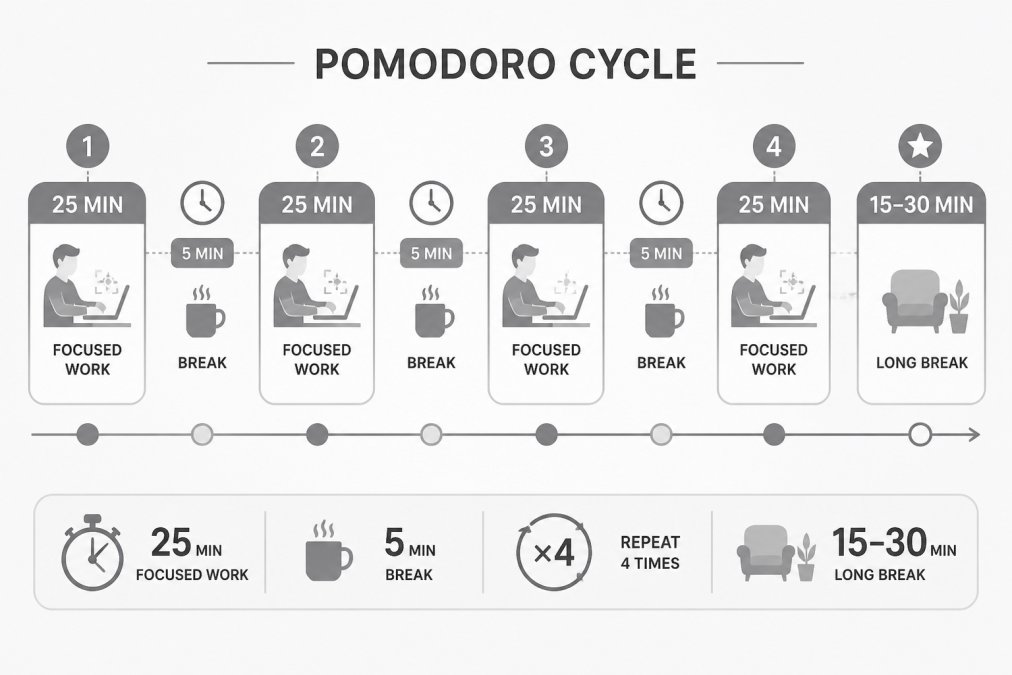
Here is how a full cycle runs:
- Pick one task. Write it down.
- Set a timer for 25 minutes.
- Work on that task only.
- Stop when the timer rings, even if you feel good.
- Take a 5-minute break away from screens.
- Repeat four times, then take a 15-30 minute break.
The structure gives your attention a finish line and forces recovery before fatigue builds.
| Phase | Duration | What You Do | Why It Works |
|---|---|---|---|
| Focus block | 25 minutes | One task only | Trains sustained attention |
| Short break | 5 minutes | Stand, stretch, water | Resets mental energy |
| Full cycle | 4 blocks | Repeat focus and breaks | Builds endurance over weeks |
| Long break | 15-30 minutes | Step away from the desk | Prevents burnout |
Why 25 Minutes Is a Starting Point, Not a Rule
Most guides stop at the 25/5 recipe, failing readers whose work does not fit a fixed block. The number matters less than the structure: a defined start, a single task, a hard stop, and a real break.
Use this decision guide to pick your block length:
- Struggling to start at all: Try 10-15 minutes. A short block lowers the activation cost. You can always run a second one.
- Standard knowledge work (writing, coding, email triage): 25 minutes is a solid default.
- Deep, stateful work (complex analysis, long-form writing, debugging): Try 45-50 minutes. The 25-minute stop can interrupt the momentum you are trying to build.
People who "can't focus" often focus fine for 12 minutes and simply never tested a block that short. Start where you succeed, then add five minutes per week.
Adapting Timed Sessions to Different Situations
One routine does not fit every reader. Adjust the method to your context:
- Students: Pair a 25-minute block with active recall, close the book and write what you remember before the break. Passive rereading inside a timer still produces passive results.
- Office workers: Use the block to batch shallow tasks (messages, approvals) so they stop fragmenting your deep-work hours. Do not spend your best focus block on email.
- Remote workers: The break is the risk. A 5-minute break that becomes a 40-minute scroll is not a break. Set a second timer for the break itself.
tip Track two numbers during each block: how many times you got pulled away, and how many times you caught yourself and returned. The second number is the one that grows. Watching it climb over two to three weeks is the clearest evidence the method is working.
Step 5: Use Ways to Stay Focused While Studying and Working
Staying focused during real work differs from training in a quiet room: real work has deadlines, noise, and people who need you.
Ways to stay focused while studying and working that hold up in practice:
- Single-tasking: Do one thing at a time, on purpose. Multitasking feels productive and is not.
- Screen-free time: Block 30 minutes with no phone, no tabs, no messages.
- Positive self-talk: Replace "I can't focus" with "I'm building this skill." Self-belief shapes effort.
If you check messages every few minutes, expect the first week to feel uncomfortable. That discomfort is the training working.
Focus is not a personality trait you either have or lack. It is a set of habits you build, and habits respond to repetition, structure, and honest measurement.
Step 6: Build a Personal Focus Plan and Measure Your Progress
A generic focus plan fails because your day is not generic. Build one that matches your actual schedule, then track whether it works. This section covers what most guides skip: honest measurement, realistic expectations, and what to do when standard strategies are not enough.
Your Personal Focus Plan Template
Fill this in once, then revise it every Sunday. Keep it to one page.
- Best focus window: __________ (when your energy peaks, for most people, 1-3 hours after waking)
- Daily focus blocks: __________ (start with two)
- Block length: __________ (start at 25 minutes, or 15 if 25 fails)
How to Measure Focus Progress
"I feel more focused" is not a measurement. Use countable signals instead, pick two or three and record them at the same time each day.
| Metric | How to Track It | What Good Looks Like Over 4 Weeks |
|---|---|---|
| Completed focus blocks | Tally marks on paper or a notes app | Steady increase, even if small |
| Longest unbroken session | Note the minutes after each session | Gradual growth of 5-10 minutes |
| Distraction count | Tally each time you get pulled away | Flat or slowly declining |
| Return count | Tally each time you catch a drift and come back | Rising, this is the skill |
| Task completion | Check off planned tasks at day's end | More of your top three done |
| Self-rating | Rate focus 1-10 at end of day | Trend line, not daily score |
The return count matters more than the drift count. A day with 20 distractions and 18 returns is a better training day than one with 3 distractions and 0 returns, because the first built the muscle.
What to Realistically Expect
Most focus advice implies overnight transformation. The honest timeline looks more like this:
- Week 1: Uncomfortable. You will notice distractions more, not less, because you are paying attention to them for the first time. This is normal.
- Weeks 2-4: Block completion becomes easier. You may not feel "more focused" yet, but your tallies should show more completed blocks.
- Weeks 4-8: Longer unbroken sessions become possible. This is where most people notice a real difference.
A common pattern is a plateau around week three. Do not read it as failure. Change one variable, block length, time of day, or task type, and continue.
Troubleshooting When Standard Strategies Are Not Enough
If you have followed the steps in this guide for four to six weeks and see no movement in your tallies, work through this checklist before assuming the problem is you:
- Check the foundations first. Sleep, movement, and food are not optional add-ons. Chronic short sleep, a sedentary week, and skipped meals all degrade attention directly. Fix these before adding more techniques.
- Rule out environment. If your workspace has unavoidable noise, interruptions, or shared traffic, no amount of willpower will compensate. Change the environment or change when you work.
- Check for a mismatch. Some people fail at 25-minute blocks and succeed at 10. Some fail in the morning and succeed at night. Test the variables you have not tested.
If focus problems are persistent, severe, and interfere with work, school, or daily life despite consistent effort, talk to a qualified healthcare professional. Attention difficulties can have medical causes, and a professional can help you understand what is happening.
Professionals who travel or work unpredictable hours. Two focused blocks a week still move the needle if you track them honestly.
Every session at Kajukenbo and Filipino Martial Arts Club runs in dated, progressive phases with a clear start, a defined task, and a measurable outcome. That is the same shape your focus plan should take.
Frequently Asked Questions
How long does it take to improve focus skills?
Most people notice small changes within two to three weeks of consistent practice, but measurable gains in attention span usually take six to eight weeks. The pace depends on how often you practice focus exercises, how much sleep you get, and how many distractions you remove from your environment. Treat it like any skill: short daily sessions beat one long session per week. Track your work-session length each week so you can see the trend instead of guessing.
What exercises can improve focus and concentration?
Breathing exercises and short mindfulness sessions train attention by giving your mind one anchor to return to. Cognitive exercises such as puzzles, Sudoku, chess, and reading build analytical skills and task completion habits. Timed work sessions like the Pomodoro Technique apply that training to real tasks. Pick two or three exercises, do them at the same time each day, and increase the duration slowly. Variety matters less than consistency.
Can practicing a skill improve concentration?
Yes. Structured skill practice requires you to hold one thing at a time, notice errors, and adjust, which is the same loop that builds attention span. Progressive training, where each session adds one new element, keeps the demand just above your current level. That is why martial arts, music, and similar disciplines are often linked to better focus. The key is deliberate practice with clear feedback, not passive repetition.
Why am I really struggling to focus even when I try hard?
Effort alone rarely fixes focus problems. Common causes of lack of focus include sleep debt, chronic stress, notifications, and multitasking habits that fragment attention. If you have ruled those out and still struggle for weeks, talk to a healthcare provider. Persistent concentration problems can have medical causes that no productivity tip will solve. For most people, fixing sleep and removing distractions restores a large part of their attention span.
Focus fails for real reasons: broken sleep, constant notifications, and a habit of doing five things at once. Fixing it takes a plan, not willpower. At Kajukenbo and Filipino Martial Arts Club, we teach focus as a trainable skill through a neuroscience-based methodology, with progressive phases, measurable milestones, and instruction from a Master's degree holder in Neuroscience. Book a trial class and train your attention the same way you would train any other skill.