 How-to
How to Choose Martial Arts for Busy Professionals
Last Updated: November 17, 2026
Quick Summary
The best martial arts for busy professionals is the one whose core skill set matches your goal and whose class structure respects a tight calendar. Train two classes per week plus 10-15 minutes of home practice on two off days, and evaluate schools on schedule fit, curriculum structure, instructor background, beginner onboarding, and total commitment.
- A well-structured program delivers real skill on two sessions a week.
- Your first month covers stance, footwork, basic strikes, and safe falling.
- Count door-to-door commute time before committing to a school.
- If you're exhausted from work, train technique, not conditioning.
- Ask to see a dated phase plan or a sample month of classes.
Table of Contents
- Why Martial Arts Fit a Professional's Schedule Better Than You Think
- Beginner Martial Arts for Busy Professionals: Which Style Fits Your Goals
- Martial Arts Basics for Beginners: What You Actually Learn First
- A Martial Arts Training Schedule for Beginners Who Work Full Time
- Martial Arts vs Gym Workout: What Each One Delivers
- How to Evaluate a School Before You Commit
- Recovery, Injury Risk, and Training Around Work Stress
- Book a Trial Class and Test the Schedule for Yourself
- Frequently Asked Questions
Why Martial Arts Fit a Professional's Schedule Better Than You Think
The biggest myth about martial arts for busy professionals is that you need four nights a week and a spare decade. You don't. A well-structured program delivers real skill on two sessions a week, and the U.S. industry now counts 76,364 martial arts studios, 6.0% more than the year before, according to Gymdesk's martial arts industry statistics, citing IBISWorld. At Kajukenbo and Filipino Martial Arts Club, our program is designed for professionals who train around demanding calendars.
Here's what most guides get wrong. They treat class time as the whole equation. In practice, progress comes from how efficiently a school uses the hour you give it. Progressive, dated phases beat open-ended drilling because you always know what you're working toward. Below, we break down style selection, weekly schedules by work pattern, school evaluation, and recovery, so you can choose with data instead of guesswork.
Beginner Martial Arts for Busy Professionals: Which Style Fits Your Goals
The best beginner martial arts for busy professionals is the one whose core skill set matches your goal and whose class structure respects a tight calendar.
Style Comparison: Time Commitment, Intensity, and Self-Defense Focus
| Style | Typical Class Length | Intensity | Self-Defense Focus | Best For |
|---|---|---|---|---|
| Kajukenbo | 60 min | Moderate-high | High, striking plus grappling | Practical self-defense |
| Boxing | 60 min | High | Moderate, striking only | Cardio and footwork |
| Muay Thai | 60-75 min | High | Moderate-high, striking and clinch | Fitness with striking |
| BJJ | 60-90 min | Moderate | High, ground control | Grappling and patience |
| Karate | 60 min | Moderate | Moderate, forms-based | Structure and focus |
| Krav Maga | 60 min | High | Very high, scenario drills | Fast self-defense basics |
| Wrestling | 90 min | Very high | Moderate, takedowns | Athletic conditioning |
| MMA | 60-90 min | Very high | High, mixed range | Cross-training athletes |
Typical Class Length
If you're weighing options beyond traditional styles, our guide on choosing a martial arts alternative as an adult walks through the trade-offs. Readers focused on practical self-defense should also see self-defense training for busy professionals.
Martial Arts Basics for Beginners: What You Actually Learn First
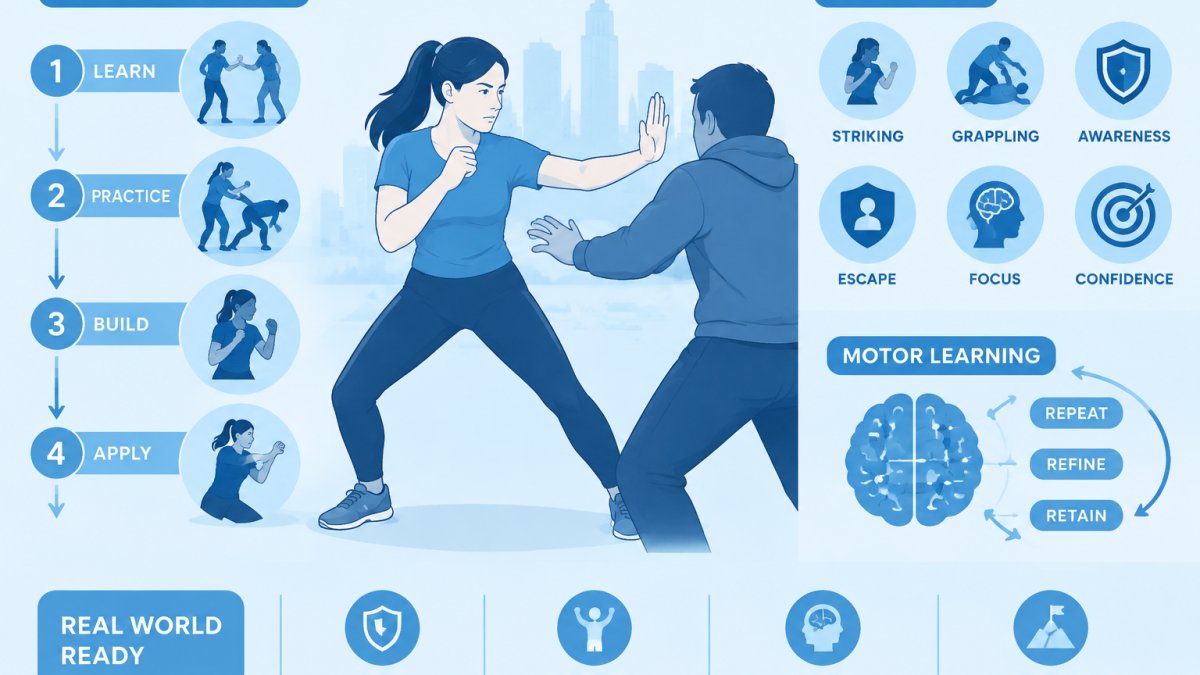
Your first month covers stance, footwork, basic strikes, and safe falling, not complex sequences. Good schools sequence these fundamentals so each class builds on the last.
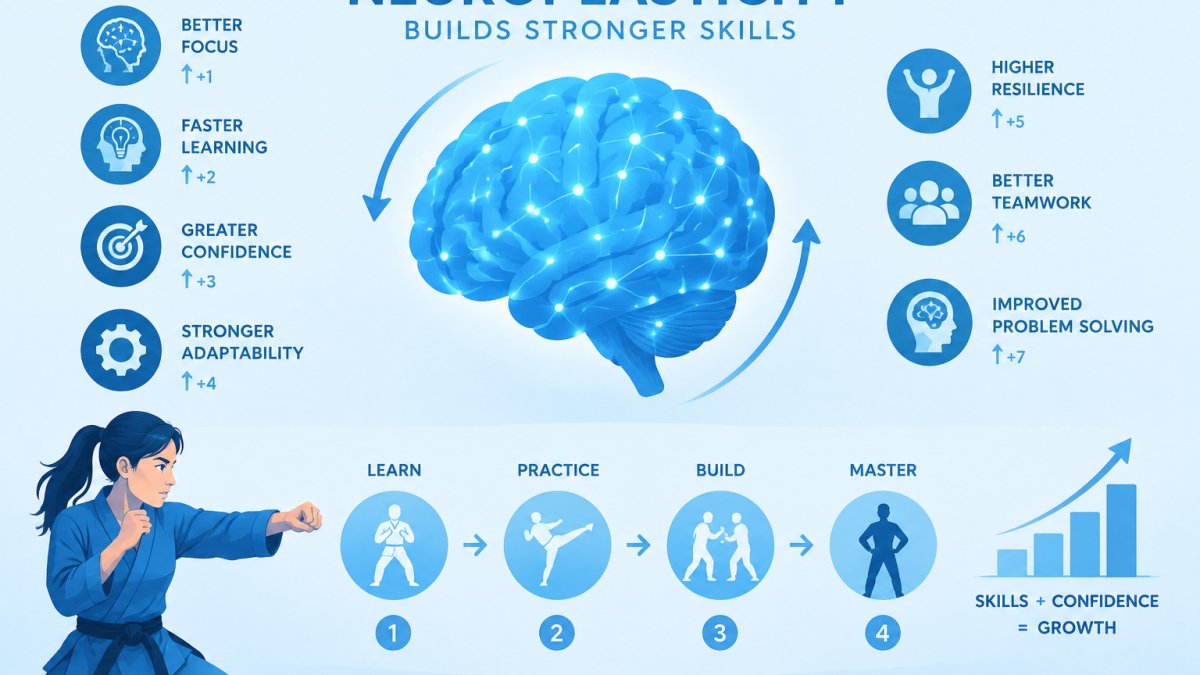
What most guides miss is how much of early training is cognitive, not physical. A Bellarmine University study by B. Harris examined how martial arts training influences quality of life in college students, and its stated purpose was to identify that relationship.
A common mistake is chasing advanced material before the basics are automatic. In practice, beginners who drill stance and footwork until they're boring progress faster by month three.
A Martial Arts Training Schedule for Beginners Who Work Full Time
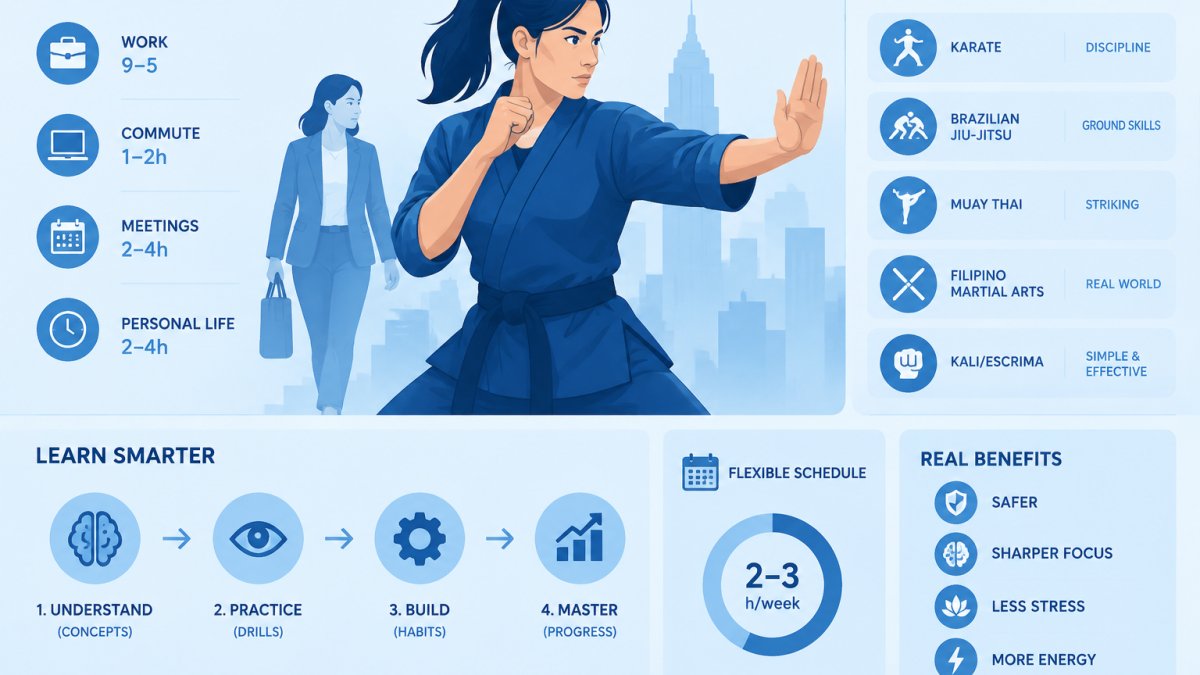
A realistic martial arts training schedule for beginners is two classes per week plus 10-15 minutes of home practice on two off days. That's enough to build retention without wrecking your week. The mistake most guides make is treating "busy professional" as one schedule. A hospital nurse on rotating shifts, a consultant who flies out Sunday night, and a parent managing school pickup do not have the same available hours, and a plan that ignores that difference fails by week three.
Weekly Templates by Work Pattern
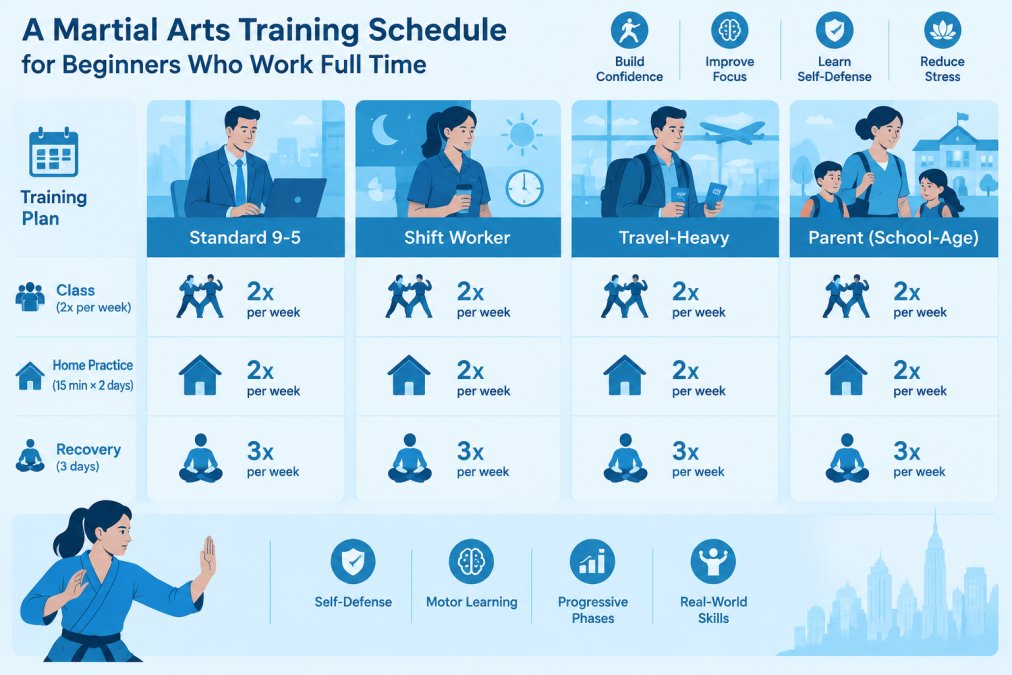
- Standard 9-5: Tuesday and Thursday evening classes, 15 minutes of shadow drilling Monday and Saturday. Protect the two class nights like meetings you cannot move.
- Shift worker: Anchor one class to a fixed day off and pair the second with a short home session after your shift ends, not before. Rotating schedules reward a fixed weekly anchor plus one floating slot you book 48 hours ahead.
- Travel-heavy: Two back-to-back classes early in the week, then 10 minutes of footwork and stance work in the hotel room on travel days. Choose a school with a make-up class policy so a missed week does not become a missed month.
- Parent with school-age children: One weekend morning class plus one weekday class that overlaps with a partner's pickup duty. Home practice happens in 10-minute blocks, not a single 30-minute session.
- Unpredictable calendar: One fixed weekend class plus one flexible weekday slot, with short home sessions filling the gaps. Book the flexible slot at the start of each week before it fills.
How to Build the Schedule Around Your Real Week
Start by counting the hours you actually control, not the hours you wish you had.
A common pattern among time-limited students is to treat home practice as optional. It is not.
Watch out: if your plan requires a 45-minute commute each way, two classes a week quietly becomes a four-hour commitment. Count door-to-door time before you commit to a school, and favor locations on your existing route home.
What Progress Looks Like on Two Sessions a Week
Time-limited students need measurable milestones, not vague encouragement. A realistic first-quarter arc looks like this: weeks 1-4, you learn stance, footwork, and safe falling and can complete a basic warm-up without instruction; weeks 5-8, you chain two techniques together and hold form under light pressure; weeks 9-12, you spar or drill at controlled intensity and can explain why a technique works, not just copy it.
If you want to compare training against a standard gym routine, our roundup of gym alternatives for professionals covers seven options worth comparing. Readers focused on practical self-defense should also see self-defense training for busy professionals.
Martial Arts vs Gym Workout: What Each One Delivers
A martial arts vs gym workout comparison comes down to this: the gym builds general fitness, while martial arts build fitness plus a usable skill. That difference matters when choosing how to spend limited training time, and Martial Movement 360 can help frame the trade-off between skill-building and general fitness.
Conditioning in class covers stamina, mobility, coordination, and flexibility through technique work, not just machines. The trade-off is that a gym offers more flexible hours and no partner requirement.
How to Evaluate a School Before You Commit
Evaluate a school on five criteria: schedule fit, curriculum structure, instructor background, beginner onboarding, and total commitment. Ask each one directly before you pay anything, and judge the answer, not the brochure.
The Pre-Commitment Checklist
- Can I see a written class schedule for the next month, including make-up options?
- Are techniques taught in progressive, dated phases with a stated sequence?
- What happens in my first three classes as a total beginner, step by step?
- How large is a typical class, and how many instructors are present per student?
- What are the instructor's credentials, and can I watch a class before joining?
- Can I pause or adjust my membership when work travel spikes?
- What is the total monthly cost, including gear, testing fees, and any uniform requirement?
- What safety practices are in place for adult beginners, including warm-up, sparring rules, and mat supervision?
What a Good Answer Sounds Like
A school with a real curriculum can explain its sequence in plain terms: what a beginner learns in month one, month three, and month six, and why the order matters.
On schedule fit, the useful question is not "how many classes do you offer" but "which two classes can I reliably attend every week, and what happens when I miss one." Schools that serve working adults usually have a make-up policy, a trial period, and a clear pause option. Schools that serve competition athletes often do not, and that mismatch is what drives adult beginners to quit.
On instructor background, look for a teaching style that matches adult learners: explanations of why a technique works, corrections delivered without humiliation, and a willingness to slow down for a beginner. Credentials matter, but the ability to teach a tired adult at 7 p.m. matters more.
Judge the Total Commitment, Not the Monthly Fee
The number on the website is rarely the full picture. Total commitment includes membership, uniform and gear, testing or belt fees, travel time, and the class hours themselves.
Watch out: a school that cannot explain its curriculum sequence in plain terms usually does not have one. Structure is the feature that matters most for time-limited adults, and no amount of friendly atmosphere replaces it.
If you are still choosing a style, our guide on choosing a martial arts alternative as an adult walks through the trade-offs. Our step-by-step guide to booking a martial arts trial class covers what to bring, what to ask, and how to read the first session.
Recovery, Injury Risk, and Training Around Work Stress
Recovery is where busy professionals get hurt, not in class. Sleep, hydration, and at least two rest days per week keep injury risk low for adult beginners.
Training also doubles as stress relief when the intensity is managed. Our guide on martial arts for stress relief covers practical ways to use training to manage work stress without overtraining.
A review by A. Stamenković and coauthors on martial arts in children covered 16 original research articles on kids ages 4-13, so it doesn't establish effects for adults.
Book a Trial Class and Test the Schedule for Yourself
The only way to know if a program fits your week is to test it. Book a trial, attend at your realistic frequency, and judge how you feel and perform after two weeks.
Our step-by-step guide to booking a martial arts trial class covers what to bring, what to ask, and how to read the first session.
Most professionals stall because they wait for a free schedule that never arrives. Two sessions a week, chosen well and structured properly, will take you further than you expect.
Frequently Asked Questions
How many times a week should a beginner train martial arts?
Two classes a week is enough to build a foundation if you add short home practice sessions between them. Consistency matters more than volume: three 45-minute sessions spread across the week beat one long weekend class. Working adults who train twice weekly and review basics at home retain technique better than those who cram. Start at two, hold that for six to eight weeks, then add a third class only if recovery and your calendar allow it.
Can you learn martial arts with only one or two classes a week?
Yes, provided the school structures its curriculum in progressive phases rather than open-ended drilling. One or two classes a week works when each session has a defined objective and you can review material briefly at home. Ask a prospective school how it tracks progress for students who attend twice weekly. If the answer is vague, the program likely assumes more mat time than you have. A phased curriculum makes limited hours count.
Is martial arts training a good alternative to the gym?
It depends on your goal. A gym workout is more efficient for isolated strength and muscle building. Martial arts training covers conditioning, mobility, coordination, and practical self-defense in the same session, which suits professionals who want one activity instead of three. Many students keep one or two short strength sessions alongside class. If your only goal is hypertrophy, the gym wins. If you want fitness plus a usable skill, martial arts does both.
Which martial arts suit adult beginners with no experience?
Boxing, Brazilian Jiu-Jitsu, Muay Thai, karate, and Filipino weapon systems all have beginner tracks designed for adults with no background. The deciding factor is the school's beginner structure, not the style. Look for separated beginner classes, a dated curriculum, and instructors who explain the why behind each drill. Kajukenbo and Filipino martial arts blend striking, grappling, and stick work, and progressive programs break those complex skills into phases a newcomer can absorb.