 How-to
7 Ways Neuroplasticity Boosts Professional Growth
Last Updated: November 12, 2026
Quick Summary
Neuroplasticity is the brain's ability to reorganize its neural connections in response to experience, and it supports neuroplasticity professional development by letting working adults keep building new skills. Repeated practice, specific feedback, and spaced sessions strengthen the connections involved, and that change continues across the lifespan.
- Repeated practice strengthens the pathways you use most, while unused connections can weaken over time.
- Practice short, focused blocks several times a week and ask for specific feedback after each attempt.
- Start with one skill and schedule three practice sessions per week, each 20 to 30 minutes.
- Track one effort, one capability, and one transfer indicator to see whether practice reaches real work.
- Treat the research as supportive rather than a guarantee, since many findings come from lab or small trials.
Table of Contents
- How Does Neuroplasticity Work in the Working Adult's Brain?
- Why Neuroplasticity Matters for Professional Development
- Neuroplasticity and Skill Acquisition at Work
- A Step-by-Step Plan to Use Neuroplasticity to Your Advantage
- Role-Specific Applications: Leadership, Communication, and Technical Skills
- Measuring Progress and Choosing Useful KPIs
- Limits of the Evidence and Realistic Workplace Barriers
- Booking Your First Trial Class to Start Building New Skills
- Frequently Asked Questions
How Does Neuroplasticity Work in the Working Adult's Brain?
Neuroplasticity is the brain's ability to reorganize and change its neural connections in response to experience, which is the foundation of neuroplasticity professional development.
For working adults, this matters because the brain does not stop changing after school.
Repeated practice is the main way that change happens. Each time you rehearse a skill, the connections involved get stronger. Stop using them, and they weaken.
Here is what that looks like at work:
- Repeated practice strengthens the pathways you use most
- Unused connections can weaken over time
- Changes build gradually, not overnight
Why Neuroplasticity Matters for Professional Development
Professional development is, at its core, a learning problem. New tools, new roles, and new expectations all require the brain to form fresh connections.
The American Psychological Association reports that researchers are using neuroplasticity to help older adults adapt to change and boost cognitive function (APA Monitor on Psychology on neuroplasticity and aging).
Not every claim about the brain holds up, though. The British Academy has warned against overstating what neural plasticity can do (Neural plasticity: don't fall for the hype).
Neuroplasticity and Skill Acquisition at Work
Skill building follows a predictable pattern. You practice, you get feedback, you adjust, and you repeat. Each cycle reinforces the connections that matter.
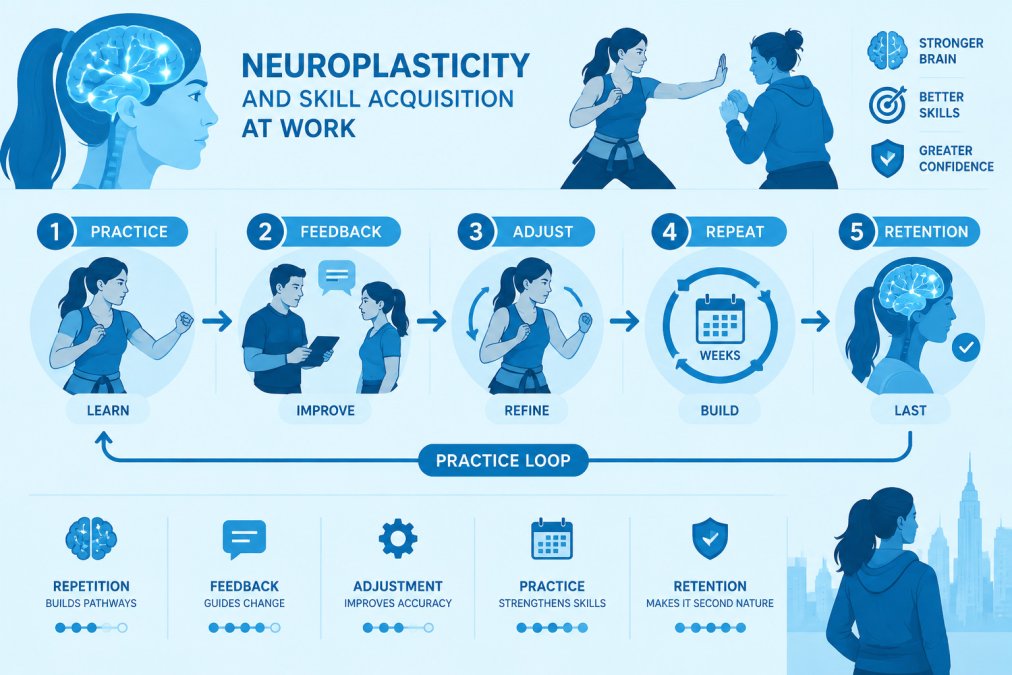
This is why deliberate practice beats passive exposure. Attending a webinar does little on its own. Applying what you heard, then checking the result, creates the loop your brain needs. Our practice-based methods follow this approach, and you can see how it works in this guide to applying deliberate practice.
Repetition, Feedback, and Knowledge Retention
Repetition alone is not enough. Feedback tells the brain which version of a movement or decision to keep. Without it, you can practice a mistake for months.
Retention improves when practice is spaced out and tied to real results. Short, focused sessions usually beat one long cram session.
Practical habits to try:
- Practice the same skill in short blocks, several times a week
- Ask for specific feedback after each attempt
- Review what you learned within 24 hours
If your training feels overwhelming, the reason may be the amount of new information. Why cognitive load theory improves training outcomes explains how to reduce that load so more of it sticks.
Learning Across the Career Lifespan
Your ability to learn does not disappear with age. Research on neuroplasticity suggests that adults keep the capacity to build new skills, even if the pace changes.
A Step-by-Step Plan to Use Neuroplasticity to Your Advantage
Start with one skill that matters for your next review or role change. Keep the goal narrow.
- Pick one skill and define what good performance looks like.
- Schedule three practice sessions per week, each 20 to 30 minutes.
- Get feedback from a mentor, coach, or recording after each session.
- Adjust one thing at a time based on that feedback.
- Review progress every two weeks and note what improved.
- Extend the plan once the skill feels reliable under pressure.
Consistency beats intensity here. Plenty of people quit after a burst of effort, which wastes the early gains.
Role-Specific Applications: Leadership, Communication, and Technical Skills
The same practice-feedback-adjust loop underlies all workplace learning, but the loop has to be tuned to the task. A manager rehearsing a hard conversation and an engineer rehearsing a debugging routine are both building stronger neural pathways, they are just building different ones, and they need different feedback and different difficulty curves. Most general articles on neuroplasticity stop at "practice more." The useful question is what to practice, how hard, and who should judge the result.
Managers and People Leaders
Leadership skills are interpersonal and largely invisible, which makes feedback scarce. By pairing clear feedback with habits for mental clarity, leaders can better notice which repeated behaviors are strengthening trust and where to adjust.
- Pick one behavior per cycle. Examples: opening a one-on-one with a question instead of an update, or stating the decision before the rationale. Rehearsing five behaviors at once dilutes the signal.
- Schedule low-stakes reps. Practice the behavior in routine meetings before using it in a high-stakes conversation. A common pattern is two to three deliberate reps per week for four to six weeks.
- Get feedback from the person affected. Ask a direct report or peer a specific question after the meeting ("Did I leave room for you to disagree?") rather than a vague "How did I do?"
Watch out: leaders often practice the version of the behavior they are comfortable with rather than the one their team needs, which reinforces the wrong pathway.
Individual Contributors and Communicators
Communication is the most measurable interpersonal skill because it leaves a record. Recordings, written drafts, and audience reactions all serve as feedback the brain can use.
- Record and review. A short recording of a presentation or a saved draft of an email gives you a concrete artifact to compare against your intent.
- Change one variable per rep. Rewrite only the opening, or only the closing, then deliver again. Changing everything at once makes it impossible to tell what worked.
- Use a listener as a sensor. Ask one colleague to note the single point they remember. If it is not your main point, the message did not land.
Technical and Analytical Skills
Technical skills are the easiest to practice deliberately because correctness is often verifiable. That is also the trap: solving problems you can already solve feels productive but produces little new learning.
- Work at the edge of your ability. Choose problems slightly beyond your current level, then check your solution against a reference, a test suite, or a more experienced colleague.
- Separate retrieval from review. Attempt the problem from memory first, then study the solution. The attempt is what strengthens the pathway.
- Log your errors. A short error log turns repeated mistakes into a feedback source you can review weekly.
Career Changers
Career changers face a different constraint: they are building new pathways while old habits stay strong. The practical move is to attach new skills to existing routines so the new behavior gets triggered automatically.
- Pair a new skill with an existing daily task (for example, review one industry term each time you open your inbox).
- Expect a slower early curve than in your prior field, and judge progress by reps completed rather than by how fluent you feel.
- Seek feedback from people in the target role, not from people in your current one.
Across every role, the pattern is the same: define the behavior, get specific feedback, adjust one variable, and repeat on a schedule. What changes is the task and who is qualified to judge it.
Measuring Progress and Choosing Useful KPIs
Most workplace learning fails quietly: people attend training, feel encouraged, and change nothing measurable. The reason is usually that no one defined what success would look like before practice began. Neuroplasticity gives you a mechanism, not a scoreboard, you still have to build the scoreboard. The practical approach is to track a small set of indicators that separate effort, capability, and real-world transfer.
Three Layers of Measurement
- Effort indicators (leading). Reps completed per week, practice minutes logged, feedback sessions held. These are easy to count and tell you whether the plan is actually running.
- Capability indicators. Accuracy on a practice task, time to complete a standard task, quality rating from a reviewer, or number of attempts needed to reach a passing standard. These show whether the skill is improving under controlled conditions.
- Transfer indicators (lagging). Whether the skill shows up in real work: a presentation that lands its main point on the first try, a meeting where the new behavior appears without prompting, a task completed without escalation. These are the outcomes that matter and the ones most often skipped.
A useful rule is to pick one indicator from each layer. Effort without capability is busywork; capability without transfer is practice that never reaches the job.
Choosing Metrics That Survive Real Work
Good metrics share three traits: they are cheap to collect, they are specific enough to move, and they are tied to a behavior you can observe.
- Replace "get better at communicating" with "main point recalled correctly by a listener on the first attempt."
- Replace "improve leadership" with "direct report reports feeling heard in one-on-ones, asked monthly."
- Replace "learn the new system" with "tasks completed without help, tracked weekly."
Avoid metrics that depend on self-report alone. People are poor judges of their own skill gains, and self-ratings tend to drift upward regardless of actual improvement.
A Simple Review Cadence
- Weekly: count reps and note one thing that went well and one that did not.
- Every two weeks: compare capability indicators against the prior period.
- Monthly: check whether transfer indicators are moving. If capability is rising but transfer is flat, the practice setting is too different from the real task.
Watch out: changing the metric every time it stalls hides the signal. Change the practice first, and only change the metric if it was poorly chosen.
When a Number Stops Moving
A plateau is normal and is often a sign that the task has become too easy or feedback has become too vague.
The point of measurement is not to prove that neuroplasticity works. It is to make sure your practice is actually reaching the job, and to catch the common failure where effort rises while performance does not.
The article suggests tracking one indicator from each layer so effort, capability, and real-world transfer stay visible.
| Layer | Indicator | Review frequency |
|---|---|---|
| Effort (leading) | Reps completed per week, practice minutes logged | Weekly |
| Capability | Accuracy on a practice task, time to complete a standard task | Every two weeks |
| Transfer (lagging) | Skill appears in real work without prompting | Monthly |
Limits of the Evidence and Realistic Workplace Barriers
Much of the neuroplasticity research comes from lab studies, animal models, or small human trials. Results do not always carry over neatly to busy offices.
Real barriers include limited time, unclear feedback, and workloads that leave little room for practice. Plan for these instead of assuming you will find extra hours.
A 2024 chapter on neuroplasticity techniques notes possible benefits for learning and emotional regulation, but it does not promise quick results (Enhancing Neuroplasticity and Promoting Brain Health).
Booking Your First Trial Class to Start Building New Skills
Skill building works best when practice is structured and feedback is built in. At Kajukenbo and Filipino Martial Arts Club, our neuroscience-based approach breaks complex techniques into progressive phases, so each session builds on the last. Carla Villaorduña is a customer whose experience is shared here.
If you want to see how this approach fits your schedule, book a trial class and try it before you commit.
Frequently Asked Questions
What are the advantages of neuroplasticity?
Neuroplasticity is the brain's ability to reorganize and modify neural connections in response to experience. Reviews in Brain Sciences (2023) and Brain Research Bulletin (2025) describe it as supporting learning, memory, and recovery from injury. For professionals, this means that new skills, communication habits, and decision-making approaches can be built through deliberate practice rather than fixed at an early age. The advantage is adaptability: the brain keeps changing across adulthood, though the rate and extent of change vary between individuals and tasks.
At what age is neuroplasticity strongest?
Plasticity is highest in early childhood, when synaptic connections form rapidly. However, a 2025 review in Brain Research Bulletin reports that plasticity continues throughout the lifespan and supports learning and memory. Adults can still acquire skills, though the research available does not establish a single precise age when change slows. For professional development, the practical takeaway is that consistent practice matters more than age alone, and adults who keep learning new things tend to maintain flexibility in their thinking.
How can neuroplasticity support professional development?
Professional growth depends on forming and strengthening neural pathways for skills like communication, leadership, and technical problem-solving. Spaced repetition, specific feedback, and practice in realistic conditions help those connections stick. A useful starting point is to pick one skill, practice it in short sessions several times a week, record what you observe, and review progress every few weeks. The American Psychological Association notes that researchers are applying neuroplasticity findings to help adults adapt to change and build cognitive function.
How does neuroplasticity contribute to education and workplace learning?
Research on neuroplasticity suggests that learning is most effective when it involves repetition, varied practice, and emotional engagement. A chapter by M. Forget and coauthors (2024) discusses potential benefits including improved learning, cognitive-skills development, and emotional regulation. Workplace training can apply these principles by breaking skills into progressive stages and building in regular feedback. Be cautious with strong claims: some commentary, including a British Academy article titled 'Neural plasticity: don't fall for the hype,' warns that benefits are sometimes overstated.