 How-to
How to Learn Self Defense Efficiently: A Structured Path
Last Updated: November 19, 2026
Quick Summary
To learn self defense efficiently, build awareness, distance management, balance and a calm decision loop before any techniques, then follow a phased plan of four-week blocks that adds pressure testing. Short, frequent sessions with feedback and cold recall beat long hours of unfocused drilling.
- Each phase of the progressive plan lasts four weeks, with short sessions and a weekly review.
- Phase 3 adds a resisting partner, time constraints and constrained spaces for pressure testing.
- Most beginners handle basic awareness, stance and escapes within a few months of consistent training.
- Space practice, test recall cold and keep techniques simple to improve retention.
- Ask whether an instructor explains why a technique works and whether progress is measured.
Table of Contents
- Why Most Self-Defense Training Wastes Your Time
- The Core Skills You Need Before Any Self-Defense Techniques for Beginners
- How to Learn Self Defense at Home Without Building False Confidence
- A Progressive Learning Plan That Builds Skills in Phases
- How Long Does It Take to Learn Self-Defense? Setting Realistic Milestones
- Self-Defense Training Tips for Retention and Pressure Testing
- Choosing a Class That Teaches You to Learn Efficiently
- Book a Trial Class and Test the Method Yourself
- Frequently Asked Questions
Why Most Self-Defense Training Wastes Your Time
Most people who want to learn self defense efficiently start with the wrong assumption: that more hours equal more skill. More hours alone don't guarantee better skill. Hours spent drilling the same technique without feedback build familiarity, not reliability. The gap between "I've done this a hundred times" and "I can do this when it matters" is where most training quietly fails.
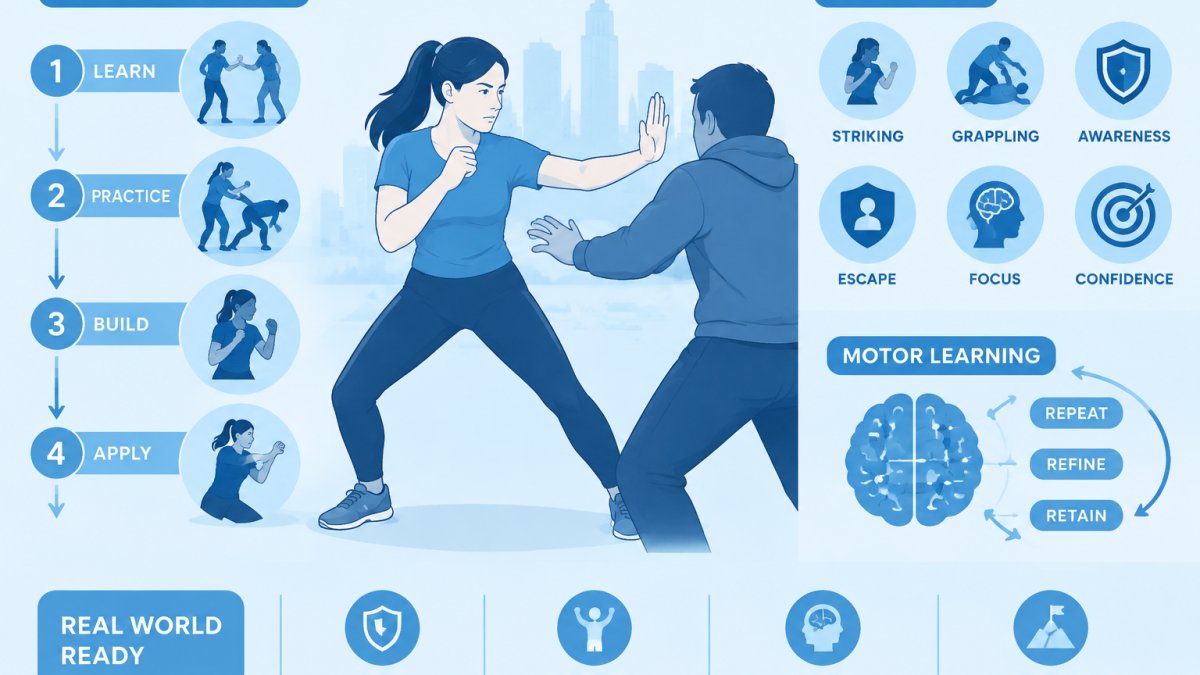
A common mistake we see is treating class attendance as the goal. Showing up twice a week and going through the motions feels productive. But motor learning research, including a 2025 study on resilience and martial arts training, keeps pointing at the same thing: how you practice matters more than how often.
Self-defense is the set of practical skills you use to recognize, avoid, and escape a threat. Training is how those skills get built into your body.
Below, we'll show you a structured path and the specific mistakes that stall progress, which we break down in this guide to common training mistakes.
The Core Skills You Need Before Any Self-Defense Techniques for Beginners
Before a single strike, beginners need four foundations. These are the skills that make every later technique work:
- Awareness: scanning your environment and spotting risk early
- Distance management: keeping space between you and a threat
- Balance and stance: staying on your feet under pressure
- A calm decision loop: noticing, choosing, and acting without freezing
Self-defense techniques for beginners only stick when these come first. Skip them, and you get someone who can throw a decent elbow but panics the moment a real situation starts moving.
We teach these foundations as separate, measurable skills. Can you spot an exit in a crowded room within seconds? Can you step back and hold a defensive position without losing balance? Those are checkpoints, not vague goals.
How to Learn Self Defense at Home Without Building False Confidence
You can learn a lot at home. You cannot learn everything. Watching videos builds understanding, not skill under pressure. Analysis of the risks of learning self-defense from viral videos makes the point plainly: real attackers don't follow choreographed sequences.
So use home practice for the right jobs:
- Conditioning: a simple bodyweight routine for legs, core, and grip
- Mobility: hip and shoulder movement that supports defensive positions
- Shadow work: slow repetitions of stance changes and distance steps
- Mental rehearsal: walking through scenarios in your head
What home practice cannot give you is a resisting partner, real feedback, or pressure. Treat solo work as homework, not the class. If you want a deeper look at how complex skills hold up under stress, read our guide to remembering self-defense skills under pressure.
A Progressive Learning Plan That Builds Skills in Phases
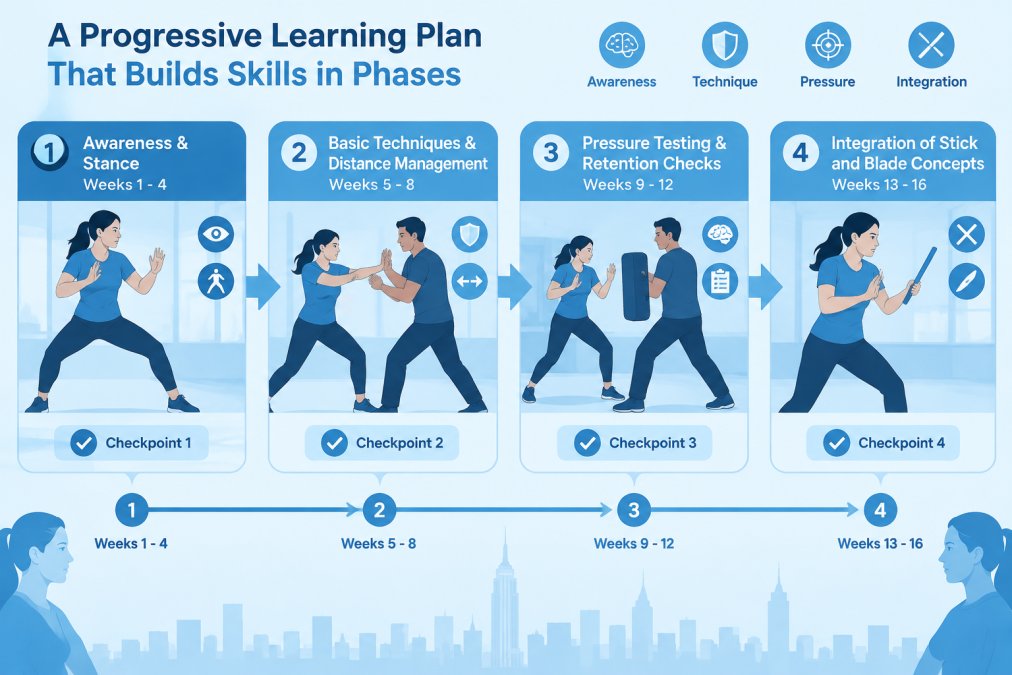
A realistic plan beats open-ended drilling. Here's the phased structure we use, built around how the brain actually acquires movement. Each phase lasts four weeks, with short practice sessions and a longer review session each week.
Phase 1 (Weeks 1-4): Awareness, stance, and basic movement. Focus on scanning habits, a stable defensive stance, and stepping off the line of attack.
Phase 2 (Weeks 5-8): Basic defensive techniques and distance management. Introduce simple blocks, parries, and escape footwork.
Phase 3 (Weeks 9-12): Pressure testing and retention checks. Add a resisting partner, time constraints, and constrained spaces.
Phase 4 (Weeks 13-16): Integrating stick and blade concepts. Apply the same foundations to improvised or training weapons, emphasizing distance and control.
For the full breakdown, see our guide to structured self-defense training programs.
How Long Does It Take to Learn Self-Defense? Setting Realistic Milestones
There's no single timeline, but you can set honest milestones. Most beginners who train consistently can handle basic awareness, stance, and escape movements within a few months. Real reliability under pressure takes longer, and it depends on practice quality, not just time. Because reliable movement under pressure depends on sound practice, a beginner kickboxing guide can help you build striking skills without losing sight of safety and control.
A useful way to think about it:
| Milestone | Typical Focus | What It Means |
|---|---|---|
| Foundation | First weeks | Awareness, stance, balance |
| Basic defense | First months | Distance, simple escapes |
| Pressure-tested | Later months | Skills hold up under stress |
| Integrated | Ongoing | Stick and blade concepts |
The honest answer to how long does it take to learn self-defense is: faster than most people fear, slower than most videos promise. Milestones keep you honest.
Self-Defense Training Tips for Retention and Pressure Testing
Retention is where efficient training is won or lost. These self-defense training tips matter more than any single technique:
- Space your practice. Short, frequent sessions beat one long one.
- Test recall cold. Try a skill you haven't drilled in two weeks.
- Add mild pressure. A partner who resists, a timer, a constrained space.
- Keep techniques simple. Fewer moves, better recall.
- Review film or notes. Feedback closes the loop.
University of Oregon research on empowerment self-defense notes that this kind of training reduces fear and anxiety while building confidence. That confidence comes from tested skill, not repetition alone.
Choosing a Class That Teaches You to Learn Efficiently
The instructor matters more than the style name on the door. A good class teaches you how to learn, not just what to copy. But how do you evaluate an instructor before committing? Start with credentials: ask about their training in motor learning or pedagogy, not just rank. A black belt does not guarantee teaching ability.
Next, assess class safety. A qualified instructor will emphasize controlled contact, proper equipment (mats, gloves, mouthguards), and clear rules for tapping out or signaling distress. Ask about insurance and first-aid training. Observe a class: do students receive individual feedback, or are they left to drill unsupervised? Is there a structured warm-up and cool-down?
Finally, use a trial session as a test. During a trial, note whether the instructor explains why a technique works and whether feedback is specific. Ask how progress is measured.
Before you commit, ask these questions:
- Does the instructor explain why a technique works?
- Is training organized in dated, progressive phases?
- Do you get feedback and retention checks?
- Is pressure testing built in safely?
- Can the schedule fit a demanding work week?
- What are the instructor's teaching credentials and safety protocols?
- Is a trial session available?
A class that only drills moves in open-ended loops will stall you. Look for structure, feedback, and a clear path from beginner to pressure-tested skill. If you're comparing options nearby, our guide to finding the best self-defense classes in Midtown walks through what to look for.
Book a Trial Class and Test the Method Yourself
Reading about a method only gets you so far. The real test is standing in a class and feeling whether the structure clicks. At Kajukenbo and Filipino Martial Arts Club, our program is built on a neuroscience-based teaching method, with training organized in dated, progressive phases rather than endless drilling. Instruction is led by Carlos Jiménez, who holds a Master's degree in Neuroscience.
The program is designed to support measurable progress, retention under pressure, and complex skills broken into pieces you can remember. If you've wondered whether your training will stick when it counts, this is how you find out. Book a trial class step by step and test the method yourself.
The challenge is simple: stop collecting techniques and start training in a way your brain can keep. Kajukenbo and Filipino Martial Arts Club combines a neuroscience-based method, dated progressive phases, and a Midtown location built for busy professionals. Get started with Kajukenbo and Filipino Martial Arts Club and build self-defense skills that hold up under pressure.
Frequently Asked Questions
How can a beginner learn self-defense efficiently?
Start with awareness, distance management, and a small set of simple techniques rather than a long list of moves. Practice in short, frequent sessions and test each skill under light pressure instead of drilling it in isolation. A progressive plan with dated checkpoints keeps you from repeating the same drills without measurable improvement.
Can you learn self-defense at home, and what are the limits?
You can build a useful foundation at home: stance, movement, balance, verbal de-escalation scripts, and bodyweight conditioning. What home practice cannot give you is a resisting partner or honest feedback. Use solo practice to reinforce skills you learned in class, not to replace supervised training.
How long does it take to learn basic self-defense?
Building reliable fundamentals and making them hold up under pressure takes time that depends on practice frequency and feedback quality. Progress depends on practice frequency, feedback quality, and whether your training includes pressure testing. Treat timelines as checkpoints for skills, not calendar promises, and measure retention rather than attendance.
How often should you practice self-defense, and is a class better than training on your own?
Two focused sessions a week plus short solo reviews beat one long weekly class. A class gives you a partner, corrections, and pressure you cannot create alone, while solo practice builds the conditioning and repetition that make techniques automatic. If your schedule is tight, prioritize class time for feedback and use ten-minute home sessions for stance, movement, and recall drills. Track what you remember from the previous week to confirm the training is sticking.