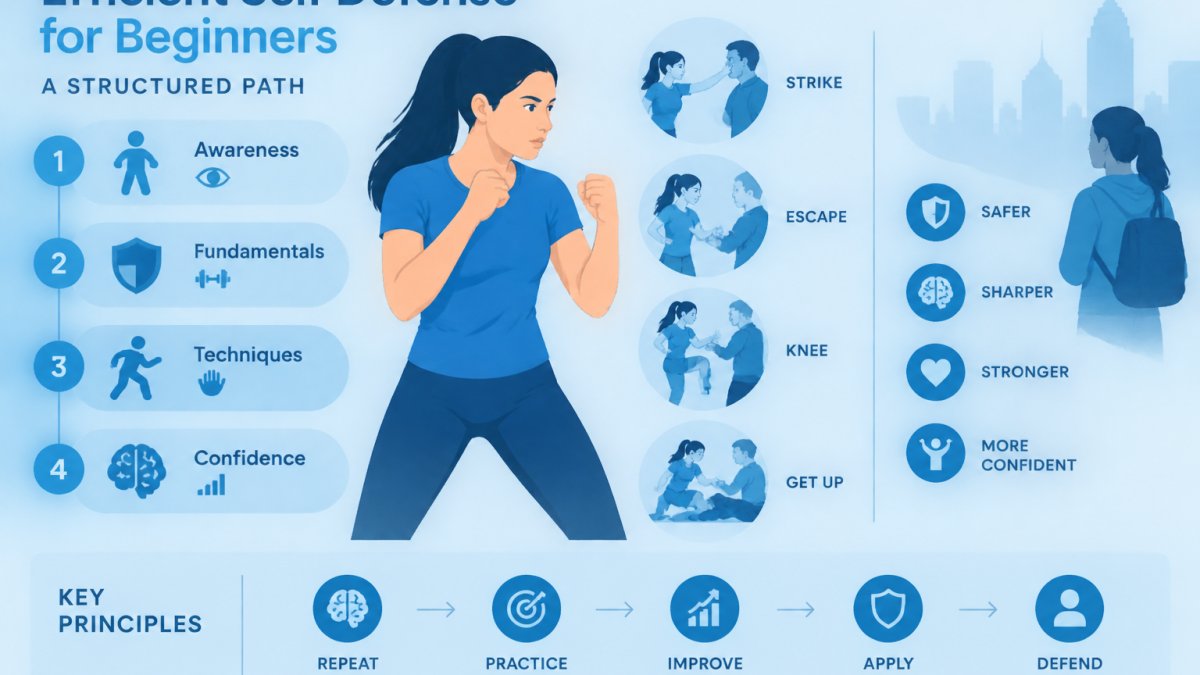
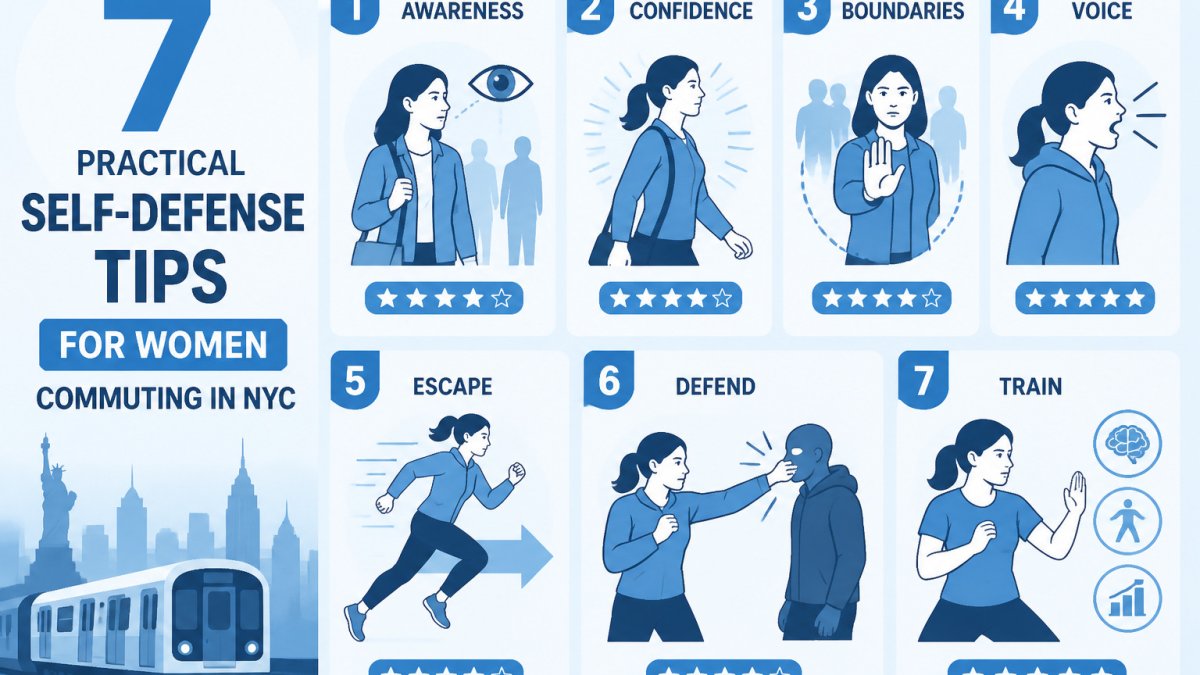
 Listicle
7 Practical Self-Defense Tips for Women Commuting in NYC
Quick Summary
Practical self defense tips for NYC commuters start with situational awareness: plan your route, keep your head up, and notice who is near you. Stand back from the platform edge, use calm, firm words to de-escalate, and move toward staffed areas if someone follows you.
- Decide your route, backup plan and first person to call before you leave home.
- Stand back from the yellow line until the train visibly slows down.
- Use short, direct phrases like "Back up" or "Stop" and keep your hands visible.
- If someone follows you, change direction and move toward people or an open business.
- Keep headphone volume low enough to hear footsteps and announcements.
Table of Contents
- Why Self-Defense Matters for Women Commuting in NYC
- Tip 1: Build Situational Awareness Before You Leave the Door
- Tip 2: Follow Subway Safety Tips That Keep You Off the Edge
- Tip 3: Use Verbal De-Escalation Techniques Before Anything Physical
- Tip 4: Know What to Do If Someone Follows You
- Tip 5: Walk and Stand With Purpose and Confidence
- Tip 6: Limit Distractions and Protect Your Digital Safety
- Tip 7: Build a Personal Safety Plan for Commuters
- Frequently Asked Questions
7 Practical Self-Defense Tips for Women Commuting in NYC
Last Updated: November 4, 2026
Why Self-Defense Matters for Women Commuting in NYC
Self-defense for women starts before any physical contact. Most commuters who avoid trouble do so because they notice it early, not because they fight well. Self defense tips like these are built on that same order: awareness first, then de-escalation, then physical skill as the last resort.
Commuting puts you in crowded trains, busy platforms and long walks between stations. Each of those moments gives an attacker a chance to pick a target. The self defense tips below focus on habits you can build now and use on any route.
One point drives the rest of this guide: reaction time decides outcomes. That is why these habits are worth practicing until they become automatic.
Tip 1: Build Situational Awareness Before You Leave the Door
Situational awareness is the habit of noticing your surroundings before anything goes wrong. Start it at home. Before you step out, decide your route, your backup plan and the first person you would ask for help.
Safety guidance for urban commuters now stresses scanning your environment and identifying high-risk zones as a core habit (Krav Maga Institute guidance on urban safety habits). Keep your head up, check reflections in windows, and note who is near you as you walk.
Preparation matters as much as vigilance. "The more ready and aware you are every time you leave the house, the better your chances are at staying safe," a martial artist told the New York Post in 2026.
If you want to build these habits in person, a structured class can help. Find a nearby self-defense class to practice awareness with an instructor.
Tip 2: Follow Subway Safety Tips That Keep You Off the Edge
Platform edges cause as many problems as strangers do. The simplest rule: stand back from the yellow line until the train is visibly slowing down. Crowds push toward the edge when a train approaches, so wait for the doors to open before you move forward.
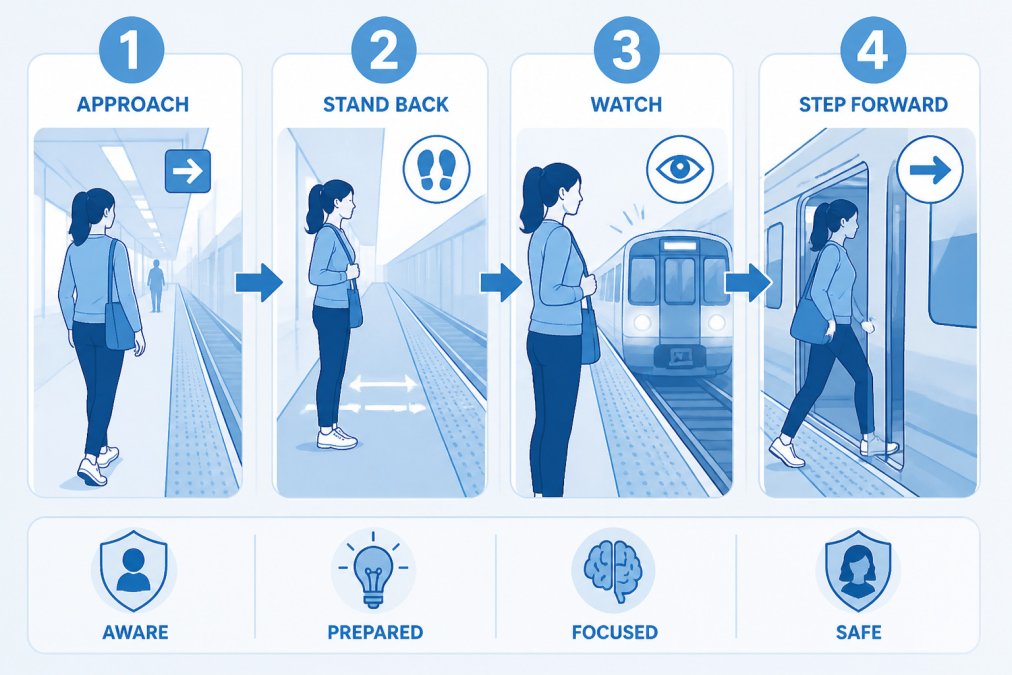
Red Dawn BJJ's commuter awareness guidance recommends the same habit for subway riders. Stand where you can see the platform and the nearest exit, and avoid isolated corners late at night.
Watch out: if you are pushed toward the edge, do not grab the person closest to you. Turn your body, widen your stance and move away from the crowd.
Different transit environments call for different habits. On a crowded subway car, position yourself near the doors but not blocking them, keep your back toward the wall or a partition when possible, and avoid standing in the center of the car where you can be surrounded. On an empty late-night platform, wait near the token booth or the MTA employee booth if one is staffed, and stand under good lighting. At bus stops after dark, wait near the curb but with a clear path to an open business, and board near the driver rather than at the rear doors.
Digital safety overlaps with physical safety on transit. Keep your phone secure and within reach rather than in a back pocket or open bag, especially in crowds. Sharing your live location with a trusted contact and avoiding real-time posts about your route or schedule are sensible habits. Keeping your phone secure is one part of a broader safety routine, and Paragraph 2, LLC connects that awareness with the confidence to respond when a situation calls for it.
If you want to practice these habits in a structured setting, a class can help you drill platform positioning and crowd awareness. Ask a self-defense program directly about its curriculum, or check its website for current details.
The article's subway guidance comes down to a few concrete habits, summarised below.
| Setting | Habit | Why it matters |
|---|---|---|
| Platform edge | Stand back from the yellow line until the train slows | Crowds push toward the edge as trains approach |
| If pushed toward edge | Turn your body and widen your stance | Avoids grabbing the person closest to you |
| Crowded subway car | Stay near doors without blocking them | Keeps your exit clear |
| Empty late-night platform | Wait near a staffed booth under good lighting | Puts you near help |
| Bus stop after dark | Wait near the curb, board near the driver | Keeps you visible and close to help |
| Phone use | Keep it secure and within reach | Reduces the chance of theft or distraction |
Tip 3: Use Verbal De-Escalation Techniques Before Anything Physical
Most confrontations start with words, and they can often end the same way. Keep your voice firm and calm. Use short, direct phrases such as "Back up" or "Stop," and make eye contact without staring.
Verbal de-escalation buys you distance and time. Stand at an angle, keep your hands visible, and open a clear path to a crowded area or staffed booth. Name the behavior you want to stop, not the person.
Practice these phrases out loud so they come easily under stress. Repetition builds the motor memory that matters when adrenaline is high.
Tip 4: Know What to Do If Someone Follows You
If you think someone is following you, do not wait to confirm it. Booking a trial class lets you try these responses in a safe setting. Change direction, cross the street, or walk toward a store, lobby or open business. Move toward people, not away from them.
Call someone while you walk, and tell them where you are. Keep your phone in hand, not buried in a bag. If the person keeps pace, go to a staffed location and ask for help loudly and clearly.
Trust your instincts. A gut sense that something is wrong is worth acting on, even if you cannot yet explain why.
Tip 5: Walk and Stand With Purpose and Confidence
Posture sends a signal before you say a word. Walk with your shoulders back, your head up and a steady pace. Attackers often look for people who seem distracted, lost or hesitant.
Confidence is not aggression. It means moving as if you know where you are going, even when you are unsure. Stand with your weight balanced and your feet set, so you can step away quickly if needed.
Most of this comes down to habit. The more often you practice walking with purpose, the more natural it feels on a crowded platform.
Tip 6: Limit Distractions and Protect Your Digital Safety
Headphones and phones make you an easier target. Keep the volume low enough to hear footsteps, announcements and nearby conversations. Put the phone away when you cross a street or stand near platform edges.
Digital safety matters too. Share your live location with a trusted contact for your commute, keep your phone charged, and set up emergency contacts on your lock screen. These steps cost little and can speed up help if you need it.
Avoid posting real-time details about your route or schedule. Public posts can tell strangers where you will be and when.
Tip 7: Build a Personal Safety Plan for Commuters
A personal safety plan turns the other six tips into a routine. Write down your usual routes, your nearest staffed locations, and the contacts you would call. Review the plan every few months and after any change in your schedule.
Include a few concrete steps: which route you take at night, where you wait for a train, and what you say to a stranger who makes you uneasy. Practice those steps so they become automatic.
Most guides stop at the fight. The part they miss is what to do immediately after an incident. If you are assaulted or threatened, your first call should be to 911. When officers arrive, give a clear description: height, build, clothing, distinguishing marks, and direction of travel. Ask for the incident number and the responding officer's name and shield number. Write down what happened while your memory is fresh, including time, location, and any witnesses. If you are injured, seek medical attention and ask for documentation. Keep any torn clothing or other evidence in a bag rather than washing it.
Know your legal rights for self-protection tools before you need them. Self-protection tools are regulated, and rules on possession and carrying vary. Check the current New York State and city rules before you carry or rely on any such device. Commuters often assume a tool is legal because it is sold locally, so check the current rules before you rely on any device. When in doubt, ask a local attorney or a qualified instructor rather than guessing.
Structured training can make the plan stick. A program that drills these responses over time can build the skill and confidence to use them.
Frequently Asked Questions
What can I use to defend myself in NYC?
Your strongest tools are awareness, movement and your voice, and training makes them reliable. Many women also carry a personal alarm or pepper spray, but you should check current New York State and city rules before carrying any self-protection product, since legal limits apply. Because reaction time is the critical factor and an attacker will not give you time to plan, practicing responses in a controlled setting is worthwhile.
What should I do if someone follows me on the street?
Do not ignore it. Change direction, cross the street or move toward a lit, occupied area such as a shop or lobby, and keep your phone in hand with a trusted contact ready to call or share your live location. Speak in a firm, clear voice, telling the person to stop following you. If the person closes distance or threatens you, get to a safe place and call 911. Afterward, write down what you saw, including clothing, direction and time, while the details are fresh.
How can I set a boundary with someone who is making me uncomfortable?
Be direct and brief. State the behavior and the expectation, such as "Stop touching me, step back now." Use a steady voice, keep your posture open and your feet ready, and avoid long explanations, which can invite argument. Repeat the boundary once if needed, then move toward other people or an exit. Practicing these phrases out loud beforehand makes them easier to say under stress.
When should I call 911 during a safety emergency?
Call 911 whenever you feel physically threatened, when someone has touched or hurt you, when you are being followed and cannot reach safety, or when you witness a violent act. You do not need certainty before calling. Give your location, describe the person and what is happening, and stay on the line if it is safe to do so. On the subway, you can also alert the conductor or a station agent or use the emergency intercom.