 How-to
Why Cognitive Load Theory Improves Training Outcomes
Quick Summary
Cognitive load theory improves training outcomes because working memory has limited space, and learning suffers when a lesson asks for more than that space can hold. Reducing unnecessary load, such as crowded instruction or too many terms at once, frees learners to focus on the skill itself. Training built on this principle tends to produce better retention and performance under stress.
- Working memory holds only a handful of pieces of information at once.
- Intrinsic load comes from the skill itself and should be managed with structure, not removed.
- Extraneous load comes from presentation and is the part trainers can reduce.
- Overload signs include freezing, rising mistakes, repeated questions, and visible frustration.
- Reduce load by dropping a layer, slowing the tempo, or returning to the last stable step.
Table of Contents
- What Cognitive Load Theory Says About How People Learn
- Intrinsic Cognitive Load Theory: The Difficulty You Cannot Remove
- Extraneous Cognitive Load and the Distractions Trainers Create
- Applying Cognitive Load Theory in Instructional Design for Workplace Training
- Telling Productive Challenge From Overload
- Measuring Whether Your Training Reduced Load and Improved Performance
- Book a Trial Class to See a Load-Reduced Method in Practice
- Frequently Asked Questions
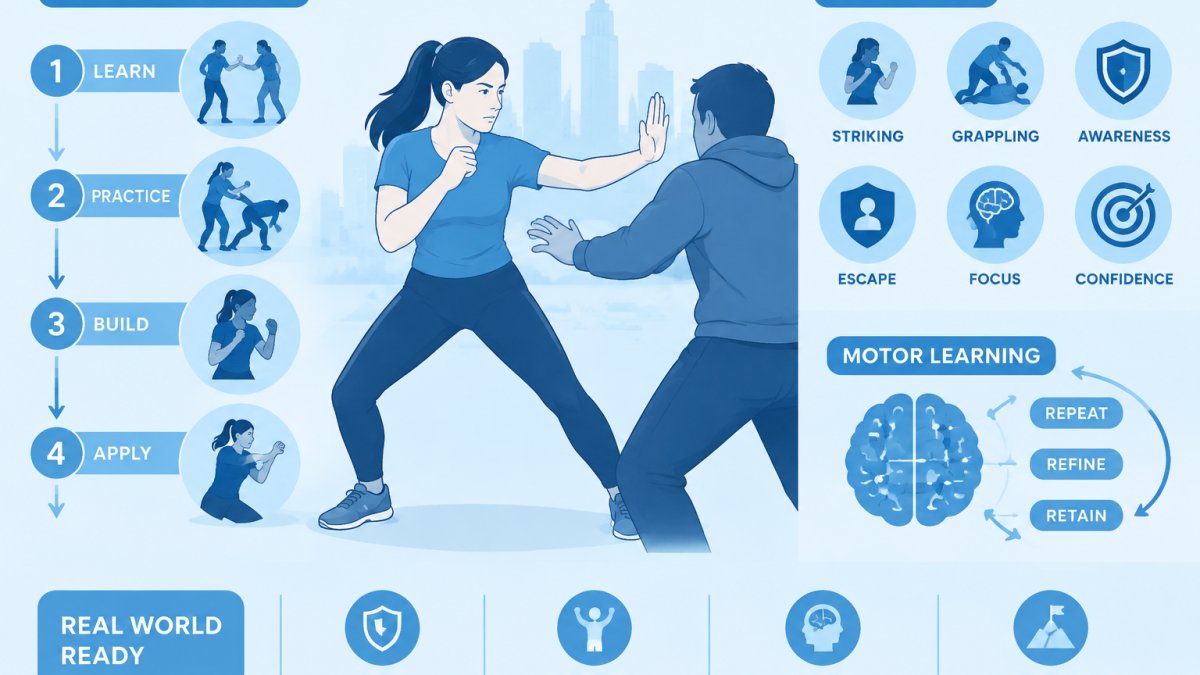
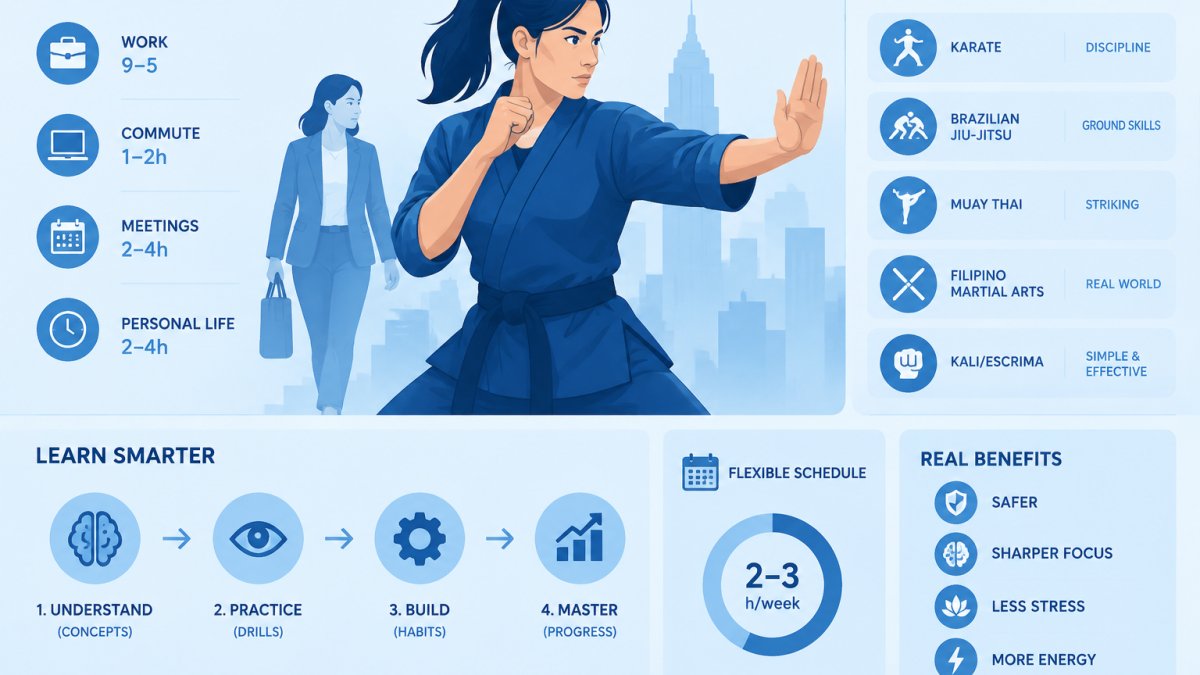
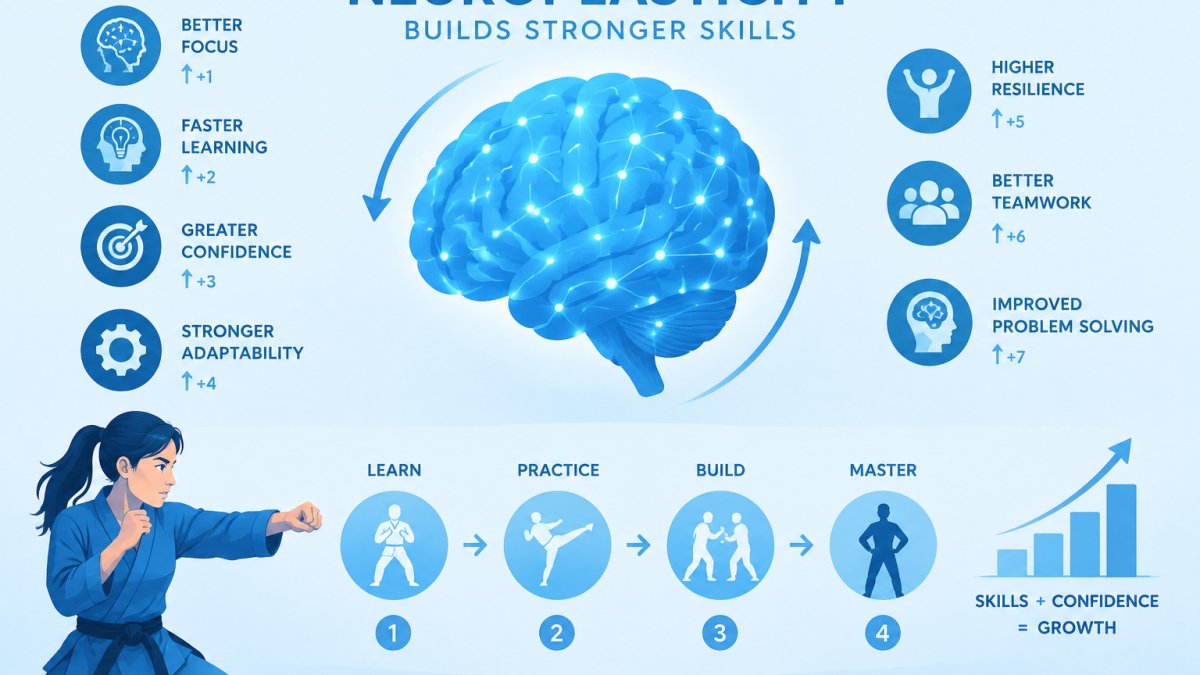
Women's self defense starts with one idea: the best defense is the one you can actually use under stress. For professionals in Midtown Manhattan, that idea matters more than most. A training schedule that works on paper can collapse when a deadline, a commute, or a travel week gets in the way. This guide from Kajukenbo and Filipino Martial Arts Club looks at why cognitive load theory improves training outcomes, and what that means for anyone learning to protect themselves.
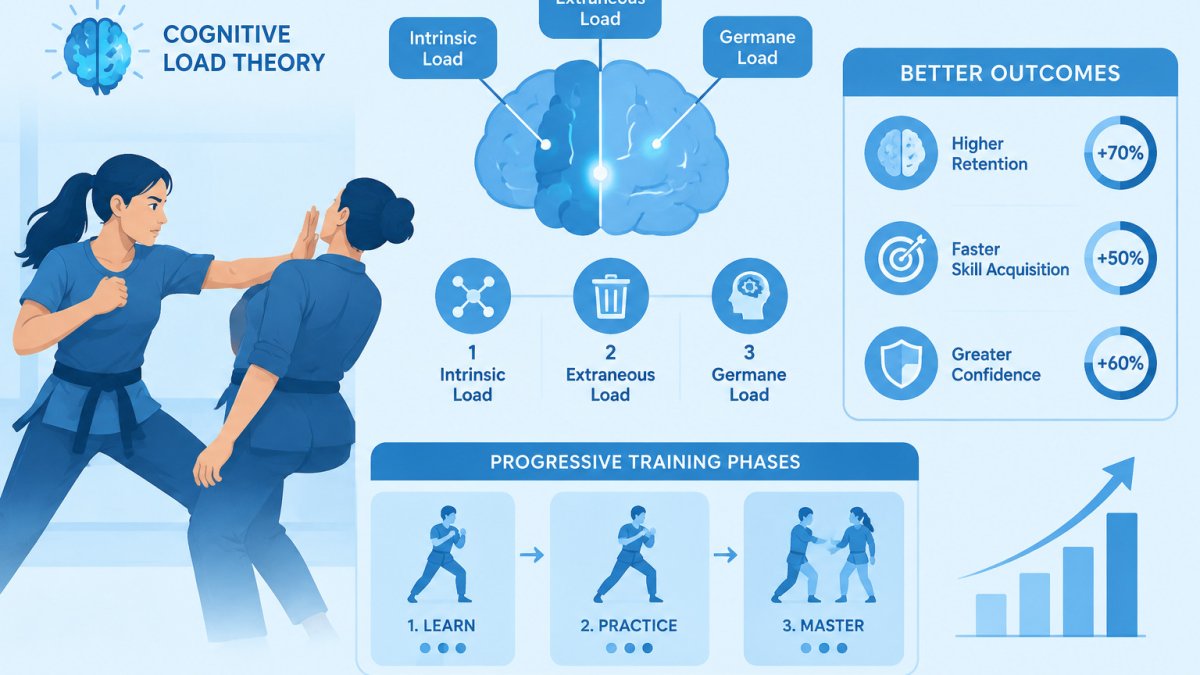
Cognitive load theory is a model of how the brain handles new information. It says that working memory has limited space, and that learning suffers when a lesson asks for more than that space can hold. Cognitive load theory is widely used to explain why reducing unnecessary load tends to support learning. That principle is the reason this guide is built around reducing unnecessary load.
What Cognitive Load Theory Says About How People Learn
Cognitive load theory explains why a lesson can feel overwhelming even when the material is simple. Learners process new information in a small working memory, and that memory fills up fast. Instruction that respects this limit tends to produce better retention. Instruction that ignores it tends to produce confusion.
Working memory and its limits
Working memory holds only a handful of pieces of information at once (ncbi.nlm.nih.gov). When a student is trying to follow a new movement, remember the name of the technique, watch the instructor, and feel their own balance, all of those demands compete for the same small space. Something gets dropped.
This is why trainers who teach a full combination at once often see the same result: the student remembers the first move, forgets the transition, and loses the rest. The fix is not more repetition of the whole sequence. It is breaking the sequence into smaller parts.
Long-term memory and schemas
Long-term memory works differently. It stores organized knowledge called schemas, which let a learner treat many small details as one familiar pattern. An experienced practitioner does not think about every step of a throw. They recognize the pattern and act on it.
Building schemas takes deliberate practice with clear, sequenced material. A good training program helps students form these patterns by presenting skills in an order that makes each new piece easier to attach to what they already know.
Intrinsic Cognitive Load Theory: The Difficulty You Cannot Remove
Some difficulty is part of the skill itself. Learning to move your hips and hands in coordination is hard no matter how well a class is designed. This is intrinsic cognitive load: the effort that comes from the complexity of the material.
You cannot remove intrinsic load without making the skill less real. What you can do is manage it. Hard material, presented with structure, can help learners build capacity rather than just overwhelm them.
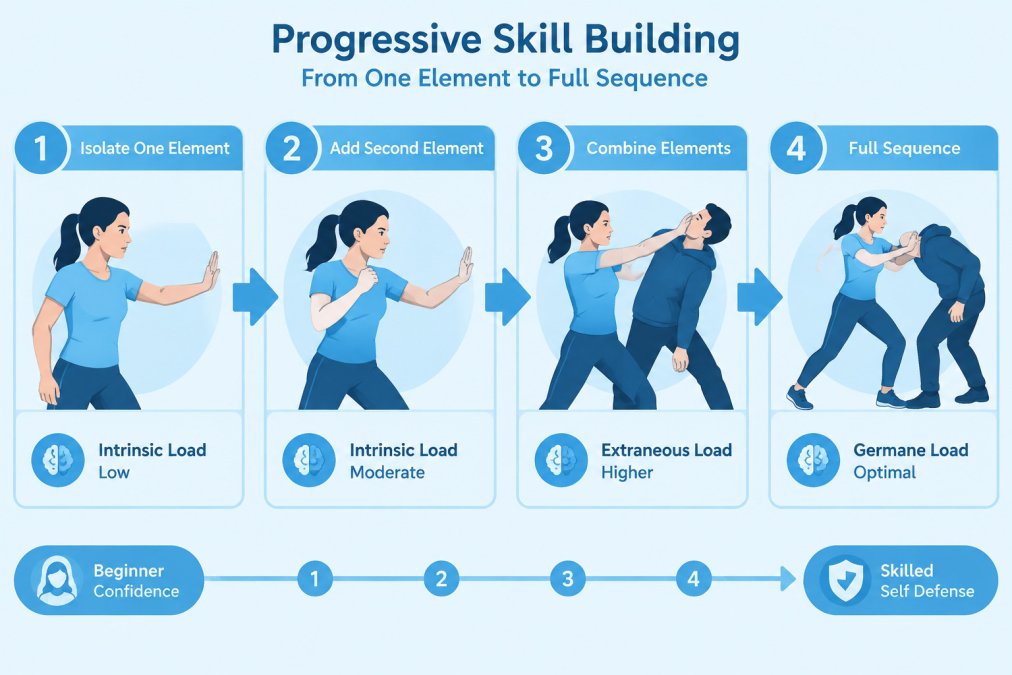
- Isolate one element of the skill before combining it with others
- Add one new layer at a time
- Return to the full sequence only after each part feels stable
The article separates two sources of difficulty and how each should be handled.
| Load type | Source | What to do |
|---|---|---|
| Intrinsic | The skill itself | Manage it with structure, do not remove it |
| Extraneous | How material is presented | Reduce it, since trainers control it |
| Productive challenge | Stretches the learner slightly | Keep it at a level they can continue |
| Overload | Exceeds working memory | Drop a layer, slow the tempo, or step back |
Extraneous Cognitive Load and the Distractions Trainers Create
Extraneous load is the effort that comes from how material is presented, not from the skill itself. It is the part trainers control, and it is often where training goes wrong.
Common sources include:
- Explaining a technique with too many terms at once
- Switching between drills without a clear reason
- Asking students to watch the instructor and track a partner at the same time
- Crowded rooms and constant noise during instruction
Each of these adds load that does nothing for the skill. Practical tips for making complex self-defense skills easier to recall under stress are covered in a separate guide. Reducing them frees working memory for the movement itself. This is one of the most practical applications of the theory: cut what does not serve the lesson.
Applying Cognitive Load Theory in Instructional Design for Workplace Training
Cognitive load theory is often discussed in classrooms, but it applies just as well to training for adults at work. Instructional design guidance recommends organizing information into smaller pieces and avoiding demands that exceed working memory capacity. The gap most guides leave open is the actual workflow: how a training team moves from a job task to a load-aware course and then checks whether it worked. Here is a practical, end-to-end method. A Classroom Writer can make the workflow more concrete by using labelled diagrams to check whether learners can identify the parts and relationships that matter in a job task.
Step 1: Analyze the task, not the topic. Start with a real job task and break it into its component procedures. For onboarding, that might be "complete a new-hire equipment check"; for safety, "lock out a piece of machinery"; for software, "reconcile a customer account." List every step a competent performer takes, then mark which steps are intrinsic to the skill and which are presentation artifacts (menus, forms, terminology) that could be simplified.
Step 2: Separate intrinsic from extraneous demand. For each step, ask whether the difficulty comes from the skill itself or from how it is taught. A software trainee who must remember three menu paths while also learning a reconciliation rule is carrying extraneous load. A safety trainee who must recall a lockout sequence under time pressure is carrying intrinsic load that should be preserved and practiced.
Step 3: Sequence from part to whole. Teach one component per session with a single clear goal, then combine components only after each is performed reliably. A common pattern in procedural training is to teach the first and last steps together, because learners remember beginnings and endings better than middles.
Step 4: Use worked examples, then fade guidance. Show a complete worked example before asking for independent practice. As expertise grows, remove the example and let the learner attempt the task with less support. This guidance-fading approach is one of the most consistent findings in the instructional-design literature and prevents the over-scaffolding that keeps experienced learners dependent.
Step 5: Remove split attention and redundancy. When a diagram, a narration, and a text block all describe the same procedure, learners waste working memory integrating them. Put labels directly on the diagram, keep narration and visuals aligned, and cut text that repeats what the visual already shows.
Step 6: Evaluate against performance, not satisfaction. After the course, compare trained and untrained groups on task accuracy, completion time, and delayed retention. A course that learners rate highly but that does not change on-the-job performance has not reduced load in a way that matters.
Watch out: over-chunking is a real failure mode. Breaking a task into too many tiny pieces can obscure the overall procedure and leave learners unable to assemble the parts. Chunk to the level of a meaningful sub-goal, not to the level of every keystroke.
Telling Productive Challenge From Overload
Not all difficulty is bad. A productive challenge stretches a learner slightly beyond their current level and leaves them able to continue. Overload leaves them unable to follow, plan, or recall anything.
Watch for these signs of overload:
- The student freezes or loses track of the sequence
- Mistakes increase as the drill goes on
- The student asks the same question repeatedly
- Frustration or avoidance begins to show
When these appear, reduce the load. Drop a layer, slow the tempo, or go back to the last stable step. Learners can also be taught to manage cognitive load themselves, which makes self-regulation a skill worth building.
Measuring Whether Your Training Reduced Load and Improved Performance
Measuring training results is where many programs fall short. A useful evaluation asks two questions: did the learner perform the skill better, and did they expend less mental effort while doing it? The strongest way to answer both is to measure performance and perceived effort together, because a course can reduce effort by making the task too easy, which does not improve outcomes.
Track these concrete measures over time:
- Task accuracy. Count correct steps or correct completions per attempt. A load-aware course should raise accuracy on the target task without raising accuracy on unrelated tasks.
- Completion time. Time how long a learner takes to finish a procedure. Reduced extraneous load usually shortens completion time for the same accuracy level.
- Delayed retention. Re-test the skill after a gap of one week or more. Immediate post-test gains often fade; delayed retention is a better signal that schemas formed.
- Transfer. Give a novel but related task and see whether the learner applies the procedure. Transfer is the outcome most training programs claim and least often measure.
- Learner-reported mental effort. Use a simple one-item rating of perceived effort after each session. A common pattern is for effort ratings to fall as accuracy rises; if effort falls while accuracy stays flat, the task may have become too easy.
A practical comparison design is a pre-test, post-test, and delayed post-test with a small comparison group that receives the existing training. Even a modest sample can reveal whether the load-aware version produces better retention or transfer.
The research on this question is still developing. Treat any single measure with caution and look for patterns across several.
Watch out: learner satisfaction scores are the most common and least useful measure here. A course can feel easy and enjoyable while producing no durable skill, so pair satisfaction data with accuracy, retention, and transfer before drawing conclusions.
Book a Trial Class to See a Load-Reduced Method in Practice
Reading about cognitive load is useful, but feeling it work in a live session is more convincing. Kajukenbo and Filipino Martial Arts Club builds its teaching around progressive, dated phases rather than open-ended drilling, so each session has a clear focus and a clear next step. Instruction is led by Carlos Jiménez, who holds a Master's degree in Neuroscience with a specialization in Multiple Intelligences, and the curriculum includes Kajukenbo, Balintawak, and Kalis Ilustrisimo.
If you want to see how a structured, load-aware method feels for yourself, book a trial class. Ask about the phases that fit your schedule and your goals. Hear it from a student who has tried it: Carla Villaorduña shares her experience with the program.
Frequently Asked Questions
How does cognitive load theory apply to teaching?
Cognitive load theory holds that working memory can hold only a few new elements at once. Teachers apply it by sequencing material so each step introduces one new idea, using worked examples before independent practice, and removing content that does not support the learning goal. In a training setting, this means fewer slides, shorter practice blocks and clear phase boundaries, so learners spend their limited mental capacity on the skill itself rather than on decoding the lesson.
Is cognitive load theory still relevant today?
Yes. The theory continues to be tested and refined, and current work often pairs load reduction with teaching learners to manage their own load.
What happens when cognitive load is too high?
When the load exceeds working-memory capacity, learners lose track of steps, miss how parts connect and recall less later. In practice, a trainee overwhelmed in a session may freeze under pressure, which is why training teams watch for signs of overload and shorten or resequence the material when they appear.
How can trainers reduce unnecessary cognitive load?
Trainers can reduce extraneous load by removing decorative graphics, splitting attention-heavy visuals, cutting redundant narration and delivering one instruction at a time. Chunking complex tasks into smaller parts, using worked examples and building in guided practice before full-speed drills all lower the burden. Instructional design guidance recommends organizing information into manageable pieces and avoiding demands that exceed processing capacity.