 blog
Aim Smart Martial Arts vs TSR Kali: 2026 Comparison
Last Updated: October 23, 2026
Quick Summary
Aim Smart Martial Arts vs TSR Kali comes down to confirmed training philosophy: Aim Smart Martial Arts presents itself as a Filipino martial arts school with a self-defense emphasis, while TSR Kali describes three stated layers of physical training, contextual drills, and situational awareness. Neither school publishes curriculum maps, beginner tracks, or instructor credentials, so a trial class is the only real comparison.
- TSR Kali's three-layer model is the most specific public description either school offers.
- Neither school states weapons progression, class length, or trial class terms publicly.
- Bring the same five questions to both trial classes so answers are directly comparable.
- A well-run beginner month teaches stance, footwork, and basic angles before adding a weapon.
- Do not sign an annual contract before taking a trial class at either school.
Table of Contents
- Aim Smart Martial Arts vs TSR Kali: What Each School Actually Offers
- Side-by-Side Comparison: Curriculum, Instruction, and Beginner Fit
- Kali vs. Arnis vs. Eskrima: Why the Names Matter When Comparing Schools
- Kali Training for Beginners: What a First Month Should Look Like
- Stick-Fighting Training Methods: How to Judge What You'll Actually Drill
- How to Choose a Martial Arts School: A Decision Framework for Busy Professionals
- Conclusion
- Frequently Asked Questions
Aim Smart Martial Arts vs TSR Kali: What Each School Actually Offers
Comparing Aim Smart Martial Arts vs TSR Kali starts with an honest admission: public information on both programs is thin, and the two schools publish very different levels of detail about what happens in class. Aim Smart Martial Arts is a Filipino martial arts school, and its name places it in the same commercial landscape as other Kali and Arnis programs. TSR Kali describes its training as physical training, contextual drills, and situational awareness, according to TSR Kali's program overview.
Aim Smart Martial Arts at a Glance
Aim Smart Martial Arts presents itself as a martial arts school teaching Filipino systems. Its public materials emphasize the practical self-defense side of the art rather than competition. What the school does not publish clearly is the granular stuff a beginner needs: how a first month is structured, how weapons work is introduced, and what a trial class involves. That is not a knock.
TSR Kali at a Glance
TSR Kali describes a training model built on three layers: physical training, contextual drills, and situational awareness. That framing suggests a program that wants students to understand why a technique works in a given scenario, not just how to repeat it. The school's public description does not specify class length, beginner tracks, or how stick work is sequenced. If you are evaluating TSR Kali, ask directly how much of a typical class is conditioning, how much is technique, and how much is scenario work.
Side-by-Side Comparison: Curriculum, Instruction, and Beginner Fit
Most comparison articles for this query either skip the direct side-by-side entirely or fill a table with promotional language lifted from each school's homepage. Neither approach helps a prospective student. The honest comparison separates three things: what each school confirms in public materials, what is unverified, and what you can only learn by asking. That structure is the unique angle here, no ranking result we reviewed does it.
What Each School Confirms
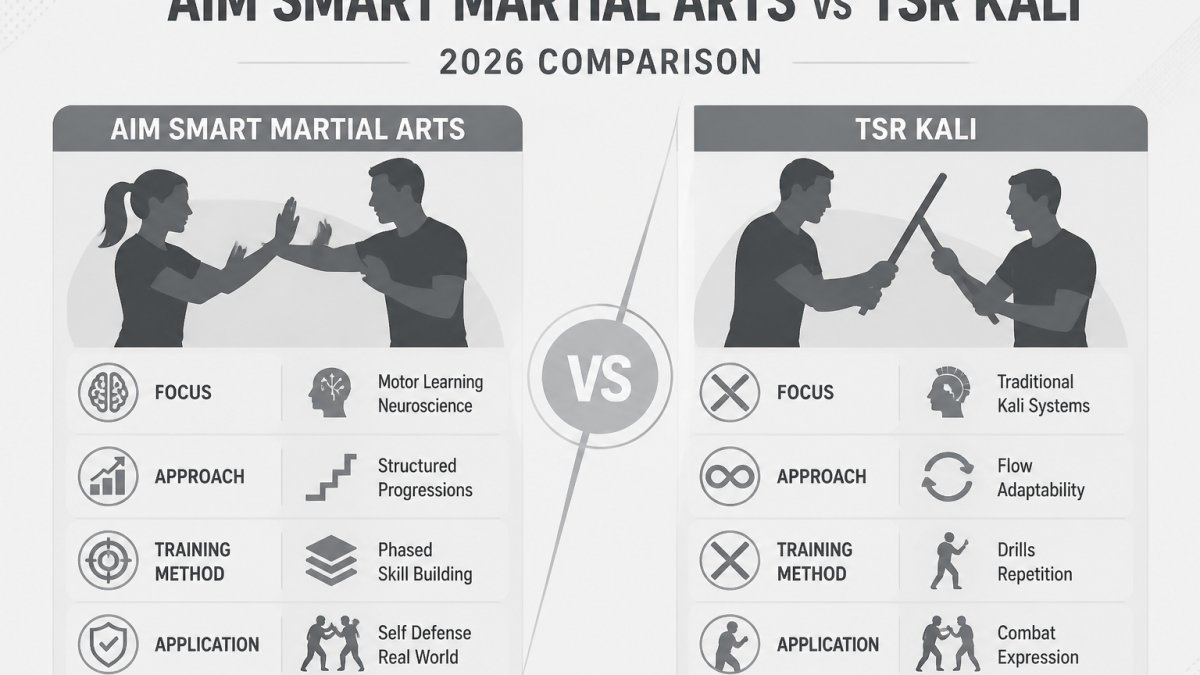
Aim Smart Martial Arts publicly presents itself as a Filipino martial arts school with a self-defense emphasis rather than a competition focus. That is the confirmed baseline.
TSR Kali describes its training model in three stated layers: physical training, contextual drills, and situational awareness, per TSR Kali's program overview. That three-layer framing is the most specific public description either school offers. Class length, beginner sequencing, weapons progression, and instructor credentials are not stated publicly.
The Comparison Table, With Honest Labels
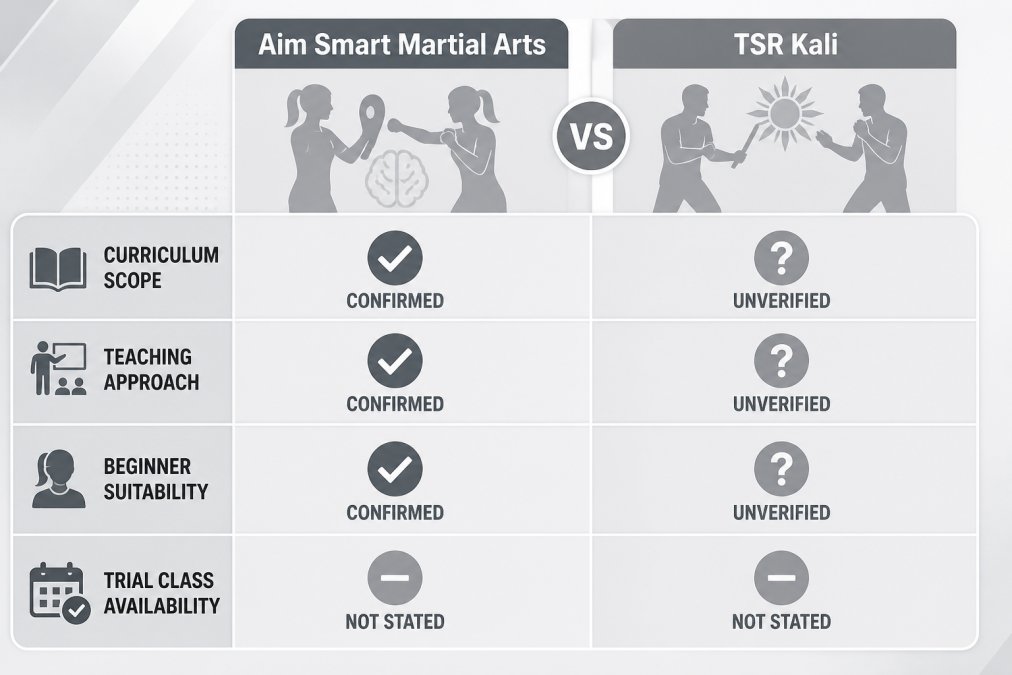
| Category | Aim Smart Martial Arts | TSR Kali |
|---|---|---|
| Core system | Filipino martial arts (confirmed) | Kali (confirmed) |
| Stated training layers | Self-defense focus (confirmed) | Physical training, contextual drills, situational awareness (confirmed) |
| Weapons progression | Not stated publicly | Not stated publicly |
| Beginner track | Not stated publicly | Not stated publicly |
| Instructor credentials | Not stated publicly | Not stated publicly |
| Trial class terms | Not stated publicly | Not stated publicly |
| Class length and frequency | Not stated publicly | Not stated publicly |
| Sparring or contact level | Not stated publicly | Not stated publicly |
What the Table Actually Tells You
The table is short on confirmed rows, and that is the finding, not a flaw in the article. Two schools can both teach Filipino martial arts and still differ enormously in how a Tuesday night class runs. The confirmed differences are philosophical: TSR Kali names situational awareness as a pillar, which suggests scenario-based drilling is built into the model. Aim Smart Martial Arts leans on self-defense framing, which points the same direction but says less about method.
How to Close the Gaps Yourself
Because so much is unstated, the trial class becomes the real comparison. Bring the same five questions to both schools so the answers are directly comparable:
- What does a beginner learn in the first four weeks, specifically?
- How much of a typical class is conditioning, technique, and scenario work?
- When is a weapon introduced, and what protective gear is used?
Any article that hands you a tidy verdict on these two schools without naming its sources is guessing. What you can compare today is training philosophy and the quality of answers you get when you ask. Both schools point toward applied skills, and both require a visit to verify.
Kali vs. Arnis vs. Eskrima: Why the Names Matter When Comparing Schools
Kali, Arnis, and Eskrima are three names for related Filipino fighting systems, and schools use them with different emphasis. The terminology matters for this comparison because the name on the door is one of the few confirmed signals you get before a trial class, and it is the only confirmed signal that distinguishes Aim Smart Martial Arts from TSR Kali in their public materials.
What Each Term Signals
- Arnis is the term written into Philippine law as the national martial art, which is why many programs use it as an umbrella label. A school branded around Arnis often teaches a broader mix of sport, self-defense, and forms.
- Kali carries a connotation of blade-oriented training in many lineages. A program branded around Kali usually leads with weapon-based movement and empty-hand translations from weapon ranges.
- Eskrima tends to signal stick and weapon work, with a strong emphasis on partner drills and flow.
In practice, the three overlap heavily. Many instructors teach all three under one roof and use the terms interchangeably. The label tells you what a school prioritizes in its marketing, not what it teaches on every night of the week.
Applying the Distinction to These Two Schools
TSR Kali's name places it in the Kali tradition, and its stated three-layer model, physical training, contextual drills, situational awareness, is consistent with a weapon-first, scenario-oriented approach.
That is why the terminology is a starting question, not an answer. Ask each school which term it uses and why. The answer reveals the curriculum faster than any brochure, and it is one of the few questions that produces a directly comparable answer across both programs.
Why the Names Matter for Beginners
A beginner choosing between a Kali-branded program and a broader Filipino martial arts program is really choosing between two entry paths. A Kali-first program may introduce a weapon earlier, which some students find motivating and others find intimidating. A broader program may spend longer on empty-hand fundamentals before adding a stick.
Academic work in this space is thin on direct school comparisons. Researchers publishing in Perception and Motor Skills have studied how practitioners across fighting styles define success in martial arts, which is a useful reminder that "good school" depends on what you want to get good at.
Kali Training for Beginners: What a First Month Should Look Like
A well-run beginner month in Kali training should teach a small number of core movements and repeat them until they are automatic. Not a tour of a hundred techniques. A good program spends early weeks on stance, footwork, and the basic angles of attack, then adds a weapon only after the body understands the pattern.
Here is a realistic first-month arc to expect from any competent Filipino martial arts program:
- Weeks 1-2: Stance, footwork, and empty-hand coordination drills
- Weeks 3-4: Single-stick basics introduced slowly, with partner drills at controlled speed
- Throughout: Short, repeated drills rather than long open-ended practice
A common mistake beginners make is judging a school by how advanced the demo looks. The better question is whether the instructor breaks movements into pieces you can actually absorb.
Stick-Fighting Training Methods: How to Judge What You'll Actually Drill
Stick-fighting training methods fall into a few recognizable patterns, and the mix a school uses tells you how fast you will progress. Some programs lean on solo pattern work, where students repeat angles and strikes alone. Others prioritize partner drills with padded sticks. A third group builds scenario work, where a drill starts from a realistic position rather than a fixed stance.
TSR Kali's stated emphasis on contextual drills and situational awareness suggests the third pattern plays a role there. Aim Smart Martial Arts' self-defense framing points the same direction. What you want to confirm on a visit:
- How much class time is partner work versus solo repetition
- Whether padded sticks and protective gear are standard for beginners
- How instructors correct errors, and how often
How to Choose a Martial Arts School: A Decision Framework for Busy Professionals
Choosing a martial arts school comes down to matching the program's structure to your schedule and your goal.
Step 1: Define the outcome. Self-defense competence, fitness, stress management, or weapons skill. Rank them.
Step 2: Score each school from 1 to 5 on four criteria.
| Criterion | What a 5 Looks Like |
|---|---|
| Curriculum structure | Dated, progressive phases with clear milestones |
| Schedule fit | Classes you can actually reach twice a week |
| Instruction quality | Credentials stated, corrections frequent, questions welcomed |
| Beginner support | A defined entry track, not sink-or-swim |
Step 3: Multiply by weight. Weight schedule fit and curriculum structure highest if you travel or work late.
Questions to Ask on a Trial Class
Bring these to the front desk. The answers separate a structured program from an open mat with a name.
- What does a beginner learn in the first four weeks, specifically?
- How is progress measured, and who tracks it?
- What percentage of class time is partner drilling?
Conclusion
The honest answer to Aim Smart Martial Arts vs TSR Kali is that both schools describe practical, scenario-minded Filipino martial arts training, and neither publishes enough detail to rank one above the other from a desk. What separates them is what you find on the mat: how the instructor breaks down movement, how drills progress, and whether the schedule survives your calendar.
Frequently Asked Questions
How should I compare Aim Smart Martial Arts and TSR Kali?
Start with the curriculum and teaching method, not the logo. Aim Smart Martial Arts presents itself as a Filipino martial arts school with a self-defense emphasis, while TSR Kali describes physical training, contextual drills, and situational awareness. Ask each school for a sample class structure, instructor background, and how beginners are integrated. Then attend a trial class at both and judge which one gives you clearer feedback and measurable progress. Confirm schedule, enrollment terms, and pricing directly with each school, since published details are limited.
Is Kali a legitimate martial art for self-defense?
Kali is one of the Filipino martial arts alongside Arnis and Eskrima, and it is taught as a practical self-defense system in many schools. It covers weapons training with sticks and blades as well as empty-hand techniques, footwork, and coordination. Legitimacy depends less on the name and more on the instructor, the curriculum structure, and whether drills include pressure testing. Look for a school that explains its progression, offers beginner-friendly entry points, and can show how techniques are applied in real-world situations rather than only in choreographed patterns.
What should beginners look for in a Filipino martial arts school?
Look for a structured beginner path, a clear explanation of stick-fighting training methods, and instructors who can describe how they teach footwork and coordination before adding speed. Ask whether empty-hand techniques are taught alongside weapons, how sparring or drills are introduced, and what safety equipment is used. Class size and schedule matter for busy professionals. Request a trial class and watch how the instructor corrects students. A school that explains its method plainly and lets you observe a full session is usually a safer bet than one that only promises results.
Do Filipino martial arts classes teach stick fighting and blade concepts?
Most Filipino martial arts systems, including Kali, Arnis, and Eskrima, introduce stick fighting early because the stick teaches range, timing, and angle recognition that transfer to other tools. Blade concepts are often taught as part of the same curriculum, with training handled through drills and controlled practice rather than live contact. Ask each school how it sequences weapons work for beginners and what protective gear is required. If blade concepts are important to you, confirm they are part of the regular curriculum and not an advanced-only add-on.