 How-to
How to Improve Martial Arts Retention: 7 Proven Steps
Table of Contents
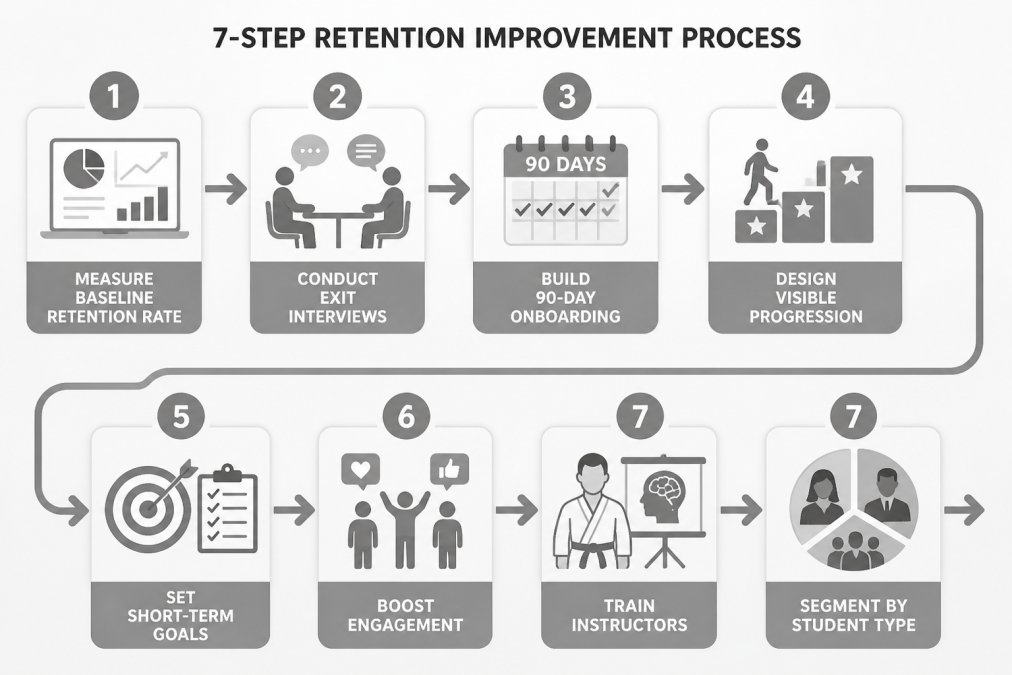
- Step 1: Measure Your Martial Arts Retention Rate Before You Change Anything
- Step 2: Build a First 90 Days Onboarding System
- Step 3: Design Martial Arts Beginner Progression That Shows Visible Progress
- Step 4: Use Martial Arts Goal Setting to Drive Short-Term Wins
- Step 5: Improve Martial Arts Student Engagement With Class Variety and Recognition
- Step 6: Train Instructors for Consistency and Connection
- Step 7: Segment Retention Strategies by Student Motivation and Life Stage
- Conclusion: Build the Retention Playbook That Fits Your School
- Frequently Asked Questions
Last Updated: October 14, 2026
Step 1: Measure Your Martial Arts Retention Rate Before You Change Anything
Most schools fix retention by guesswork. Before changing anything, get a baseline number.
Martial arts retention is the share of students who keep training over a set period. Without it, you can't tell if a change worked.
Here's how to get your baseline:
- Pull your attendance records for the last 6 to 12 months
- Count how many students were active at the start of the period
- Count how many are still active now
That's your retention rate. Track it monthly from here on.
Cohort Tracking: The Metric Most Schools Ignore
A single school-wide rate hides the real story. A cohort is a group of students who started in the same month. Track each group separately to see which start months produce students who stay and which leak, a pattern more useful than any average.
Exit Interviews: Finding Out Why Martial Arts Students Quit
Ask every departing student one question: "What would have made you stay?" A short exit interview by phone or email surfaces the real reasons, schedule conflicts, feeling lost, not clicking with classmates. Log every answer; after 20 or so, patterns become your priority list.
Step 2: Build a First 90 Days Onboarding System
New students quit fastest in their first three months, so a structured welcome process is the highest-impact fix for martial arts retention. The goal: make new students feel known, capable, and connected before doubt sets in.
The Welcome Process: Days 1 Through 30
Your first 30 days should remove every source of confusion:
- Assign one instructor as the main point of contact
- Set a clear first-month goal, like learning three core techniques
- Check in by message after class one, three, and seven
A student who knows one name in the room is far more likely to return.
Days 31 Through 90: Building Classmate Connections
Connection keeps students better than curriculum does. From day 31, pair new students with a training partner, invite them to a group event, and give them a small job like holding pads for a newer student. By day 90, they should have a routine, a partner, and a reason to show up beyond the workout.
Step 3: Design Martial Arts Beginner Progression That Shows Visible Progress
Beginners stay when they can see themselves getting better, so martial arts beginner progression should make growth obvious. Break each skill into clear stages with dated checkpoints, so students know exactly what they just achieved.
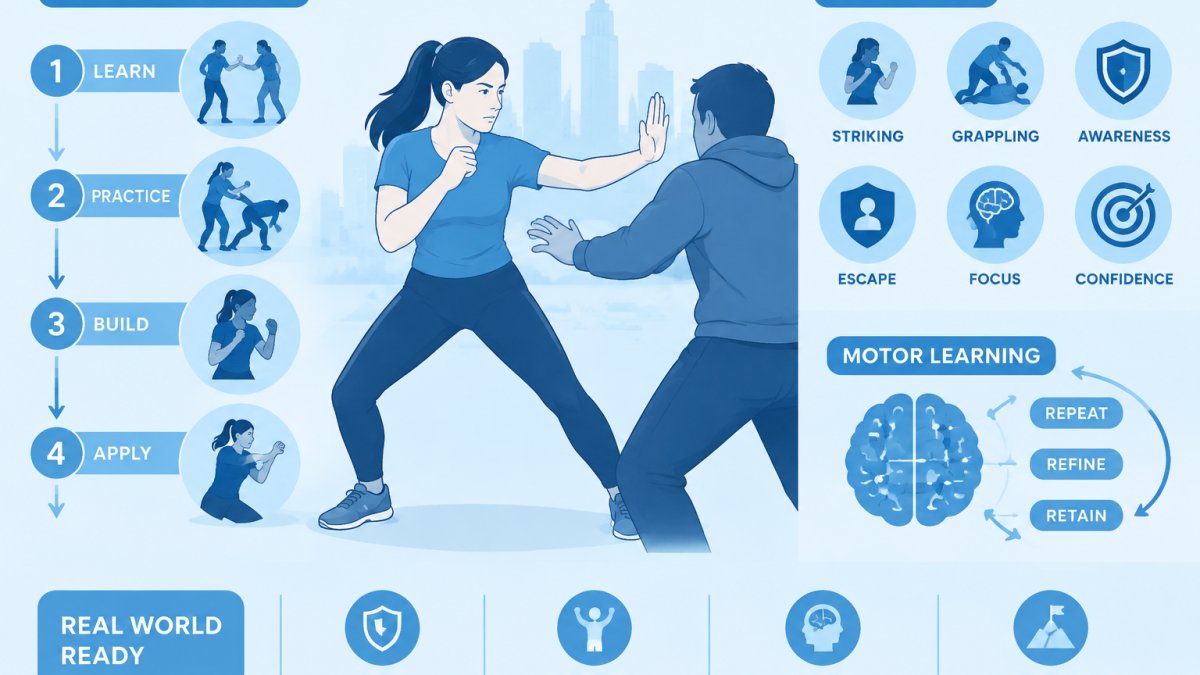
The brain learns motor skills in phases (pubmed.ncbi.nlm.nih.gov). At our school, we structure every technique into dated, progressive phases rather than open-ended drilling, so students see the path, not just the practice, the difference between schools that retain students and schools that churn them.
Step 4: Use Martial Arts Goal Setting to Drive Short-Term Wins
Long-term goals inspire. Short-term goals retain. Martial arts goal setting should give students a win every few weeks.
Set goals that are specific and close:
- "Land three clean combinations this month"
- "Attend eight classes in four weeks"
- "Pass your next rank check"
Review goals in a monthly one-on-one and celebrate each completed goal out loud. Recognition costs nothing and pays back in loyalty.
Step 5: Improve Martial Arts Student Engagement With Class Variety and Recognition
Routine builds skill; too much kills interest. Rotate your class structure every few weeks with a new drill, partner exercise, or themed session to keep training fresh without breaking the curriculum. Recognition matters just as much: post belt testing results, name a student of the week, celebrate rank progression in front of the group. Students who feel seen stay longer.
Step 6: Train Instructors for Consistency and Connection
Your instructors are your retention system, and instructor consistency decides whether a student's experience holds steady from class to class. Most schools never train for it, they hire a skilled martial artist and assume teaching skills come with the belt. They don't, so the student experience depends on which instructor is on the mat that night.
Build a Shared Lesson Plan Library
Standardize how techniques are taught. Shared lesson plans ensure every instructor teaches the same progression the same way, so a student who misses Tuesday isn't lost on Thursday.
A practical format that works:
- One page per class block, listing the technique, the key coaching cue, and the common mistake to correct
- A dated progression so instructors know what students saw last week and what comes next
- A short debrief line at the bottom for what worked and what didn't
Store these in a shared drive or binder. Review them in a 15-minute instructor huddle before the week starts.
Train the Four Instructor Behaviors That Drive Retention
Skill in the art isn't skill on the mat. Train your team on four behaviors:
- Names. Every instructor should know every student's name and use it at least twice per class. A student who hears their name feels seen.
- Specific feedback. Replace "good job" with "your hip rotation on that kick was cleaner than last week." Specific feedback signals that the instructor is actually watching.
- Tone calibration. Match energy to the student. A nervous beginner needs calm reassurance; a competition-focused student needs sharper push. One tone for everyone reads as indifference.
- Follow-up. If a student misses two classes in a row, the instructor who normally teaches them should reach out personally, not a mass email, not a front-desk text. A short, specific message ("Missed you Tuesday, we worked on the guard pass you were close on. See you Thursday?") outperforms any automated nudge.
Onboard New Instructors With a Shadowing Rotation
Don't throw a new instructor onto the mat alone in week one. A simple rotation:
- Week 1: observe three classes taught by your strongest instructor, noting names, feedback, and pacing
- Week 2: co-teach, with the veteran leading and the new instructor handling warm-ups and one drill block
- Week 3: lead a full class with the veteran observing and giving feedback
This costs a few weeks of overlap but saves the students who would have quit over a fumbled first month.
Measure Instructor Consistency
You can't manage what you don't track. Once a quarter, pull attendance data by instructor and look for two patterns: do students in one instructor's classes retain noticeably better or worse than the school average, and do new students who start with a particular instructor drop off faster in their first 90 days? Class times and student mix matter, but a consistent outlier is worth investigating.
Step 7: Segment Retention Strategies by Student Motivation and Life Stage
Not every student trains for the same reason, and treating them the same is why many quit. Most schools segment by age and stop there, missing the bigger driver: motivation. A 40-year-old training for self-defense and one training for competition have almost nothing in common when it comes to what keeps them showing up.
Segment by Motivation First
Tag every student with a primary motivation using a one-question intake form and a check-in at day 30 and day 90.
Self-defense focused students want practical, pressure-tested skills. They stay when they can see themselves handling a real scenario. What retains them:
- Scenario-based drills that simulate realistic situations
- Periodic "what would you do if" discussions after class
- Progress markers tied to practical competence, not just rank
Fitness-focused students want a challenging workout with measurable improvement. They stay when they can track effort and results. What retains them:
- Simple performance benchmarks (push-ups, plank time, rounds completed) logged monthly
- Class formats that keep heart rate up and downtime low
- Acknowledgment of physical milestones alongside belt milestones
Skill-focused students want rank progression and mastery. They stay when the path forward is visible. What retains them:
- A published curriculum map showing what's required for each rank
- Regular technical feedback, even when it's critical
- Access to advanced or specialty training
Social students want community and belonging. They stay when they feel like part of the group. What retains them:
- Pairing with a consistent training partner
- Invitations to social events, tournaments, and seminars
- Small roles in the school (helping newer students, running warm-ups)
Then Layer in Life Stage
Motivation tells you what a student wants.
Children (roughly ages 5-12): The parent is often the real customer.
Teens (roughly ages 13-17): Identity and peer connection drive retention.
Adults with demanding careers: Schedule flexibility is the retention lever.
Parents of young children: Time is the constraint.
Older adults and returning students: Injury fear and pace are the main barriers.
Match Communication to the Segment
Segmentation only pays off if it changes what you do. A simple matrix:
| Segment | Primary retention lever | Communication cadence |
|---|---|---|
| Self-defense | Scenario relevance | Monthly practical-skills check-in |
| Fitness | Measurable progress | Monthly benchmark update |
| Skill | Visible rank path | Rank-progress review every 4-6 weeks |
| Social | Belonging and roles | Event invites and personal check-ins |
| Parents (children) | Child progress updates | Weekly short update |
| Busy professionals | Flexibility and no-guilt re-entry | Re-engagement message after 2 missed classes |
Use Exit Data to Refine Segments
When a student cancels, log their primary motivation and life stage alongside their reason for leaving. After 20-30 exits, patterns emerge: fitness-focused adults may leave because class times don't fit, while social students leave because they never connected to a group. Different problems, different fixes, and invisible in a single school-wide retention number.
Busy professionals who train twice a week and need to see measurable progress fast.
Conclusion: Build the Retention Playbook That Fits Your School
Retention isn't one tactic. It's a system you build, measure, and adjust.
Start with your baseline. Talk to the students who leave. Then fix onboarding, progression, goals, engagement, and instructor consistency in order.
At Kajukenbo and Filipino Martial Arts Club, we've built our whole method around this idea.
If you want to see how a measured, structured approach to martial arts retention works in practice, book a trial class with us and watch your progress add up.
Frequently Asked Questions
How can martial arts schools improve student retention?
Start by measuring your current martial arts retention rate through cohort tracking and exit interviews. Then build a structured 90-day onboarding system that pairs new students with a training partner, sets clear short-term goals, and celebrates rank progression milestones. Schools that track attendance data and follow up with absent students within 48 hours catch dropout risks early. Consistent instructor communication and age-appropriate class structures also keep students engaged long enough to see real progress.
Why do martial arts students quit?
Common reasons include lack of visible progress, feeling disconnected from classmates, schedule conflicts, and unclear goals. Beginners often quit between months two and four when the initial excitement fades but competence has not yet developed. Exit interviews reveal patterns specific to your school. When students cannot articulate what they are working toward or do not feel part of the school community, they disengage. Addressing these factors directly through structured onboarding and regular feedback reduces attrition.
What role does goal setting play in martial arts retention?
Goal setting gives students a reason to return each week. When instructors help students define specific short-term goals, such as mastering a particular technique or earning the next rank, training becomes measurable rather than open-ended. Review goals monthly and adjust as students progress. Students who see their goals being met stay longer because they experience tangible improvement. Pairing belt testing milestones with personal goals creates both structure and motivation.
How can instructors make martial arts classes more engaging?
Vary class structure so students experience new drills, partner work, and scenario-based practice rather than repetitive solo drilling. Recognize individual effort publicly, not just rank advancement. Use attendance tracking to identify students who may be losing interest and reach out personally. Age-specific classes and achievable curriculum progressions keep students challenged without overwhelming them. When instructors learn each student's name, goals, and preferred learning style, engagement improves because students feel seen.