 blog
7 Self-Defense Training Mistakes That Stall Skill Progress
Quick Summary
Self-defense skills stall when training lacks measurement, because motor skills need practice, feedback, and repetition to hold up under pressure. Tracking accuracy, response time, distance management, decision-making, and escape success on a fixed schedule shows whether a technique actually works. Retesting after each training break confirms that skills are being kept rather than lost.
- Set a clear target or checkpoint for every practice session.
- Score technique accuracy out of 10 reps against a fixed rubric.
- Record response time from cue to movement and average five trials.
- Retest benchmarks after each 7-day break to check retention.
- Use a mix of solo drills, pad work, light sparring, and scenarios.
Table of Contents
- Why Self-Defense Skills Stall Without Measurement
- What Motor Skill Acquisition Means for Self-Defense Training
- How to Measure Progress in Martial Arts
- Deliberate Practice for Martial Arts: Repetition With Purpose
- Self-Defense Training Drills for Beginners and Their Trade-Offs
- How Often Should You Practice Martial Arts to Build Skill?
- Booking Your First Trial Class at Kajukenbo NYC
- Frequently Asked Questions
7 Self-Defense Training Mistakes That Stall Skill Progress
Last Updated: October 28, 2026
Why Self-Defense Skills Stall Without Measurement
Many people start a self-defense class with real enthusiasm, then stop improving their self-defense skills after a few months. The problem is rarely effort.
Self-defense skills are motor skills. Motor skills involve practice, feedback, and repetition. A student can feel busy in class for years and still not know whether a technique works under pressure.
Here are the mistakes that most often stall progress:
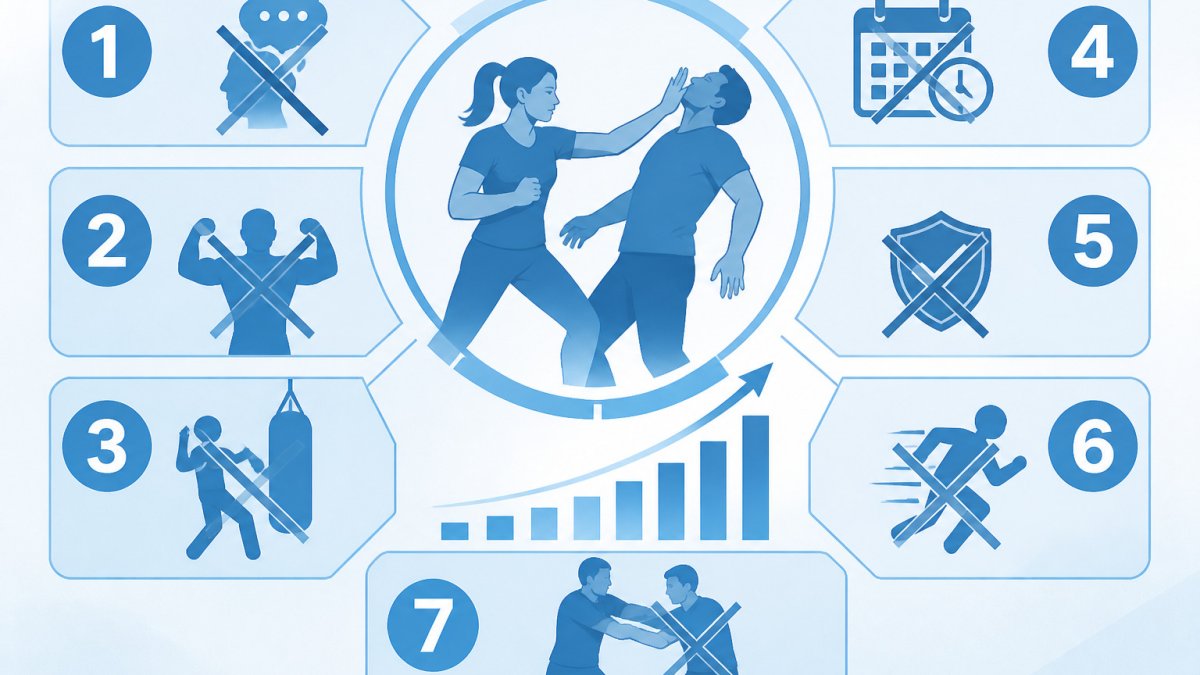
- Practicing without any clear target or checkpoint
- Repeating the same drill at the same level of difficulty
- Relying on how confident a student feels instead of how they perform
- Skipping review after a gap in training
- Mixing too many new techniques into one session
- Never testing skills against an unpredictable partner
- Assuming one class a month is enough to hold skills
The rest of this article covers these issues, starting with what motor skill acquisition means for your training.
What Motor Skill Acquisition Means for Self-Defense Training
Motor skill acquisition is the process of learning a movement. A new student's punch is slow and uses too much thought.
Retention and Transfer Under Stress
Retention means keeping a skill over time. Transfer means using it in a new situation, such as a different partner, a different room, or a moment of fear.
Stress is the hard part. Training in a calm class does not guarantee a technique will hold up in a parking lot at night.
How to Measure Progress in Martial Arts
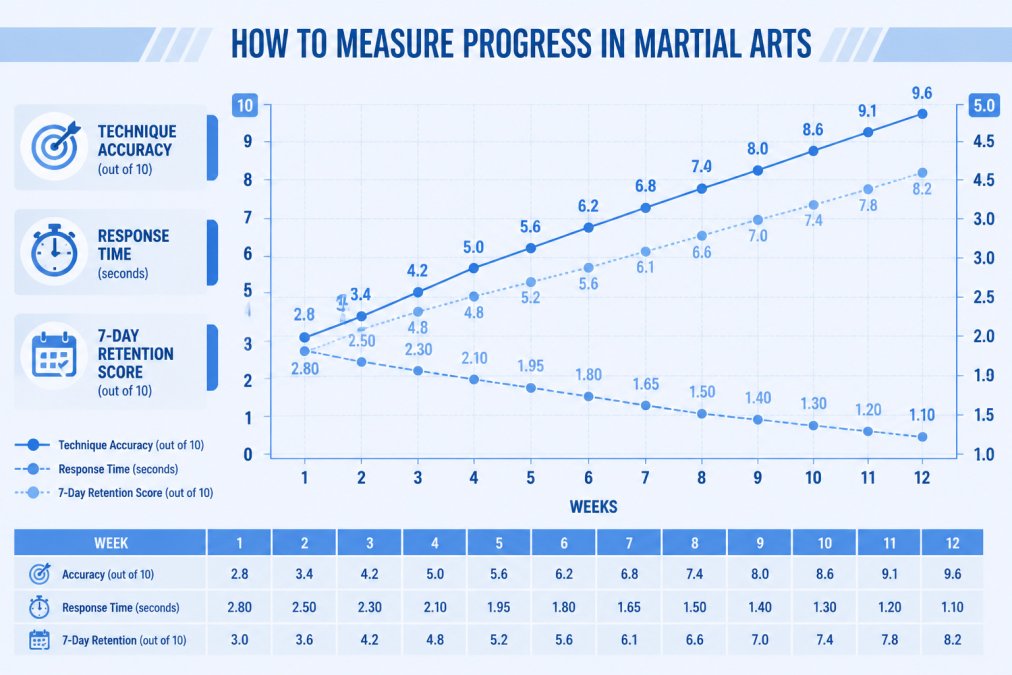
Measurement turns vague effort into clear feedback, but only if the checks are repeatable. Learn how to build focus skills step by step so the scores you track reflect steady gains. A student who feels sharper after a month of classes may still freeze when a partner resists.
- Technique accuracy: Count correct reps out of 10 against a fixed target or pad. Score form against a short rubric (stance, hip rotation, guard recovery) rather than a gut feeling.
- Response time: Use a partner or a timer app to cue a stimulus (a pad flash, a verbal "now") and record seconds from cue to first committed movement. Average five trials.
- Distance management: Mark a start line and a threat line. Record whether the student can create or close distance on cue without overcommitting, scored pass/fail across 10 reps.
- Decision-making under pressure: Run a short scenario (partner throws a slow, telegraphed attack from an unannounced angle) and score whether the student chooses an appropriate response within two seconds.
- Escape and recovery: From a controlled grab or clinch, time how long it takes to reach a neutral or exit position. Cap the drill at 10 seconds and record success rate.
| Checkpoint | What to Record | Frequency | Pass Standard |
|---|---|---|---|
| Technique accuracy | Correct form out of 10 reps | Every 2 weeks | 8/10 with rubric score of 3+ |
| Response time | Seconds from cue to movement (avg of 5) | Every 2 weeks | Under 0.5 seconds |
| Distance management | Pass/fail across 10 reps | Every 2 weeks | 8/10 passes |
| Decision-making | Appropriate response within 2 seconds | Every 2 weeks | 7/10 scenarios |
| Escape and recovery | Success rate within 10 seconds | Every 2 weeks | 7/10 attempts |
| Retention | Same benchmark after a 7-day break | After each break | Within 10% of pre-break score |
Deliberate Practice for Martial Arts: Repetition With Purpose
Deliberate practice means repeating self-defense skills with a specific goal and clear feedback. Read how to improve martial arts retention with seven proven steps to keep those skills from fading between sessions.
- One clear goal per drill, such as keeping the elbow tucked
- Immediate correction from an instructor or a video check
- Slow, correct reps before fast ones
- Short sessions that stay focused
Self-Defense Training Drills for Beginners and Their Trade-Offs
| Drill Type | Learning Value | Time Cost per Session | Safety Risk | Transfer to Real Threat |
|---|---|---|---|---|
| Solo striking drills | High for form and speed; low for timing | 10-20 minutes | Very low | Low |
| Partner pad work | High for targeting and timing | 20-30 minutes | Low | Medium |
| Light sparring | High for response and distance | 20-40 minutes | Medium | Medium-high |
| Scenario training | High for decision-making and stress | 15-30 minutes | Low if controlled | High |
- Two solo sessions of 10-15 minutes for form and footwork
- One partner pad session for targeting and timing
- One light sparring round capped at low intensity
- One short scenario block every other week
How Often Should You Practice Martial Arts to Build Skill?
If your schedule changes, adjust the plan instead of quitting. Keep at least one checkpoint each week so you can see whether skills are holding.
Booking Your First Trial Class at Kajukenbo NYC
Kajukenbo and Filipino Martial Arts Club offers a structured approach to self-defense training in Midtown Manhattan. Its program is built around progressive phases and the neuroscience of motor learning, which fits the measurement approach described above. The curriculum includes Kajukenbo, Balintawak, and Kalis Ilustrisimo. Applying these scientific principles ensures that students can consistently measure fitness progress while refining the technical precision required for effective self-defense.
You can see how the phases are organized on the site, and book a martial arts trial class to see how the training feels in person.
For a fuller picture of the process, you can also read how to apply deliberate practice to martial arts before your first session, or compare deliberate practice with traditional repetition to decide which approach fits your goals.
Frequently Asked Questions
How can beginners track progress in martial arts?
Beginners can log checkpoints, such as how accurately they perform a core technique, how quickly they respond to a timed prompt, and whether they can recall the sequence after a week away from training.
What is deliberate practice in martial arts?
Deliberate practice means working on a specific element of a technique with clear feedback, then repeating it with corrections. It differs from simply running a routine many times. In martial arts, this might mean isolating the footwork in a defensive strike for a few minutes and checking it against a benchmark.
How often should you practice martial arts to improve?
Most adults see steady skill gains from two to three structured sessions per week, provided they also practice briefly between classes. Research on motor learning suggests that spacing practice across days supports retention better than cramming, so consistency matters more than session length. Busy professionals can often sustain two focused classes plus five-minute home drills. Tracking retention after a rest day helps show whether the current frequency is enough.
What makes a self-defense skill reliable under pressure?
A self-defense skill tends to hold up under stress when it has been practiced in varied conditions, including while tired, distracted or responding to an unpredictable opponent. Repetition in a fixed pattern builds familiarity, but transfer to real pressure requires drills that add timing, unpredictability and decision-making. Evidence on this is still limited, so the most defensible approach is to test skills under gradually increasing pressure and record how consistently they are executed.
Measuring progress is the fastest way to stop stalling. Start a simple log this week, pick one checkpoint, and test yourself again in two weeks.