 how-to
How to Apply Deliberate Practice to Martial Arts
Table of Contents
- Deliberate Practice vs. Ordinary Drilling: What Actually Builds Skill
- Breaking Techniques Into Smaller Components
- Building a Martial Arts Training Plan With Deliberate Practice
- Deliberate Practice Examples for Self-Defense and Blade Work
- Creating a Martial Arts Practice Schedule That Drives Measurable Progress
- Martial Arts Feedback and Correction: The Missing Link
- Moving From Controlled Drills to Realistic Scenarios
- Frequently Asked Questions
Last Updated: October 7, 2026
Deliberate Practice vs. Ordinary Drilling: What Actually Builds Skill
Deliberate practice is focused, goal-directed training designed to improve specific aspects of performance. Understanding how to apply deliberate practice to martial arts, unlike simply repeating movements, builds reliable, usable skills rather than the illusion of progress.
Most martial artists drill for years without measurable improvement. Repetition alone doesn't encode techniques into muscle memory under pressure. The difference between those who plateau and those who improve comes down to one factor: intentional focus during every rep.
Why repetition alone doesn't create reliable techniques
Mindless drilling creates a false sense of competence. You can perform a technique perfectly when your partner isn't resisting and you know what's coming. Real self-defense doesn't work that way.
The problem is neurological. Your brain learns what you practice. Drill a technique in a controlled, predictable environment and your nervous system encodes it as a controlled, predictable response.
This is why so many martial artists "can't remember" their training when things get real: they memorized a sequence in a safe context rather than learning the technique.
The focused attention difference
Deliberate practice requires full cognitive attention on a specific problem.
Add focused attention to repetition and your brain actively processes feedback while your nervous system refines the motor pattern. You build what neuroscientists call technical consistency: executing a technique the same way, under varying conditions, with precision.
Motor learning research shows practitioners who combine high repetition with focused attention develop skills that transfer to new contexts. They adapt to different opponents, distances, and pressure levels because they learned underlying mechanics, not a memorized sequence.
Breaking Techniques Into Smaller Components
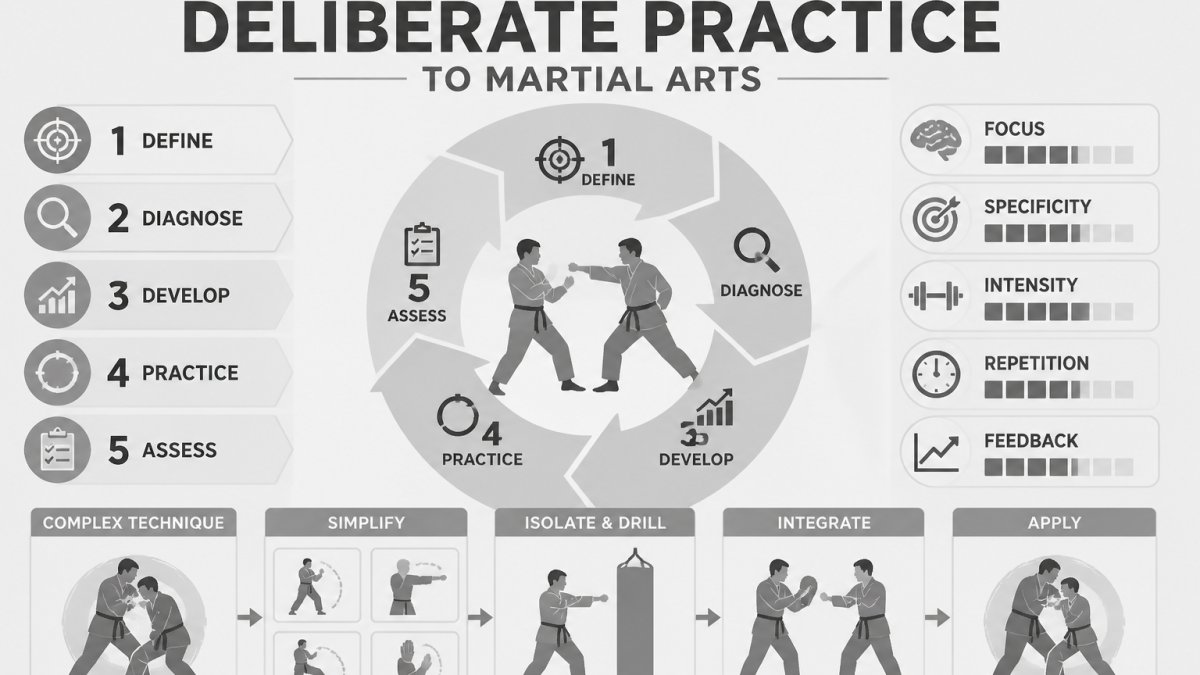
Complex techniques overwhelm beginners who try to coordinate too many moving parts at once. The solution is decomposition: breaking techniques into smaller, learnable units.
Isolating components reduces cognitive load, letting your brain focus on one movement pattern instead of juggling five. It also builds a foundation: each component becomes solid before you recombine them into the full technique.
Isolating movement patterns for precision
Take a stick defense against a downward strike. The full technique involves footwork, hand positioning, timing, and follow-up options. A beginner learning all of this at once will be confused and ineffective.
Instead, break it down:
- Phase 1: Footwork only. Step offline without worrying about your hands. Get comfortable with the movement pattern.
- Phase 2: Add hand positioning. Where do your hands go to create the defensive barrier?
- Phase 3: Add timing. When do you move relative to your opponent's attack?
- Phase 4: Add follow-up. What comes next after the defense?
Practice each phase with full focus and repetition, then recombine them. This builds precision because you're not dividing attention across too many variables.
Progressive complexity: solo drills to live resistance
Once individual components are solid, you layer in complexity. This is where progression becomes critical.
Start with solo work: no partner, no resistance, establishing the basic movement pattern.
Next, add a compliant partner. They move predictably. They give you the exact attack you're expecting.
Then add light resistance: your partner resists slightly, forcing you to adjust positioning and timing against real feedback.
This progression teaches your nervous system not just the movement, but how to execute it when things don't go as planned.
Building a Martial Arts Training Plan With Deliberate Practice
A structured session is the foundation of deliberate practice. Without structure, training becomes random and inefficient.
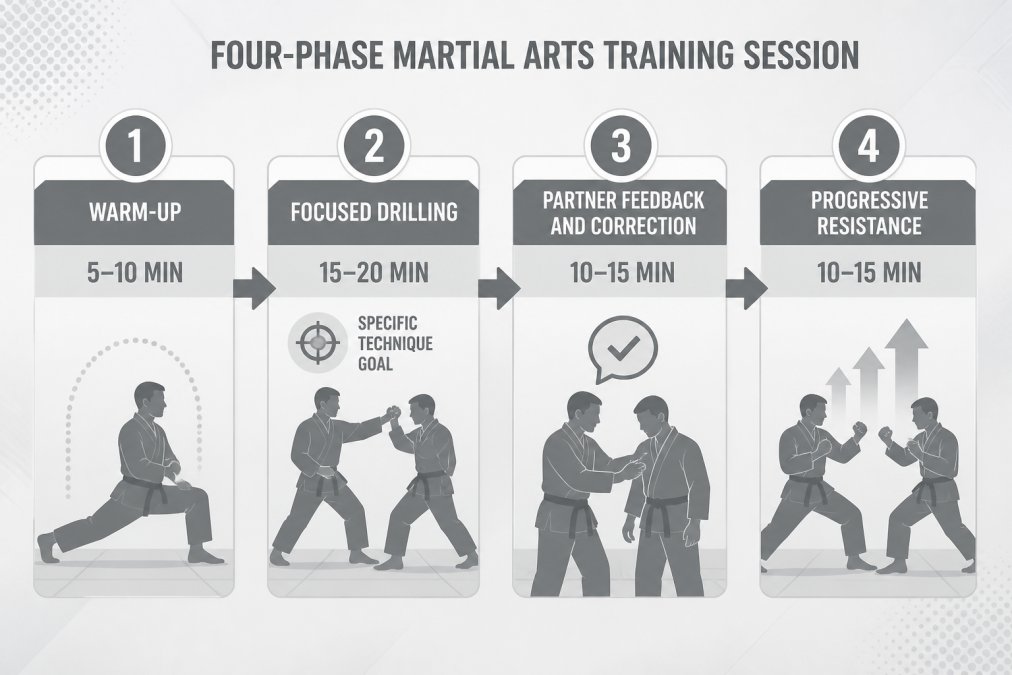
Session structure: warm-up, focused drilling, feedback, progression
An effective training session follows a predictable pattern designed to maximize learning:
Warm-up (5-10 minutes): Prepare your nervous system and joints for focused work. This isn't cardio. It's movement preparation specific to what you're about to practice.
Focused drilling (15-20 minutes): Pick one specific technique or problem and drill it with full attention.
Partner feedback and correction (10-15 minutes): Your partner or instructor observes and provides real-time correction. You adjust based on feedback, turning deliberate practice into a conversation with external input.
Progressive resistance (10-15 minutes): Apply what you just drilled under increasing pressure. Start with compliance, add resistance, move toward realism.
This structure ensures every minute has a purpose. You're not wasting time on random combinations or endless repetition.
Selecting the right difficulty level and training partner
Difficulty selection is underrated. Too easy and you don't challenge your nervous system. Too hard and you fail repeatedly without understanding why.
Choose difficulty based on current capability. For a new technique, start where you can execute it successfully 80% of the time. Too much failure creates frustration; too much success creates complacency.
Your training partner matters equally. They should be slightly better than you, skilled enough to provide realistic resistance without being too advanced to learn from, and they should understand the drill's purpose.
Deliberate Practice Examples for Self-Defense and Blade Work
Abstract concepts become useful in action. Here are specific examples you can implement immediately.
Slow-motion footwork and body mechanics drills
Footwork precision drill: From your ready stance, move offline from an imaginary attack using only footwork at half speed, focusing on weight distribution and balance.
Do 10 reps at half speed, 10 at normal speed, then 10 with a partner slowly advancing to force you to adjust your footwork timing.
The slow-motion phase trains your nervous system to execute the pattern correctly; speed comes once the pattern is solid.
Body mechanics drill: Take a basic punch and focus only on hip rotation.
Then add shoulder engagement, then the full kinetic chain, building precision layer by layer.
Controlled partner drills with progressive resistance
Blade defense progression:
- Partner holds a training blade stationary. You practice your defensive hand position and footwork. 10 reps.
- Partner moves the blade slowly toward you. You defend at half speed. 10 reps.
- Partner moves at normal speed, but you know the attack is coming. You defend with full speed. 10 reps.
- Partner attacks from different angles at normal speed. You adapt your defense. 10 reps.
- Partner attacks with light resistance to your defense. You adjust positioning. 10 reps.
Each phase adds one variable, mastered before moving on. By phase 5, your defense is reliable because you built it systematically.
Creating a Martial Arts Practice Schedule That Drives Measurable Progress
Consistency beats intensity: moderate training sustained over months outperforms sporadic intense sessions.
Frequency, duration, and recovery for skill retention
Train 3-4 times per week for sustainable progress, enough practice to build skills while giving your nervous system time to consolidate learning.
Each session should last 45-60 minutes. Longer sessions often reduce focus quality; four focused 50-minute sessions beat two 90-minute sessions where attention drifts halfway through.
Recovery matters. Your nervous system consolidates motor learning during rest. Train intensely every day without recovery and you plateau, because your brain needs time to encode what you practiced into long-term memory.
Tracking progress and adjusting difficulty over time
Measure what matters. Don't just track how often you trained; track specific improvements:
- Technique execution: Can you perform the technique successfully under increasing resistance?
- Speed: How fast can you execute it while maintaining precision?
- Adaptability: Can you adjust the technique to different partner responses?
- Pressure performance: Do you execute it reliably when your partner is actively resisting?
Review progress monthly. If you're improving on these metrics, your training is working. If you're stalled, adjust: more focused drilling on a specific component, increased resistance, or a different training partner.
This feedback loop is critical. Without measurement, you're just hoping you're improving.
Martial Arts Feedback and Correction: The Missing Link
Most martial artists underestimate how much feedback accelerates learning. Real-time correction during drills dramatically improves skill acquisition.
Real-time correction during drills
Your partner or instructor watches and provides immediate feedback: "Your elbow dropped on that punch." "You're telegraphing your defense." "You moved too early."
This immediate feedback is neurologically powerful: your nervous system adjusts and tries again, encoding the correction into the motor pattern in real time.
Without feedback, you repeat the same mistake hundreds of times. You encode the wrong pattern. Unlearning it later takes significantly longer than learning it correctly the first time.
Our instructors provide real-time correction because feedback is the accelerator for skill development. A technique drilled without correction is practiced incorrectly.
Video analysis and self-assessment tools
Video is a powerful feedback tool. Record yourself drilling. Play it back. Watch for deviations from the ideal pattern.
Compare your video to a reference of proper execution. Where do they differ: footwork positioning, hand placement, or timing?
This self-assessment builds awareness. You start noticing your own mistakes before your instructor points them out, becoming your own quality control.
Video also creates an objective record: you can see exactly what you did and compare it to what you intended.
Moving From Controlled Drills to Realistic Scenarios
The ultimate test of a technique is whether it works under pressure. Controlled drills are necessary but insufficient; you must eventually practice in conditions approaching reality.
Progressive unpredictability and live resistance
Start with known attacks: your partner telegraphs exactly what they'll do, and you defend.
Then add variation: your partner attacks from multiple angles within a known category, and you defend within a known framework.
Then add unpredictability: your partner attacks however they choose, and you must recognize the attack and respond appropriately.
Finally, add realistic pressure: your partner actively tries to disrupt your defense, so you're adapting under genuine resistance, not just responding.
This progression builds skill transfer.
Safety limits and common mistakes to avoid
Never sacrifice safety for intensity. Training should challenge your nervous system, not injure your body.
Solution: Follow the progression.
Common mistake: Ignoring pain signals. Dull soreness from training is normal; sharp pain means something is wrong.
Common mistake: Skipping the warm-up. A proper warm-up prepares your nervous system and joints for focused work.
Safety and progression aren't obstacles; they're the framework that makes training effective.
Learning how to apply deliberate practice to martial arts transforms training from repetitive motion into systematic skill development.
Train casually and you'll see slow improvement; train deliberately and you'll see rapid, measurable progress.
Book a trial class with us and experience how deliberate practice accelerates your skill development.
Frequently Asked Questions
What's the difference between deliberate practice and just drilling the same moves over and over?
Deliberate practice requires focused attention on a specific weakness, immediate feedback, and intentional correction. Ordinary drilling repeats movements without measurable goals or adjustment. In martial arts, deliberate practice means identifying a technical flaw, breaking it into smaller components, drilling with full concentration, and receiving real-time feedback from an instructor or training partner. This targeted approach builds skill retention and performance under pressure, whereas repetition alone often reinforces poor movement patterns.
Can you give me some examples of deliberate practice in martial arts?
Deliberate practice examples include: slow-motion footwork drills where you focus on weight distribution and timing, not speed; controlled partner drills where resistance increases gradually as precision improves; blade work practiced at half speed with attention to blade angle and body mechanics; and punching combinations performed against specific targets, with video review for accuracy correction. Each drill has a clear goal, measurable performance metric, and built-in feedback mechanism. Contrast this with general sparring without a specific technical focus, which is ordinary practice.
How long should a deliberate practice session last, and how often should I train?
Effective deliberate practice sessions typically run 45-90 minutes, with 20-30 minutes of focused drilling on one or two specific techniques. Beginners benefit from two to three sessions per week with rest days between, allowing the nervous system to consolidate motor learning. Intermediate and advanced practitioners can train more frequently but should still dedicate at least two sessions weekly to deliberate practice with structured feedback. Consistency matters more than duration; two focused 45-minute sessions beat one unfocused three-hour session.
How do I actually get useful feedback during martial arts practice if I don't have an instructor watching every drill?
Use video recording to review your own movement for accuracy and consistency. Record from multiple angles to assess footwork, body mechanics, and timing. Partner drills provide real-time feedback through resistance and reaction; a skilled partner can signal when technique breaks down under pressure. Ask your instructor to identify one or two key correction points per session. Track specific metrics: number of successful repetitions at target speed, or time to execute a technique with precision. This measurement-based feedback system replaces vague general drilling with actionable data.