 blog
Structured Self Defense Training Programs: A 2026 Guide
Table of Contents
- What Makes Self-Defense Training Structured (and Why It Matters)
- Best Self-Defense Training for Beginners: What to Look For
- Inside a Self-Defense Training Program Curriculum
- How Often to Train Self-Defense for Reliable Skill Retention
- Self-Defense Training Under Pressure: Making Skills Stick
- Instructor Qualifications and Safety Standards to Verify
- Comparing Program Formats: Which Structure Fits Your Life?
- Frequently Asked Questions
Last Updated: October 18, 2026
What Makes Self-Defense Training Structured (and Why It Matters)
Structured self defense training programs are organized courses that build skills in a defined sequence, with clear milestones, measurable checkpoints, and a progression path from fundamentals to realistic pressure testing. The structure, not the style, is what determines whether skills hold up when you need them.
That distinction matters more than most beginners realize. At Kajukenbo and Filipino Martial Arts Club, we build every course around dated phases so students can see exactly what they have mastered and what comes next.
The American Psychological Association's overview of motor learning research explains why this matters: skills practiced in varied, progressively harder conditions transfer better to real situations than skills drilled in a single fixed pattern.
The Four Pillars of a Structured Program
Every credible structured self-defense program rests on four elements:
- A written curriculum with named techniques and defined levels
- Progressive difficulty that adds variables only after basics are solid
- Pressure testing against resisting partners, not just compliant drills
- Assessment points where an instructor confirms readiness before advancement
Remove any one pillar and the program becomes a workout rather than training. The fourth pillar is the one most often skipped, and it is the one that tells you whether you are actually improving.
Best Self-Defense Training for Beginners: What to Look For
The best self-defense training for beginners is one that teaches a small set of practical techniques to competence before expanding, rather than sampling dozens of moves across many styles. Beginners need repetition with feedback, not variety.
Look for a program that states its beginner pathway up front. Ask three questions before you sign up:
- What will I be able to do after the first month, in plain language?
- How do you test whether I can perform a technique under resistance?
- What happens if I miss a week or two because of work travel?
A program that cannot answer those questions is running on enthusiasm, not structure. Beginners also benefit from situational awareness and de-escalation content early, since avoidance and escape solve more real encounters than any strike.
Inside a Self-Defense Training Program Curriculum
A self-defense training program curriculum is the documented sequence of techniques, concepts, and tests a student completes on the way to each level. It should exist in writing, not just in the instructor's head.
Our curriculum draws on Kajukenbo for striking and self-defense combinations, Balintawak for close-range stick work, and Kalis Ilustrisimo for blade-oriented concepts. Each system contributes specific material at specific stages rather than being mixed at random.
Sample Progression: From Fundamentals to Pressure Testing
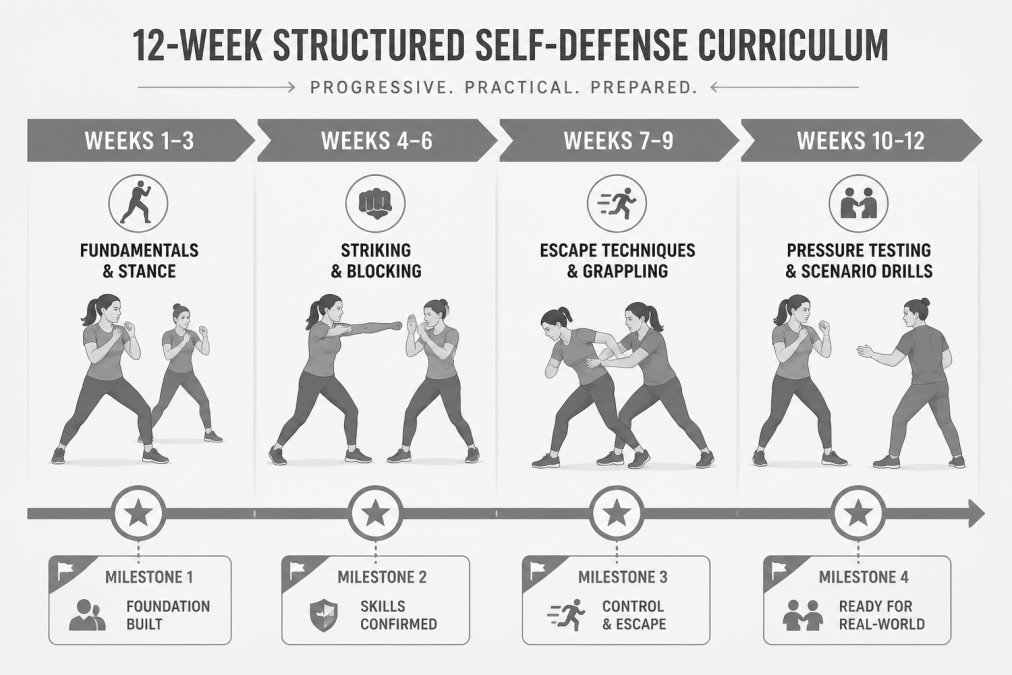
A typical progression moves through four stages:
- Weeks 1-3: stance, footwork, distance management, basic blocking
- Weeks 4-6: punching, kicking, and defensive combinations against a compliant partner
- Weeks 7-9: escape techniques, grappling basics, and stick fundamentals
- Weeks 10-12: pressure testing and scenario drills at increasing resistance
Each stage ends with a checkpoint. Students who are not ready repeat the phase, which is a feature, not a failure. Nobody advances on a calendar date alone.
How Often to Train Self-Defense for Reliable Skill Retention
Training twice per week is the practical minimum for most busy adults to retain and build self-defense skills, with three sessions accelerating progress noticeably. But frequency alone does not guarantee retention, what matters is how each session is structured and whether the program builds in deliberate retrieval practice.
Skill retention follows a predictable curve. New techniques decay fastest in the first 48 to 72 hours after learning, which is why spacing practice across the week works better than cramming. Short, frequent sessions give your nervous system repeated retrieval practice, and retrieval is what builds durable memory.
What Realistic Progress Looks Like
Most students notice improved confidence and cleaner technique within the first several weeks of consistent training. Reliable performance under genuine pressure typically takes months of progressive exposure, not days. Here is a realistic timeline based on common patterns in structured programs:
- Weeks 1-4: Basic stance, footwork, and defensive blocks become familiar; students still need to think through each movement.
- Weeks 5-8: Striking combinations and escape techniques start to flow with a compliant partner; reaction time improves.
- Weeks 9-12: Pressure testing begins; students can perform core techniques against moderate resistance but may revert to untrained responses under high stress.
- Months 4-6: Skills become more automatic; students can chain techniques and adapt to unexpected angles with less hesitation.
- Months 6-12: Consistent performance under pressure; students demonstrate reliable recall and can coach newer students through basics.
These timelines assume two to three sessions per week with a curriculum that includes regular review. Missing a week or two is normal; the key is whether the program has a structured way to reintegrate you without forcing you to restart from scratch. Consistent progress relies on this ability to maintain momentum, just as your proficiency in defensive tactics remains incomplete without integrating the right everyday carry gear into your personal safety strategy.
The Role of Sleep and Spaced Practice
Motor skill consolidation depends heavily on sleep and spacing. The National Institutes of Health's research on motor skill consolidation describes how sleep and spaced practice both strengthen retention of newly learned movement patterns. A program that schedules review sessions after a gap, rather than pretending every class is standalone, leverages this science.
If your schedule is unpredictable, ask whether the program uses dated phases with makeup options or on-demand video review. A program built for professionals should expect travel and late meetings, not punish them.
Self-Defense Training Under Pressure: Making Skills Stick
Self-defense training under pressure is the practice of performing techniques against a resisting, unpredictable partner so the skill survives adrenaline and surprise. Techniques that work only in cooperative drills have not been trained, only rehearsed.
Pressure testing introduces controlled chaos. A partner resists, changes angle, or closes distance unexpectedly.
This is where a neuroscience-informed approach earns its place. The National Institutes of Health's research on motor skill consolidation describes how sleep and spaced practice both strengthen retention of newly learned movement patterns.
Realistic timelines help set expectations. Most students notice improved confidence and cleaner technique within the first several weeks of consistent training. Reliable performance under genuine pressure typically takes months of progressive exposure, not days.
Instructor Qualifications and Safety Standards to Verify
Instructor qualifications and safety standards are the two factors beginners most often overlook, and the two that most affect whether you improve without injury. Verify both before committing to any program.
Ask about teaching credentials directly. Our lead instructor, Carlos Jiménez, holds a Master's degree in Neuroscience with a specialization in Multiple Intelligences, which shapes how techniques are broken down and taught. Not every program needs that background, but every program should be able to explain its teaching method in specific terms rather than vague assurances.
On safety, look for:
- A structured warm-up and cool-down in every class
- Defined rules for contact level and consent during partner drills
- Protective equipment available for stick and weapon-based training
- Clear injury reporting and first-aid procedures
- Class sizes that allow real individual correction
Comparing Program Formats: Which Structure Fits Your Life?
Program formats differ mainly in structure, commitment, and how progress is measured. The right choice depends on your schedule, your goals, and how much accountability you want. The table below compares common formats on the factors that matter most for structured self-defense training.
| Format | Structure Level | Typical Commitment | Progress Tracking | Best For |
|---|---|---|---|---|
| Progressive phased program | High, dated phases | 2 sessions per week | Written checkpoints and level assessments | Busy professionals wanting measurable progress |
| Open drop-in classes | Low, no fixed sequence | Pay per class | None or informal | Sampling styles before committing |
| Seminar or workshop | Medium, single topic | One weekend | Certificate of attendance only | Supplementing existing training |
| Online course | Medium, self-paced | Flexible | Self-reported quizzes | Reviewing concepts between sessions |
| Youth and summer camps | High, age-grouped | Multi-week blocks | End-of-camp skills demonstration | Younger students building fundamentals |
Real-World Selection by Need
Beyond format, match the program to your actual circumstances:
- If you travel frequently for work: Look for a phased program with makeup sessions or video review. Avoid formats that penalize absences with lost progress.
- If you are recovering from an injury or have limited mobility: Ask about adaptive techniques and whether instructors have experience modifying drills. A good program will have a clear answer, not a vague promise.
- If you are selecting for a teenager: Prioritize age-grouped classes with a written code of conduct and clear supervision ratios. Youth programs should emphasize awareness and de-escalation alongside physical techniques.
- If you want to test a style before committing: Start with a single seminar or a trial class, but ask whether the program offers a structured beginner pathway you can join afterward.
Transparent Costs and Commitment Terms
Cost structures vary widely, and the least transparent programs are often the ones that surprise you later. Ask directly about:
- Trial terms: Is the trial class free, and does it include a skills assessment or just observation?
- Contract length: Are you committing to a month, six months, or a year? What happens if you need to pause?
- Equipment costs: Are protective gear and training weapons included, or do you purchase them separately?
- Cancellation policy: What notice is required, and are there penalties for early termination?
A program confident in its structure will answer these questions without hesitation and will let you try a class before you commit. For adults balancing demanding schedules, a phased program with a fixed curriculum usually produces the most reliable results because progress is defined and tracked. Drop-in formats suit people still deciding whether martial arts fit their routine. Many students combine a phased program with occasional seminars to deepen specific areas.
Frequently Asked Questions
What is the best training for self-defense?
The best training is structured, progressive, and pressure-tested. Look for a program with a written curriculum, measurable milestones, and instructors who explain why each technique works. A blend of striking, grappling, and situational awareness beats any single discipline. Kajukenbo and Filipino Martial Arts systems combine these elements, and a neuroscience-based approach can speed up motor learning. Ask about trial classes and observe whether beginners receive clear, step-by-step instruction rather than open-ended drilling.
How often should beginners train in self-defense?
Two sessions per week is a realistic starting point for busy adults. Consistency matters more than volume: 60 to 90 minutes twice weekly, with short review between classes, supports retention better than occasional long sessions. As skills consolidate, adding a third session can accelerate progress. Programs that date each phase make it easier to see whether twice-weekly attendance is enough to hit milestones. If you travel often, ask whether the school offers make-up classes or on-demand video review.
How can you tell whether a self-defense program is practical?
Practical programs teach techniques you can perform under stress, not just in a mirror. Signs include scenario drills, pressure testing with resisting partners, and clear explanations of when a technique applies. Ask whether the curriculum covers verbal de-escalation, escape techniques, and legal use-of-force basics for your state. A structured self-defense program should also track progress with dated phases. If every class is open-ended drilling with no progression map, the training is likely less reliable when it counts.
What should a beginner expect in a self-defense class?
Expect a warm-up, technique instruction broken into steps, partner drills, and a cool-down. Good beginner classes explain the purpose of each movement and include situational awareness exercises. You should not be thrown into full-contact sparring on day one. Ask about safety equipment, mat etiquette, and injury prevention. Many schools offer a free trial class or a short introductory series so you can assess the instructor's teaching style and the group's culture before committing to a membership.