 Comparison
Self-Defense Training for Busy Professionals
Last Updated: October 26, 2026
Quick Summary
Self-defense training busy professionals need delivers measurable skill acquisition without requiring years of commitment through structured, neuroscience-based instruction that prioritizes retention over volume. Twice-weekly group classes plus occasional private sessions produce better retention than single weekly lessons because repeated pressure-testing against different partners encodes techniques reliably.
- Twice-weekly training is the practical minimum for most professionals to build reliable muscle memory and avoid the weekly reset.
- Progressive phases break complex techniques into foundation, integration, pressure testing, and automation stages to accelerate learning.
- Hybrid programs combining group classes with periodic private sessions balance affordability, flexibility, and measurable progress best for working adults.
- Deliberate practice with immediate feedback and progressive difficulty outperforms mindless repetition regardless of total training hours.
- Beginners should evaluate instructors on teaching ability, safe partner drills, clear progression, and class size before committing.
Table of Contents
- Why Self-Defense Training Works for Professionals with Limited Time
- Self-Defense Classes for Adults: What Fits a Working Schedule
- How Often to Train Self-Defense for Real Skill Retention
- Self-Defense Training for Beginners Without Prior Martial Arts Experience
- What Separates Effective Training from Ineffective Drills
- Neuroscience-Based Methods: How Progressive Phases Build Reliable Skills
- Book Your First Class and Start Measurable Progress
- Frequently Asked Questions
Why Self-Defense Training Works for Professionals with Limited Time
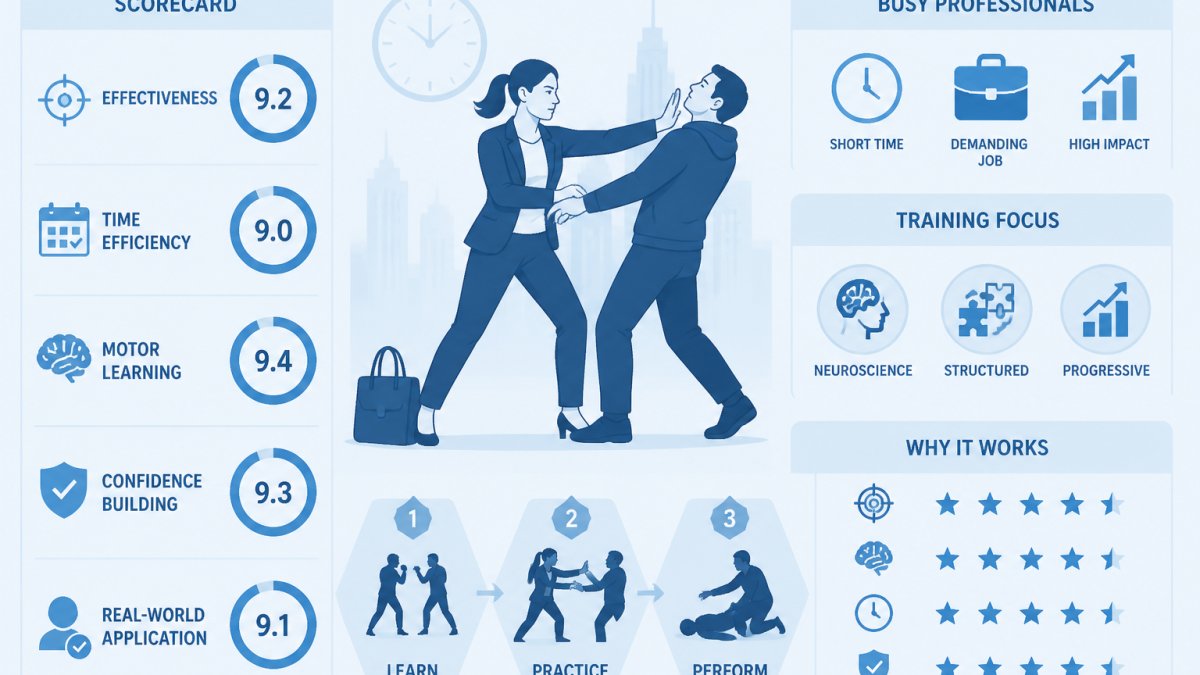
Self-defense training busy professionals need delivers measurable skill acquisition without requiring years of commitment. The challenge isn't learning, it's finding a program that fits a demanding schedule while actually building reliable techniques you can trust under pressure.
Most professionals dismiss martial arts as impractical. But research shows that empowerment self-defense training decreases women's fear and anxiety while increasing confidence and sense of agency, according to research from the University of Oregon on self-defense effectiveness.
At Kajukenbo and Filipino Martial Arts Club, we've built our program specifically for professionals who can't commit to traditional schedules. Rather than drilling the same movements repeatedly, our methodology breaks complex techniques into progressive phases.
The real advantage of self-defense training for professionals isn't the time saved, it's the confidence gained. You don't need to become a martial artist. You need techniques that work, delivered efficiently, with measurable progress you can track.
Self-Defense Classes for Adults: What Fits a Working Schedule
Adult self-defense classes come in three formats, each with different time demands and outcomes.
Group classes meet on fixed schedules, typically 1-2 hours per session. You train alongside other adults at the same skill level, which builds community and provides realistic pressure-testing. The tradeoff: you're locked into their schedule, and progression depends on class attendance.
Private lessons offer complete scheduling flexibility and personalized instruction. An instructor tailors every drill to your specific goals and pace. The cost is higher, and you lose the peer pressure that keeps many people consistent.
Hybrid programs combine group classes with periodic private sessions. You get the community and structure of group training with occasional one-on-one refinement. This format suits professionals best because it balances affordability, flexibility, and measurable progress.
Self-defense classes for adults also vary by curriculum. Some focus on awareness and de-escalation. Others teach striking and escapes. The most effective programs teach all three, awareness to avoid situations, de-escalation to defuse them, and physical techniques as a last resort.
What separates a program designed for professionals from a general adult class is intensity management. You shouldn't need to train 5 days a week to progress.
How Often to Train Self-Defense for Real Skill Retention
Training frequency determines whether skills stick or fade, but for busy professionals the more useful question is which format delivers the most retention per hour invested. Learn proven methods to retain skills through effective training frequency and practice.
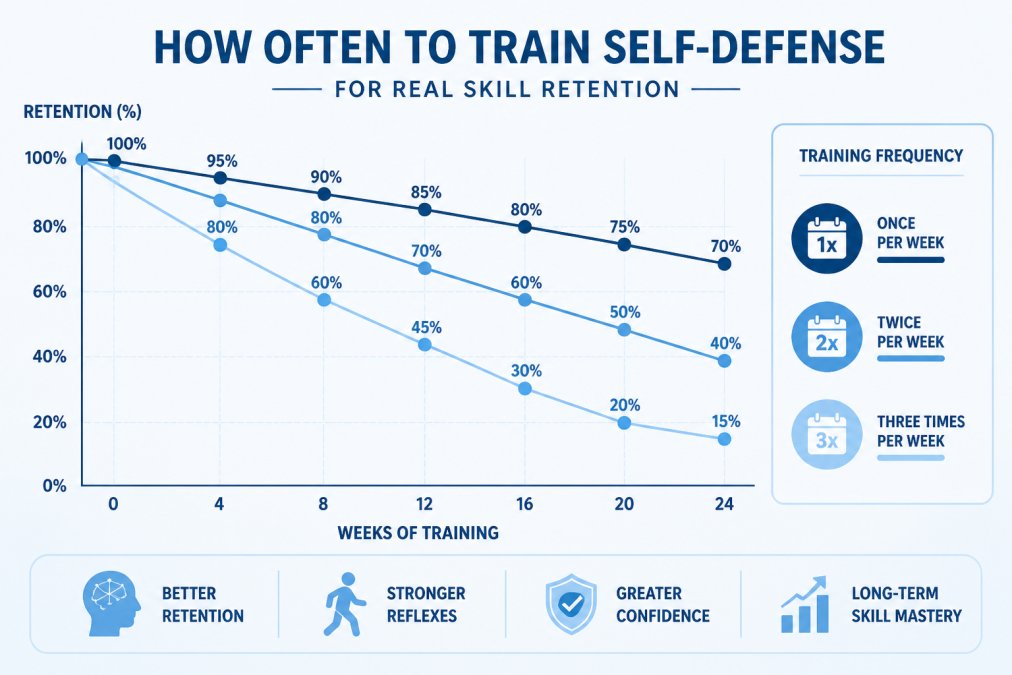
Here is how the common formats compare on the dimensions that matter to a working adult:
| Format | Typical weekly time | Feedback quality | Relative cost | Likely retention if consistent |
|---|---|---|---|---|
| Short workshop (one-time) | 2-4 hours total | Low to moderate (group setting) | Lowest per session | Low without follow-up practice |
| Recurring group classes | 2-3 hours | Moderate (instructor rotates) | Moderate | Moderate to high with twice-weekly attendance |
| Private lessons | 1-2 hours | High (one-on-one correction) | Highest per hour | High, but only if you practice between sessions |
| Hybrid (group + periodic private) | 2-3 hours plus occasional private | Moderate to high | Moderate to high | High when private sessions target weak points |
| Online programs | Self-paced | Low (no live correction) | Lowest | Low unless paired with live pressure-testing |
A common pattern among time-constrained learners is that twice-weekly group classes plus one private session per month produces better retention than a single weekly private lesson, because the group sessions provide repeated pressure-testing against different partners. The private session then corrects specific errors that group instruction misses.
Training once per week maintains basic familiarity but rarely builds reliable muscle memory. You spend the first 15 minutes of each class remembering what you learned the week before.
The key insight: consistency matters far more than intensity. Two focused sessions every week beats one marathon session monthly. Your brain encodes movement through repeated activation of neural pathways, and widely spaced repetitions interrupt that process. Choose the format you can attend reliably, then use private sessions or online review to fill gaps.
Self-defense training for busy professionals works best when structured around realistic frequency.
Self-Defense Training for Beginners Without Prior Martial Arts Experience
Beginners worry that complex techniques like stick and blade work are unrealistic without a martial arts background. Structured self-defense training programs designed for beginners without prior martial arts experience address this concern through proper sequencing and safe progression. That is a common misconception. What actually matters for beginners is not prior experience but how instruction is sequenced and whether the school provides a safe, structured entry point.
Before you commit to a program, evaluate the instructor and school against these criteria:
- Instructor experience and teaching ability. Ask how long the instructor has taught beginners specifically, not just trained. A skilled practitioner who cannot break down a technique for a nervous adult is a poor fit.
- Safe partner drills. Beginners should practice against compliant partners before any resistance. Watch a class: are students controlled, or is sparring chaotic?
- Pressure-testing with guardrails. Effective programs introduce resistance gradually, with constraints and protective gear. Full-contact sparring in week one is a red flag.
- Class size and beginner support. Large classes with one instructor mean little correction. Look for assistant instructors or capped beginner sessions.
- Clear progression. Ask what you will be able to do after four weeks, eight weeks, and three months. Vague answers signal vague instruction.
- Injury and accessibility considerations. Ask about adaptations for different fitness levels and any history of injuries. A good school will modify drills rather than push you into movements your body is not ready for.
Self-defense training for beginners should include:
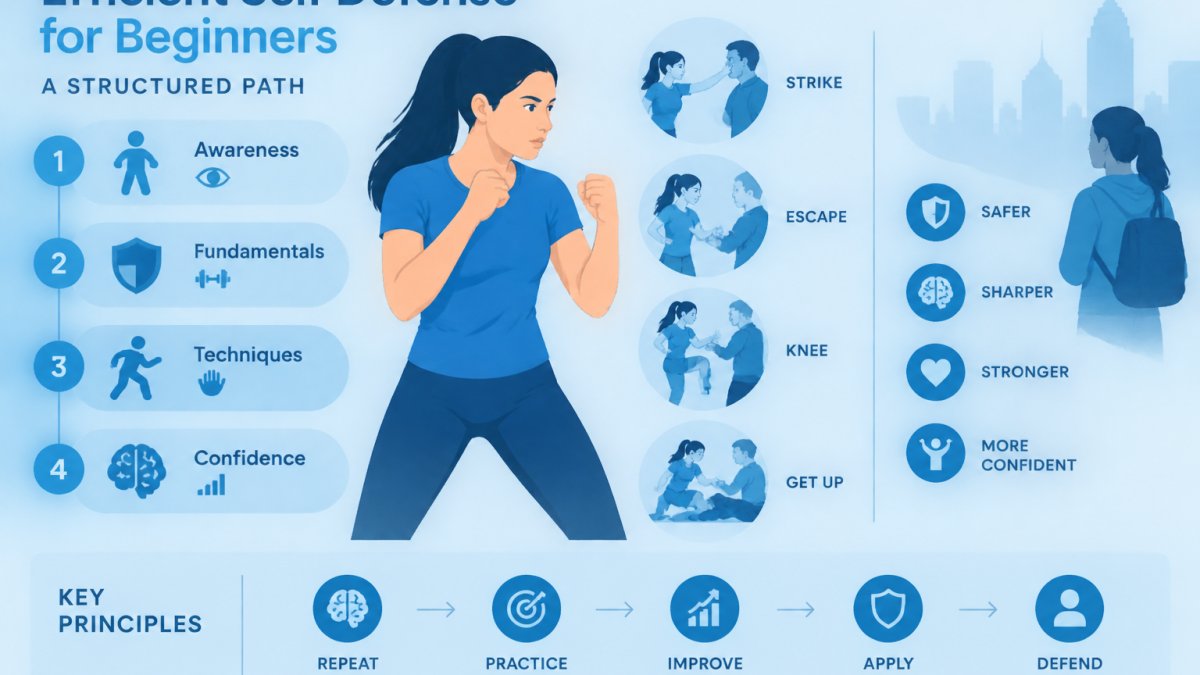
- Foundational concepts before techniques (stance, distance, timing)
- Simple movements first (basic strikes, fundamental escapes)
- Progressive complexity (combining techniques, adding pressure)
- Pressure-testing (controlled sparring to build confidence)
The biggest mistake beginners make is choosing a program that treats everyone the same. Beginners need deliberate scaffolding. Intermediate students need pressure-testing. Advanced students need refinement under realistic stress. Ask how the school separates or accommodates these groups.
Finally, define measurable progress for yourself. After four weeks of twice-weekly training, you should be able to demonstrate a basic stance and escape against a compliant partner and explain when to use it. After eight weeks, you should be able to execute those techniques against light resistance. If you cannot describe your progress in those terms, the program is not giving you the feedback you need.
What Separates Effective Training from Ineffective Drills
Many martial arts programs rely on repetition without purpose. You drill the same technique dozens of times in one class, which feels productive but builds weak neural pathways.
Effective self-defense training follows the principle of deliberate practice applied to martial arts: focused, structured repetition with immediate feedback and progressive difficulty. Each drill has a specific learning objective. Difficulty increases as competence builds.
Ineffective drills share common patterns:
- Repetition without variation (same technique, same partner, same pressure)
- No feedback loop (drilling without correction or assessment)
- No progression (never increasing difficulty or adding constraints)
- Open-ended timing (drilling until class ends, not until mastery)
Effective training looks different. You learn a technique, drill it against a compliant partner, then pressure-test it against resistance. Difficulty escalates across sessions. Instructors provide specific feedback on what changed and why.
The neuroscience matters here. Your brain doesn't encode movement through mindless repetition. It encodes through challenge and adaptation. Each time you perform a technique under slightly different pressure or timing, your nervous system refines the motor pattern.
This is why self-defense training busy professionals rely on actually works. You don't need hundreds of hours. You need deliberate practice, focused, structured, progressive.
Neuroscience-Based Methods: How Progressive Phases Build Reliable Skills
Progressive phases are the framework that makes complex skills learnable in limited time.
Phase 1: Foundation introduces the basic movement pattern without pressure. Your nervous system maps the gross motor pathway. Accuracy matters more than speed.
Phase 2: Integration adds coordination demands. You combine the foundation with other techniques or add footwork. Complexity increases, but pressure remains controlled.
Phase 3: Pressure Testing introduces realistic resistance and timing variability. Your nervous system learns to execute the technique when conditions aren't perfect.
Phase 4: Automation occurs when the technique becomes reliable under stress. You no longer think about the movement; you execute it.
Traditional martial arts programs teach a technique once and expect students to progress through these phases on their own.
The practical difference: after 8 weeks of traditional training, you can perform techniques slowly with a cooperative partner. After 8 weeks of neuroscience-based training, techniques work under realistic stress because your nervous system has encoded them properly.
This approach also reduces injury risk. You're not forcing complex movements before your body is ready. You're building progressively, which gives connective tissue time to adapt.
Book Your First Class and Start Measurable Progress
The decision to start self-defense training is straightforward when you know what to look for: structured progression, realistic time commitment, and measurable outcomes.
Guidance on booking your first martial arts trial class removes the friction of getting started.
The most common barrier isn't cost or time. It's uncertainty about whether training will actually work. That's where measurable progress matters. A program designed for professionals tracks your skill acquisition explicitly.
Kajukenbo and Filipino Martial Arts Club combines neuroscience-based instruction with a schedule built for professionals.
The investment is modest: a few hours weekly, consistency, and genuine commitment to deliberate practice. Book your first martial arts trial class to experience how structured progression works in practice.
Self-defense training works for busy professionals when it's structured around how your nervous system actually learns. Progressive phases, deliberate practice, and realistic time commitment replace the myth that mastery requires years of dedication.
| Training Format | Time Commitment | Best For | Key Advantage |
|---|---|---|---|
| Group classes | 2-3 hours/week | Community and accountability | Peer pressure drives consistency |
| Private lessons | Flexible | Personalized progression | Complete scheduling freedom |
| Hybrid programs | 2-3 hours/week + occasional private | Professionals | Balance of structure and flexibility |
| Online courses | Self-paced | Quick reference | Lowest time barrier to entry |
Frequently Asked Questions
Can you actually learn self-defense training with a busy schedule?
Yes. Research shows that consistent training, even twice per week, builds measurable skills and confidence. The key is structured, progressive instruction that prioritizes quality over quantity. Short, focused sessions with clear learning phases allow professionals to retain techniques effectively. Online courses offer a quick introduction, but in-person classes with pressure-testing and instructor feedback produce more reliable real-world application.
How often to train self-defense for skills to actually stick?
Twice weekly is the practical minimum for skill retention and muscle memory development. This frequency allows your nervous system to consolidate techniques between sessions. Once-weekly training slows progress noticeably; three or more sessions per week accelerates it. The consistency matters more than the total hours. Irregular attendance, even with longer sessions, produces weaker retention than steady, moderate-frequency training.
Is self-defense training for beginners realistic if I've never done martial arts?
Absolutely. Beginner-focused programs teach fundamental concepts before complex combinations. Look for instruction that breaks techniques into small, digestible steps rather than expecting you to drill full sequences immediately. Instructors with training backgrounds in motor learning or neuroscience can explain why you're learning something before asking you to perform it. Start with foundational striking, escapes, and control concepts before advancing to stick and blade work.
What makes self-defense training actually effective versus just drilling moves?
Effective training includes pressure-testing, stress response practice, and progressive complexity. Drilling the same move repeatedly without variation or pressure teaches muscle memory in isolation, not real-world decision-making. Quality programs introduce controlled pressure, require you to adapt techniques to different scenarios, and teach you to function under adrenaline. Neuroscience-based instruction structures these elements intentionally rather than hoping they happen naturally.