 How-to
Learn Stick Fighting: A Beginner's Guide to Arnis
Table of Contents
- What You'll Need Before You Start
- Learn Stick Fighting: Grip, Stance, and Footwork Fundamentals
- Basic Stick Fighting Techniques for Beginners
- Stick Fighting Footwork Drills to Build Coordination
- Kali Stick Fighting for Beginners: Progressive Training Structure
- Common Mistakes to Avoid When Learning Stick Fighting
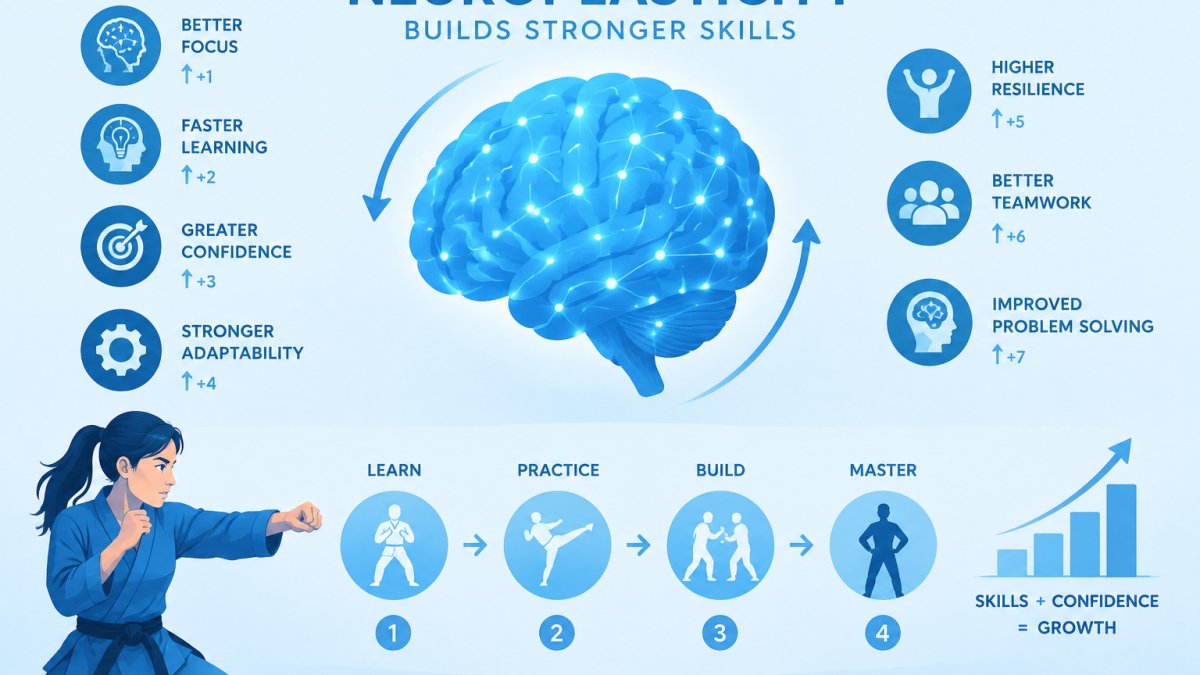
- How Neuroscience-Based Training Improves Retention
- Frequently Asked Questions
Last Updated: October 9, 2026
What You'll Need Before You Start
Learning to learn stick fighting requires minimal equipment, but what you choose matters. A quality rattan stick costs 15 to 40 dollars and lasts hundreds of hours. Protective gear, hand wraps, gloves, and a mouthguard prevent injuries during partner drills. Many beginners skip padding, then regret it after their first contact drill.
The real investment is understanding how your brain learns motor skills under pressure. Your nervous system needs progressive phases: movement mechanics, then reaction speed, then real-world application.
Start with a 24-inch rattan stick: long enough for range control, light enough to avoid fatigue. Avoid buying expensive gear before your first class; you'll discover what works for your body as you train.
Learn Stick Fighting: Grip, Stance, and Footwork Fundamentals
Stick fighting rests on three pillars: how you hold the stick, where your feet stand, and how your body moves through space. Miss one, and your techniques collapse under pressure.
Proper Grip and Wrist Rotation
Your grip determines whether your strikes have power or feel like tapping. Hold the stick at the bottom third, not the end. Your thumb and index finger grip firmly while your other three fingers stay relaxed. Tension kills speed.
Wrist rotation is where most beginners fail. The stick rotates from your wrist, not your elbow. Practice rotating your wrist 180 degrees with the stick parallel to the ground, forearm still. This motion generates all your striking power.
Many instructors emphasize a death grip. In reality, a relaxed grip with a fast wrist snap beats a tense grip every time. Your wrist should feel loose until the moment of impact.
Basic Stance and Body Positioning
Your stance is your foundation. Stand with feet shoulder-width apart, knees slightly bent, weight balanced 50-50. Keep your chest upright and shoulders relaxed. This is the neutral stance in Filipino martial arts.
From here, your body can move in any direction without resetting. When you strike, power comes from your hips rotating, not your arm swinging. Your arm is just the delivery mechanism.
When beginners learn stick fighting, they often stand too upright or lock their knees, slowing footwork and making them predictable. A slight forward lean, bent knees, and relaxed shoulders give you explosive speed.
The stance changes with range: feet closer together when close, wider when far. This range control separates beginners from fighters who work under pressure.
Basic Stick Fighting Techniques for Beginners
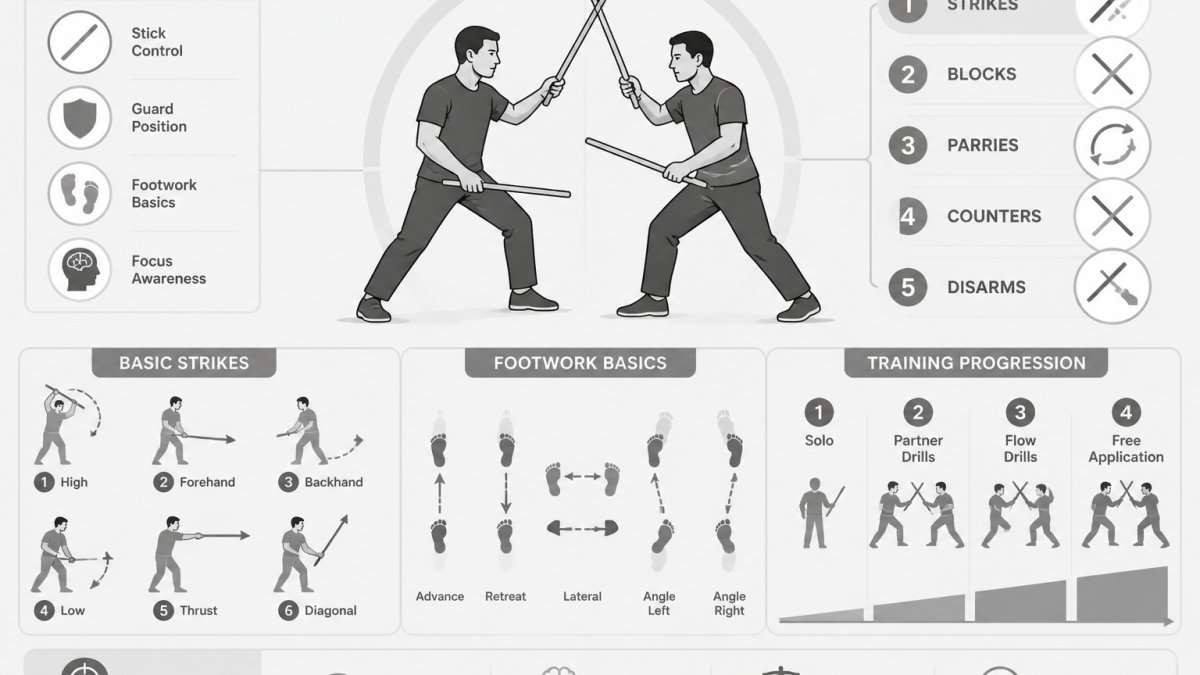
Every technique in Arnis and Kali builds from four core patterns: strikes, blocks, parries, and disarming. Master these, and you've unlocked the entire system.
Essential Strike Patterns and Angles
There are 12 primary angles of attack in Filipino martial arts. Beginners don't need all of them.
The downward diagonal strike comes from your shoulder, angling toward the opponent's head or shoulder. Your wrist rotates as you swing, and the stick finishes across your body.
The upward diagonal mirrors this motion but travels up, targeting the legs or torso. Many beginners struggle because they use their arm instead of hip rotation. The hips drive the motion.
Horizontal strikes travel straight across: fast and covering distance, but the easiest to block. Use them to set up other techniques, not as your primary attack.
Thrusts are straight-line attacks: your arm extends forward and your wrist rotates at the end for impact. They're precise and hard to predict, but require good distance management.
Defensive Blocking and Parrying
Blocking stops an incoming strike head-on, your stick absorbing the impact. Parrying deflects the strike to the side, using the opponent's momentum against them. Both are essential for self-defense.
A basic block against a downward strike: raise your stick vertically to meet it, forearms absorbing the impact. Keep your knees bent so your body can move if the block fails.
Parrying requires timing and angle. As the opponent's stick comes in, rotate your wrist to deflect it 45 degrees to the side.
The common mistake is waiting for the strike to arrive.
Defensive footwork matters as much as stick positioning. As you block or parry, step back slightly to create distance and time your counter-attack. A static defender gets overwhelmed.
Stick Fighting Footwork Drills to Build Coordination
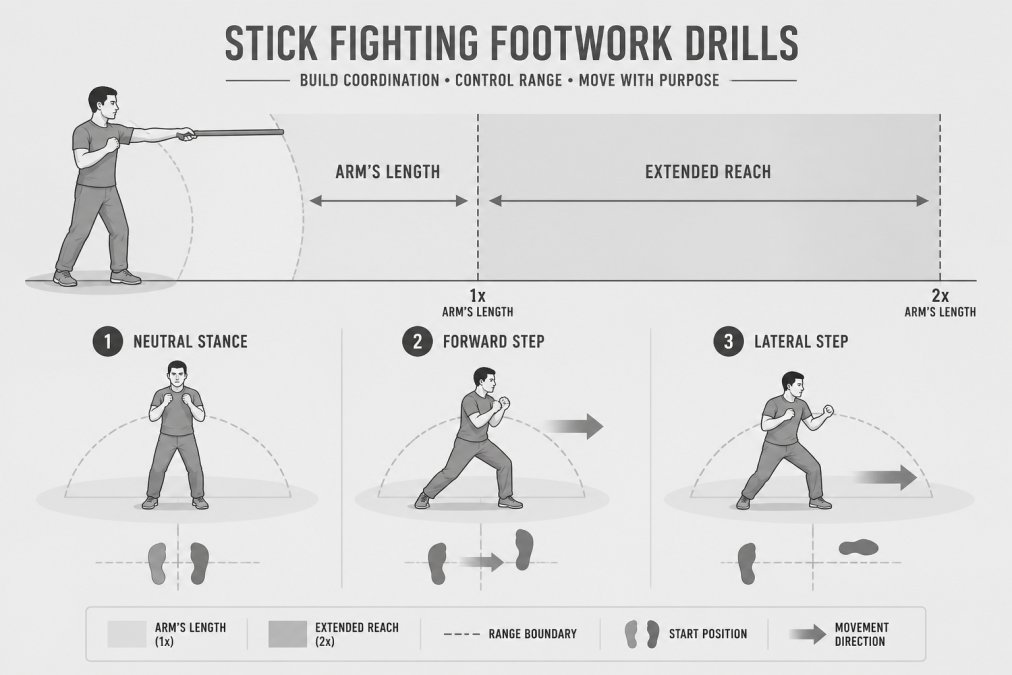
Footwork is where most beginners struggle. Your feet must move independently from your hands, so you can strike while adjusting distance. This coordination takes practice.
Solo Footwork Patterns and Range Control
Start with the basic step: forward and back. Step forward with your front foot, then bring your rear foot to reset your stance. Do 20 slow reps with your stick in ready position and eyes forward.
Now add side steps: step left, reset, step right, reset. Do 20 reps to teach your feet lateral movement while your upper body stays ready.
Combine forward, back, and side steps in random patterns. This is where coordination develops: after 50 reps, your footwork becomes automatic.
Range control is critical: distance determines which techniques work. Too close and you can't generate power; too far and strikes don't land.
Sinawali Drills for Fluid Motion
Sinawali is a two-stick weaving pattern. Both sticks move in figure-eights, creating flowing, continuous motion.
Start with basic sinawali: one stick in each hand, moving in parallel figure-eights, one up while the other goes down. Do this slowly for 30 seconds, focusing on smooth, continuous motion.
Once comfortable, add footwork: step forward, back, and side to side while doing sinawali. Your hands keep their rhythm while your feet move independently. This is where fluid motion develops.
Sinawali trains your nervous system to coordinate complex movements. When you later spar or face a real self-defense situation, your body moves fluidly under pressure because repetition builds motor memory.
Many beginners skip sinawali because it feels disconnected from fighting. That's a mistake: it's how your brain learns to move both arms and legs simultaneously without thinking. It's foundational.
Kali Stick Fighting for Beginners: Progressive Training Structure
This is where Kajukenbo and Filipino Martial Arts Club's neuroscience-based approach separates from traditional drilling. Your brain learns in phases, not all at once. We structure training to match how your nervous system actually acquires skills.
Phase 1: Movement and Mechanics
The first two weeks focus on movement: grip, stance, footwork, and basic strike patterns. No partner work, no pressure, just repetition until your body moves correctly without thinking.
Your nervous system is building motor pathways, which takes time. Rushing into partner drills before Phase 1 is solid develops bad habits under pressure, and bad habits are hard to break.
Spend 15 minutes daily on stance work, 10 on grip and wrist rotation, and 15 on footwork drills. That's enough to build the foundation: consistency beats volume.
Phase 2: Reaction Time and Drills
Once movement is automatic, add a partner. Start with slow, cooperative drills. Your partner throws a strike and you block. Then you strike and they block. This teaches your nervous system to recognize patterns and react.
Gradually increase speed. By week four, you're drilling at 70 percent speed with a partner actively trying to hit you. Reaction time improves because your brain recognizes the incoming motion faster.
Reaction time is trainable: your brain gets better at predicting where the stick is going. Sparring feels impossible for beginners because they haven't trained their visual system to track the stick. Slow drills build that ability.
Phase 3: Self-Defense Applications and Sparring
By week six, you're ready for light sparring: both partners try to land strikes at controlled intensity. Your body moves fluidly because Phases 1 and 2 built the foundation.
Self-defense applications come next. You learn how stick techniques translate to real situations: a strike becomes a defense against an attacker, a block a way to create distance. The techniques stay the same; only the context changes.
This three-phase structure works because it matches how your brain learns under stress. Your nervous system needs time to build automaticity. Pressure comes later, after the skills are solid.
Common Mistakes to Avoid When Learning Stick Fighting
Most beginners make the same errors. Knowing them saves months of frustration.
Rushing the basics. You see advanced fighters doing complex combinations and want to copy them. Don't.
Gripping too hard. A white-knuckle grip kills speed and causes wrist strain. Your grip should feel relaxed, almost lazy. Tension is the enemy of speed.
Using your arm instead of your hips. Beginners swing the stick like a baseball bat.
Neglecting footwork. You can have perfect technique but lose because your footwork is clumsy. Footwork and hand techniques must develop together.
Skipping solo drills. You want to partner drill immediately. Solo work feels boring. But solo drills build automaticity faster than partner work. They're not optional.
Locking your joints. Bent knees and relaxed elbows let you move explosively. Locked joints slow you down and increase injury risk. Stay loose.
How Neuroscience-Based Training Improves Retention
This is where Kajukenbo and Filipino Martial Arts Club's methodology differs fundamentally.
Neuroscience shows your brain learns best through structured progression: simple movements first, then complexity; slow speed, then faster; solo work, then partner work.
When you learn in phases, your brain consolidates skills between sessions. Sleep is when motor learning happens.
Progressive training also prevents injury. Your joints, tendons, and muscles adapt gradually.
The retention difference is dramatic. Beginners trained with structured progression remember 80 percent of their techniques after three months away. Random drilling?
According to research on motor learning from the American Psychological Association, spaced repetition and progressive difficulty are the two most effective variables for skill retention.
Learning to learn stick fighting is learnable.
The Filipino martial arts, Arnis, Kali, and Escrima, have survived centuries because they work. Stick fighting teaches self-defense, improves focus, and builds confidence.
Kajukenbo and Filipino Martial Arts Club specializes in turning busy professionals into confident stick fighters.
Frequently Asked Questions
How long does it take to learn basic stick fighting skills?
Most beginners develop foundational competency in 4-6 weeks of consistent training (2-3 sessions per week). Mastering strike patterns, footwork, and basic defensive blocking takes 8-12 weeks. Retention and reliable technique under pressure improve significantly when training follows a structured, progressive methodology that breaks skills into distinct phases rather than open-ended drilling.
What equipment do you need to practice stick fighting safely?
Essential safety gear includes padded hand wraps, protective gloves, and a mouthguard. Training sticks (rattan or foam) should be 24-28 inches long. Beginners benefit from padded sticks during early drills. Eye protection is recommended when practicing with a partner. Proper footwear with ankle support prevents rolling injuries during footwork drills. Start with lighter sticks to develop correct mechanics before progressing to full-weight rattan.
Is Filipino martial arts stick training suitable for beginners with no martial arts background?
Yes. Kali and Arnis are designed for quick skill acquisition because they emphasize natural movement patterns and body mechanics. Beginners learn strike patterns and footwork through structured progression, not endless repetition. A neuroscience-based teaching approach breaks complex techniques into manageable phases: movement mechanics first, then reaction drills, then self-defense applications. This methodology makes stick fighting accessible to absolute beginners while building measurable competency.
How do you practice stick fighting footwork effectively on your own?
Solo footwork drills focus on stance transitions, directional movement, and range control without a partner. Practice stepping patterns that maintain proper distance and angle relative to an imaginary opponent. Sinawali drills develop coordination and fluid motion by alternating stick patterns in rhythmic sequences. Use mirrors or video to check body alignment and mechanics. Solo drills build the foundation for later partner work and improve reaction time through repetition of controlled movements.