 blog
Is Urban Self-Defense Training Worth It?
Last Updated: October 25, 2026
Quick Summary
Urban self-defense training is worth it if you commit to at least twice-weekly classes for three to six months with pressure testing included. Research shows it decreases fear and anxiety while increasing confidence and situational awareness, though it cannot guarantee you'll win every fight or protect you against multiple armed attackers.
- Reliable skills take 3-6 months of consistent twice-weekly training to stick under stress
- Structured, progressive training with pressure testing produces far better retention than sporadic workshops
- Situational awareness and threat prevention prevent most dangerous situations before they start
- Online-only instruction cannot replicate pressure testing against a resisting partner, the biggest predictor of real-world transfer
- Honest instructors acknowledge training limits and address urban-specific risks like confined spaces and legal proportionality
Table of Contents
- What the Research Actually Shows About Urban Self-Defense Training
- The Real Benefits of Self-Defense Training for Urban Professionals
- How Long Does It Take to Learn Self-Defense Skills You Can Actually Use?
- Self-Defense Training Drills That Build Real Retention
- What Urban Self-Defense Training Cannot Do
- Evaluating Class Quality: What to Look For and Red Flags to Avoid
- Book Your Trial Class and Test the Neuroscience Approach
- Frequently Asked Questions
What the Research Actually Shows About Urban Self-Defense Training
Is urban self-defense training worth it? The answer depends on what you're actually trying to achieve.
Research from the University of Oregon Empowerment Self-Defense program shows that empowerment self-defense training decreases women's fear and anxiety while increasing confidence, self-efficacy, and self-esteem.
The gap between what people expect and what they get is where most disappointment happens. Many come in hoping for movie-style combat mastery.
Here's what matters most: self-defense training works best when it's structured, progressive, and grounded in how your brain actually learns motor skills.
The Real Benefits of Self-Defense Training for Urban Professionals
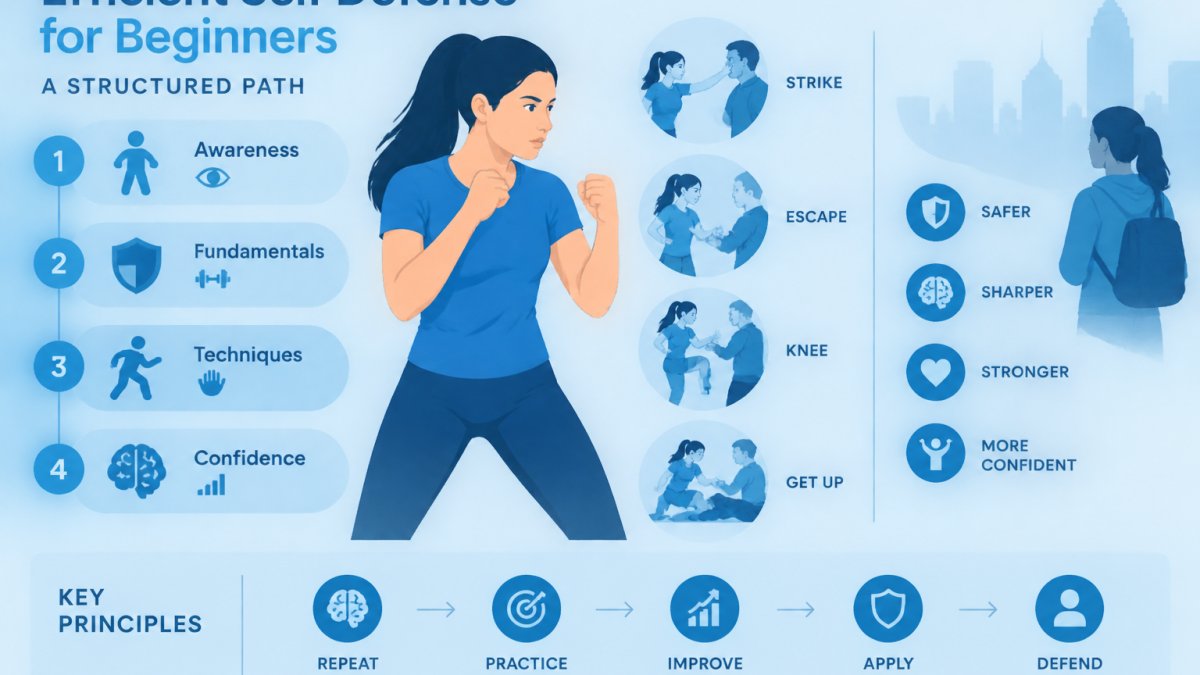
Self-defense training delivers three concrete benefits when done correctly: mental readiness, physical capability, and situational awareness. Each one matters independently. Together, they create a foundation for personal safety.
Confidence and Mental Readiness
Confidence isn't overblown marketing. It's measurable.
When you train consistently, your nervous system adapts to stress. You learn what your body can do. You practice responses under controlled pressure.
The mental readiness piece is crucial. Most people freeze in dangerous moments, not because they lack courage, but because their brain hasn't rehearsed the decision. Self-defense training rehearses it.
This matters more than technique alone. A person who freezes can't use any technique.
Physical Preparedness and Fitness
Self-defense training builds functional strength and stamina in ways generic fitness doesn't.
You're not lifting weights in isolation. You're moving explosively, changing direction, maintaining balance under fatigue, and coordinating complex movements. Your cardiovascular system adapts to short bursts of intensity.
This physical preparedness has a side benefit: people who look fit and move with confidence project a different presence. Attackers often target people who appear vulnerable. Training changes how you carry yourself. Posture improves. Movement becomes more deliberate.
Situational Awareness and Threat Assessment
Most self-defense training teaches you to notice what others miss.
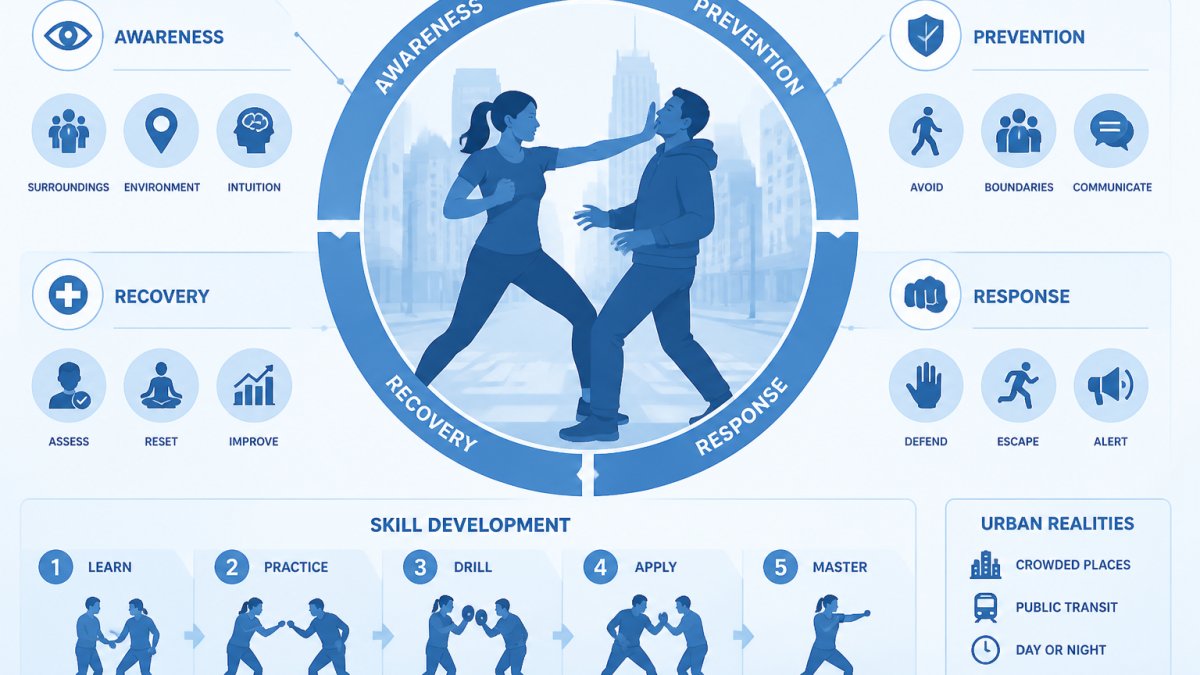
You learn to scan environments. You identify exits. You read body language for early warning signs. You understand distance and positioning. You recognize pre-attack indicators, the subtle shifts that precede violence.
This awareness is the most valuable skill you can develop. It prevents most dangerous situations before they start. You avoid the threat entirely. No fight is better than winning a fight.
How Long Does It Take to Learn Self-Defense Skills You Can Actually Use?
This is the question everyone asks. The honest answer: it depends on what "actually use" means, and on which training format you choose.
Basic defensive movements take weeks to learn. You can block, strike, and escape in basic scenarios after a few classes.
Reliable skills, ones you'll actually execute when adrenaline spikes and fear takes over, take months of consistent training.
The timeline accelerates with structured, progressive training. When your instructor breaks techniques into phases and builds complexity gradually, your brain learns faster.
The Worth-It Calculation: Time, Money, and Format
One-off workshops (2-4 hours). Low commitment, often $50-$150. Good for awareness basics and a first taste. Weak for skill retention, most participants lose technique within weeks without follow-up.
Ongoing weekly classes. The standard format. Expect $100-$250 per month in most metro areas, or $15-$40 per class drop-in.
Online instruction. Cheapest option, often $10-$30 per month. Useful for concepts and solo drills.
Complementary training. Awareness and de-escalation courses, often free through community programs or employers, pair well with physical training.
A common pattern: people who train twice weekly for six months report far more reliable skill recall than those who attend sporadic intensives. Consistency beats intensity for retention. Three intensive classes per week beats sporadic training every other month, but two consistent weekly classes beat both for most busy professionals.
The global self-defense training market is estimated at USD 4.10 billion in 2026, reflecting how many people recognize the value, but market size doesn't tell you what works for you personally.
What matters is consistency. Your nervous system needs regular rehearsal to encode skills. Gaps in training mean regression. You lose ground.
Self-defense training effectiveness depends on format, frequency, and commitment level.
| Format | Time Commitment | Skill Retention | Best For |
|---|---|---|---|
| One-off workshops | 2-4 hours | Weak, lost within weeks | Awareness basics and first taste |
| Ongoing weekly classes | Twice weekly minimum | Real retention after 3-6 months | Busy professionals seeking consistency |
| Online instruction | Self-paced | Cannot replicate pressure testing | Concepts and solo drills only |
| Complementary training | Varies, often free | Addresses majority of situations | Awareness and de-escalation focus |
Self-Defense Training Drills That Build Real Retention
The difference between training that sticks and training you forget comes down to how drills are structured.
Open-ended repetition doesn't work. Doing the same move 100 times doesn't prepare you for pressure.
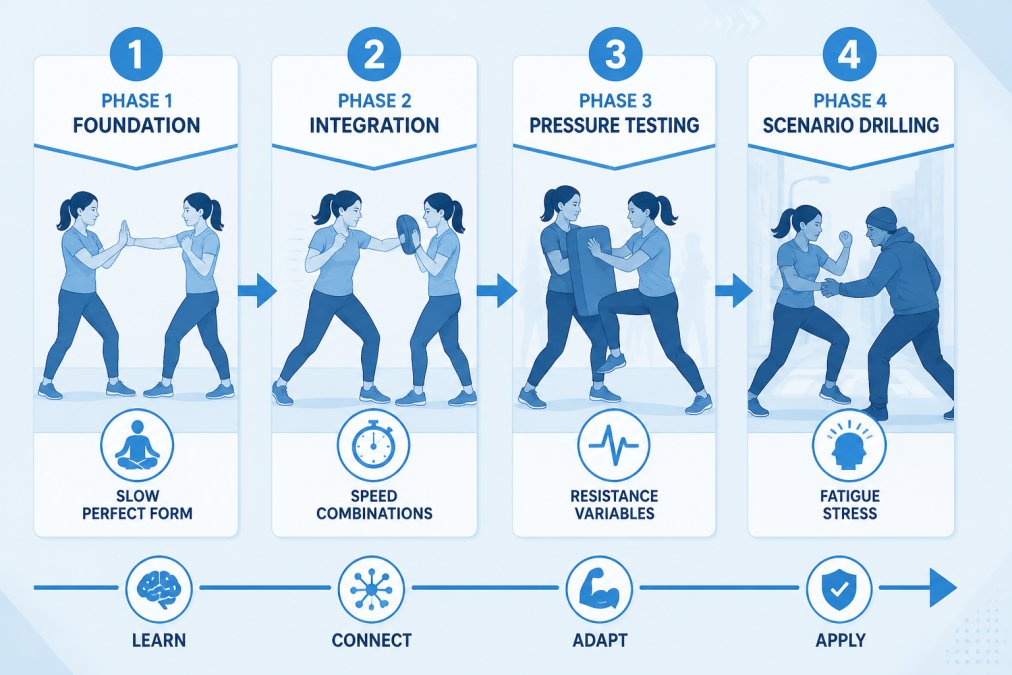
Effective drills follow a progression: Deliberate practice principles structure how your brain encodes movement skills.
- Phase 1: Foundation, Learn the basic movement slowly, with perfect form. No speed. No pressure. Just accuracy.
- Phase 2: Integration, Add speed. Combine techniques. Start introducing minor variables.
- Phase 3: Pressure Testing, Practice against resistance. Your partner moves unpredictably. You adapt and execute.
- Phase 4: Scenario Drilling, Practice in conditions closer to reality. Fatigue. Stress. Multiple threats.
Each phase has a purpose. Each builds on the last. This is how neuroscience-based training works.
The retention difference is significant. Skills learned this way persist. Discover proven methods to improve retention of the techniques you practice.
What Urban Self-Defense Training Cannot Do
Be honest about limitations.
Training won't make you unbeatable.
Training won't protect you against multiple attackers effectively. Your body has limits.
Training won't protect you against weapons unless you've trained specifically for armed threats.
Training won't fix poor decision-making. If you put yourself in dangerous situations repeatedly, training doesn't compensate.
Training won't guarantee you'll execute under extreme stress. Some people freeze despite training. Trauma, shock, or overwhelming fear can override learned responses.
Urban-Specific Limits Competitors Skip
Generic martial arts advice doesn't address the situations urban professionals actually face. Here's what training cannot do in those contexts:
- Public transit and crowded spaces. Training cannot create escape routes on a packed subway car or in a crowded station. Confined spaces limit movement, and bystanders can become obstacles. Awareness and positioning, choosing where to stand, which car to board, do more than any technique.
- Nightlife and street harassment. Training cannot prevent harassment, and escalating a verbal confrontation can turn a nuisance into a violent encounter. De-escalation and disengagement are the priority; physical skills are a last resort when escape is blocked.
- Legal proportionality. Training cannot tell you what level of force is legally justified in your jurisdiction. Self-defense laws vary by state, and using more force than necessary can create legal exposure. A qualified instructor should discuss proportionality and local law, but training itself doesn't make you a legal expert.
- Post-incident reality. Training cannot prepare you for the aftermath, police reports, medical care, or the psychological toll of a violent encounter. Knowing what to do after an incident is a separate skill set.
- Injury risk. Training itself carries injury risk, especially in high-contact programs. Poor instruction or unsafe practices can sideline you. Some contact is normal; frequent injuries are a red flag.
Training is one layer of personal safety, not a guarantee. The most valuable outcomes, situational awareness, de-escalation, and escape, often prevent the fight entirely. That's the honest measure of worth.
Evaluating Class Quality: What to Look For and Red Flags to Avoid
Not all self-defense training is equal. The instructor, structure, and methodology matter enormously.
Look for these markers of quality:
- Progressive curriculum, Classes build on each other. New students start at the foundation. Advanced students work on pressure scenarios. There's a clear progression, not random techniques each week.
- Pressure testing, The instructor includes drills where you practice against resistance. Your partner doesn't cooperate. You have to adapt and execute.
- Instructor credentials, Look for people with real martial arts experience, teaching credentials, or backgrounds in neuroscience and motor learning. Carlos Jiménez at Kajukenbo and Filipino Martial Arts Club holds a Master's degree in Neuroscience, that foundation shapes how techniques are taught.
- Realistic scenarios, Training includes realistic situations. Not choreographed sequences. Scenarios where you don't know exactly what's coming.
- Honest limitations, The instructor talks about what training can and can't do. They don't oversell results.
Red flags to avoid:
- No pressure testing, If drills are always cooperative and choreographed, you're not learning what you need.
- Vague instructor background, If you can't find information about the instructor's experience or credentials, be cautious.
- Overpromising results, "You'll never lose a fight" or "Complete mastery in 30 days" are signs of marketing over substance.
- No progression, If every class looks the same regardless of student level, the structure isn't supporting learning.
- High injury rates, Some contact is normal. Frequent injuries suggest poor instruction or unsafe practices.
- Pressure to buy merchandise, Constant upselling of gear, supplements, or upgrades suggests profit motive over teaching.
The best classes feel like you're learning something new each week. You're challenged appropriately for your level. The instructor explains the "why" behind techniques, not just the "how."
Book Your Trial Class and Test the Neuroscience Approach
The only way to know if self-defense training is worth it for you is to experience it directly.
Book a martial arts trial class with Kajukenbo and Filipino Martial Arts Club. See how structured, progressive training feels.
Our neuroscience-based methodology isn't typical. We optimize how your brain acquires and retains movement.
Come test it. See if this approach delivers the measurable skill acquisition and reliable technique retention you're looking for.
Frequently Asked Questions
How effective is self-defense training in real-life situations?
Research on community-based empowerment self-defense training shows measurable increases in confidence, self-efficacy, and self-esteem. However, effectiveness depends heavily on class quality, realistic drilling under pressure, and your own mental preparedness. Urban self-defense training works best when it combines practical techniques with situational awareness and de-escalation skills. Training cannot guarantee safety in every scenario, especially against multiple attackers or armed threats, but it significantly improves your ability to recognize danger and respond decisively.
How long does it take to learn self-defense skills that actually stick with you under pressure?
Practical self-defense skills typically require 3-6 months of consistent training (1-2 classes per week) before they become reliable under stress. Neuroscience research shows that structured, progressive training phases improve retention far more than open-ended drilling. The key is not just frequency but quality of instruction and realistic pressure-tested practice. Skills learned through this method transfer better to actual situations because your brain encodes them as reliable motor patterns rather than isolated moves.
What makes self-defense training drills effective versus just going through the motions?
Effective self-defense training drills incorporate progressive difficulty, realistic pressure, and structured repetition with feedback. Drills that break complex techniques into manageable phases and gradually increase intensity build genuine skill retention. Open-ended repetition without progression or pressure testing rarely transfers to real situations. The best programs use neuroscience-backed methodology to ensure your brain actually encodes techniques as automatic responses, not just memorized movements.
Is urban self-defense training worth the time and cost for a busy professional?
For busy professionals, urban self-defense training delivers measurable value if you choose a program designed for efficiency and real-world application. Neuroscience-based training methodology optimizes skill acquisition so you progress faster than traditional approaches. The real question is not whether training is worth it in general, but whether you select a class that fits your schedule, uses structured progression, and teaches practical techniques. A well-designed program improves confidence, situational awareness, and physical preparedness in 8-12 weeks of consistent attendance.