 How-to
How to Improve Situational Awareness in NYC Streets
Last Updated: November 8, 2026
Quick Summary
Situational awareness is the habit of noticing what is happening around you, understanding what it means, and deciding what to do next. It works best as a daily habit: look up from your phone, check exits and who is nearby, and plan one small action before a problem becomes urgent.
- Awareness means paying attention without panicking, not constant fear.
- Practice three stages: perception, comprehension and projection.
- Put your phone away before entering stations and busy entrances.
- Stand a few feet back from the platform edge while waiting for trains.
- Move toward people, lighting or staffed locations if someone follows you.
Table of Contents
- What Situational Awareness Means for Women and Anyone Moving Through NYC
- The Three Stages: Perception, Comprehension and Projection
- A Commuting Routine: What to Notice Before, While Waiting and While Riding
- Situational Awareness Exercises You Can Practice Daily
- Telling Ordinary City Behavior Apart From Real Warning Signs
- Situational Awareness Training That Builds Skills Under Pressure
- Your Next Step: Booking a Trial Class at Kajukenbo NYC
- Frequently Asked Questions
What Situational Awareness Means for Women and Anyone Moving Through NYC
Situational awareness is the habit of noticing what is happening around you, understanding what it means, and deciding what to do next. For women and anyone walking, riding or waiting in a busy city, it is one of the most practical personal safety skills you can build.
New York City is crowded, fast and full of noise. Practical tips for staying alert on NYC commutes expand on these basics. That makes it easy to drift through a commute with your head down and your phone up. The good news is that awareness is trainable. Small, repeated habits do more than one dramatic change.
Here is what situational awareness is not. It is not constant fear, and it is not scanning every stranger as a threat. Most people you pass on a sidewalk are simply going somewhere. Good awareness helps you tell the difference, so you can stay calm and still act early when something seems off.
- Awareness means paying attention without panicking
- It works best as a daily habit, not an emergency tool
- It helps you act early, before a problem becomes urgent
The Three Stages: Perception, Comprehension and Projection
Situational awareness is usually described in three stages. Perception is noticing what is there. Comprehension is understanding what it means. Projection is predicting what could happen next and planning for it.
Most people do the first stage without thinking. The second and third stages are where skill makes the difference. A person who notices a man walking close behind them still has to ask whether he is moving at their pace, whether he has changed direction, and whether anyone else is paying attention.
Watch out: Many people stop at perception. They notice something odd, then keep scrolling their phone. Take one clear step after you notice something, even if it is just moving to a brighter spot.
Practice all three stages in order:
- Notice what is around you: people, exits, lighting, sound
- Ask what is normal here, and what has changed
- Decide one small action before anything goes wrong
A Commuting Routine: What to Notice Before, While Waiting and While Riding
A simple routine makes awareness automatic. Break your commute into three moments and check one or two things in each. This routine is designed for the realities of moving through a dense city, where crowds, noise, and constant motion can dull your attention.
Before you enter: Look at the street and the entrance. Note who is near the stairs or station gate, and whether the area feels unusually quiet or crowded. Put your phone away before you reach the entrance, not after. If you are wearing headphones, take one out or lower the volume so you can hear what is happening around you. Check for the nearest open business or staffed location where you could ask for help if needed.
While waiting on the platform: Stand where you can see the approaching train and the people around you. Keep a comfortable distance from the platform edge, at least a few feet back from the yellow warning strip. Notice whether someone is standing too close, staring at you, or moving in a way that seems to follow you. If you feel uneasy, move closer to other waiting passengers or toward the station booth. Trust that instinct; it is better to relocate than to ignore a persistent concern.
While riding: Pick a spot near a car door or a group of other riders. Keep one earbud out or the volume low. Glance up at each stop to see who gets on and off, and note where the exits are. If someone boards and immediately sits close to you despite empty seats nearby, that is a change worth noting. You can stand up and move to another car at the next stop if the behavior continues.
On busy sidewalks: Walk with your head up and your phone in your bag, not in your hand. Use reflections in store windows to see behind you without turning around. When approaching a corner, scan the crosswalk and the opposite corner before stepping off the curb. If you are walking alone at night, stick to well-lit streets and stay near other pedestrians, even if they are strangers. The same habit of scanning ahead and checking what is around you can help you spot hazards on the road, too, as White Plains Driving Center emphasizes.
In parks and less crowded areas: Note the locations of park entrances, staffed buildings, and emergency call boxes. Stay on marked paths where other people are present. If you notice someone lingering without an apparent purpose, change your direction or pace to create distance. You do not need to confront anyone; simply moving away is a valid response.
This routine takes seconds. Repeated daily, it becomes second nature and does not slow you down. The goal is not to be hypervigilant but to build a habit of gentle, continuous observation that fits naturally into your commute.
Situational Awareness Exercises You Can Practice Daily
Awareness improves with practice in ordinary moments. You do not need a special class to start.
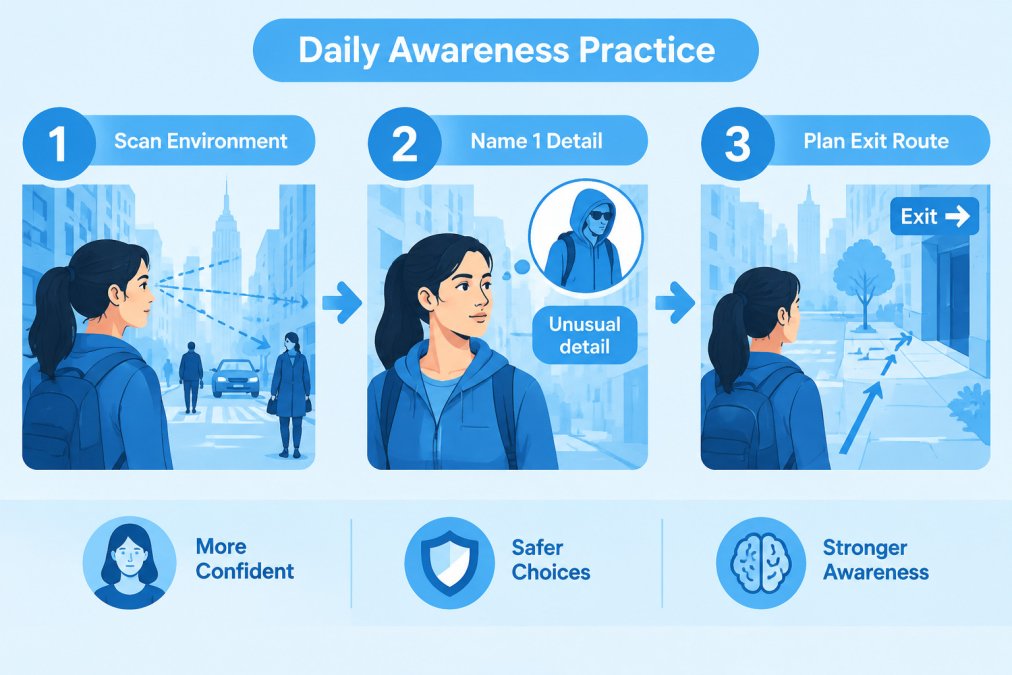
Try these short exercises during your normal day:
- The three-detail scan: When you enter any room, name three things you see without looking at your phone.
- The exit check: Each time you enter a store, restaurant or train car, find the nearest exit.
- The route plan: Before you walk somewhere unfamiliar, pick two possible routes and one place to get help, such as a shop or a staffed desk.
- The normal baseline: Spend a few minutes noticing how a familiar place usually looks and sounds, so you can spot changes later.
Practice these for two weeks. Most people find that noticing details becomes easier and less tiring over time.
Telling Ordinary City Behavior Apart From Real Warning Signs
Not everything unusual is a threat. A loud group, a person talking to themselves, or someone rushing for a train is common in a busy city. Treat these as background, not as danger. The key is to focus on behavior that is directed at you or that shows clear intent, rather than on appearance or unfamiliarity.
Warning signs are different. They tend to involve behavior that shows intent or that seems aimed at you specifically. Examples include someone repeatedly following you through different turns, a person who keeps closing distance after you step away, or someone who seems to be watching where you go. Other patterns worth noting: someone who matches your pace exactly over several blocks, a person who positions themselves between you and an exit, or someone who tries to engage you in conversation while a companion moves behind you.
When you notice one of these signs, move toward people, lighting and open spaces. If you feel unsafe, you can contact emergency services or ask a nearby worker or transit employee for help. In a store, approach a cashier or security guard. On the street, enter a business or flag down a passing police officer. On the subway, move to another car or get off at the next stop and wait near the booth.
Balance matters. Constant scanning can wear you out and make the city feel more threatening than it is. Aim for calm, steady attention, not nonstop alertness. A useful rule of thumb: if a behavior is unusual but not directed at you, let it go. If it is directed at you and persists, act early by changing your location or seeking help. This approach helps you stay safe without treating every stranger as a potential threat.
Situational Awareness Training That Builds Skills Under Pressure
Knowing what to do is one thing. Doing it when your heart is racing is another. Structured training helps bridge that gap. Whether urban self-defense training is worth it is a question worth weighing against your time and budget. Practice in a controlled setting lets you rehearse responses until they feel familiar, even under stress.
Under stress, the body's fight-or-flight response can narrow attention and make thinking harder. Rehearsing ahead of time gives your brain a script to follow.
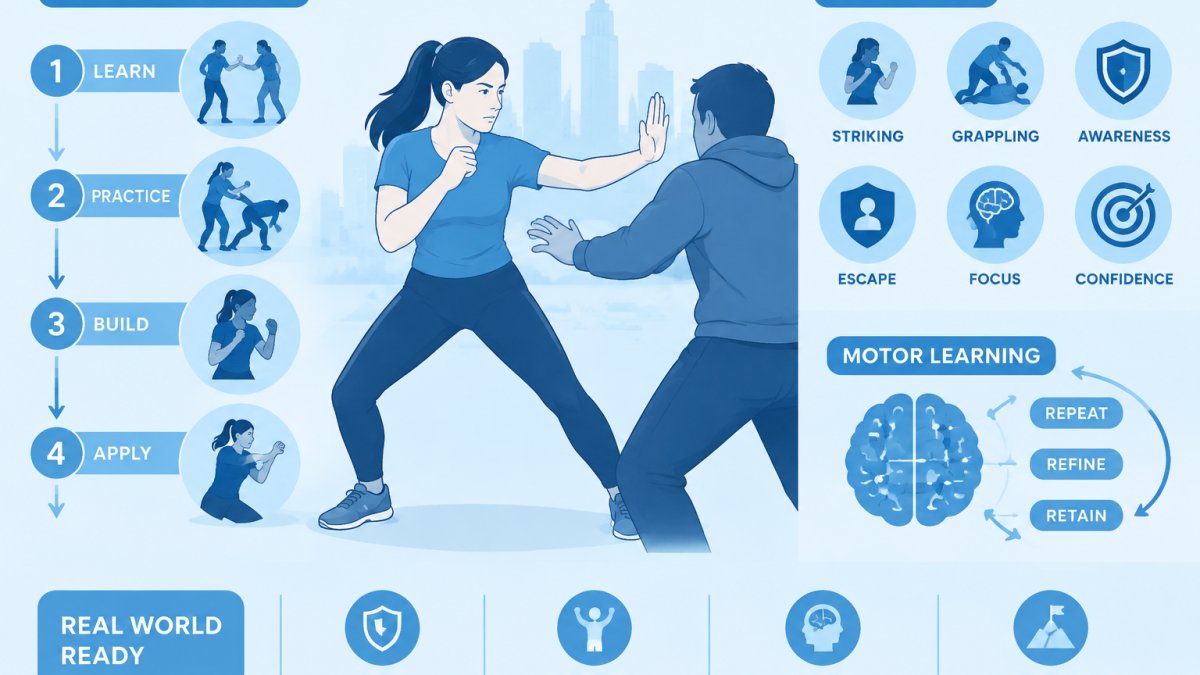
Kajukenbo and Filipino Martial Arts Club builds this kind of skill through progressive, structured practice in defined phases, which the club describes as making techniques easier to learn and more reliable under pressure.
- Practice scenarios, not just techniques
- Rehearse what to say, where to move and who to call
- Repeat under mild pressure until responses feel natural
Your Next Step: Booking a Trial Class at Kajukenbo NYC
If you want to build these habits with guided practice, the simplest first step is a trial class. Kajukenbo and Filipino Martial Arts Club offers a structured introduction to self-defense training in Midtown Manhattan for busy professionals.
Start by reviewing the club's current program details on its website, then book a trial session to see how the training feels. Step-by-step guide to booking a trial class walks you through the process. Compare Midtown self-defense class options before you commit. Bring the daily habits from this guide with you. Awareness grows fastest when you practice it in real life between classes.
Book a Trial Class
Frequently Asked Questions
How can I increase my situational awareness?
Start by putting your phone away in transit stations and on busy sidewalks for short stretches, then scan your surroundings every few seconds. Practice naming what you see: exits, people near doors, and anything that changes. Situational awareness is commonly described as deliberate observation supported by planning, so consistent small habits tend to matter more than occasional intense effort. Track your progress by noticing more details each week.
What is the 20-20 rule for situational awareness?
The 20-20 rule is a commonly taught guideline that suggests you watch for people and objects within about 20 feet and within about 20 seconds of your position, giving you time to react. It is not a formal standard from a government agency or peer-reviewed study, so treat it as a practical habit rather than a guaranteed measure. Applied on a crowded subway platform, it helps you decide when to step back from the edge or move toward a clearer exit.
Can situational awareness be improved with practice?
Yes. Situational awareness is a skill built through repetition, and training that combines observation, planning and scenario practice tends to produce the strongest results. Stress, fatigue and noise can reduce awareness, so practice when you are rested and gradually add more challenging environments. Structured, progressive training helps you retain what you learn and recall it when pressure rises.
How can I stay aware of my surroundings while using public transit?
Before boarding, identify the exits and the nearest staff or help point. While waiting, stand where you can see the platform and avoid the edge when trains approach. Once on board, choose a spot near a door or a pole where you can monitor the car, and keep headphones at a level that lets you hear announcements and movement. Notice changes in behavior, but avoid assuming danger from ordinary crowding.