 How-to
Stick and Blade Training for Beginners: A Step-by-Step Guide
Quick Summary
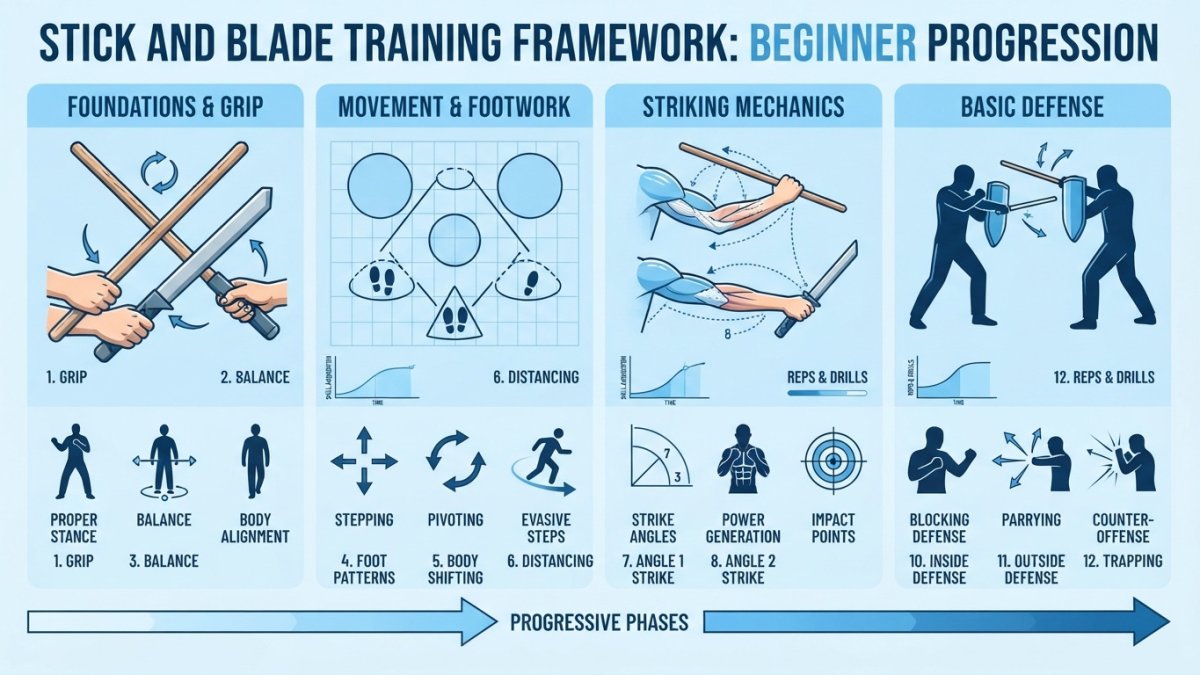
Stick and blade training is a structured way to learn Filipino martial arts, using a stick or blade as an extension of the arm. Beginners build stance, footwork, distance, and timing before attempting complex sequences. No prior experience is required to start.
- Start with stance and guard, then footwork, before learning base strokes.
- Hold a balanced stance for 60 seconds as an early checkpoint.
- Keep home sessions to about 20 to 30 minutes with full attention.
- Use padded training sticks and protective gear for partner drills.
- Expect several months of steady practice before basic drills feel comfortable.
Table of Contents
- What Stick and Blade Training Covers for Beginners
- Prerequisites: Do You Need Prior Martial Arts Experience?
- Stick Fighting at Home: Setting Up a Safe Practice Space
- Stance, Guard, and Footwork: The First Two Weeks
- Stick Fighting Solo Drills: Base Strokes and Simple Combinations
- Stick Fighting Safety Equipment and Partner Practice Rules
- How Long It Takes to Learn Stick Fighting and How to Track Progress
- Choosing Your Next Step: Finding a Qualified Instructor
- Frequently Asked Questions
Stick and Blade Training for Beginners: A Step-by-Step Guide
Last Updated: November 5, 2026
What Stick and Blade Training Covers for Beginners
Stick and blade training is a structured way to learn Filipino martial arts, using a stick or a blade as an extension of the arm. Stick and blade training can be taught as a set of progressive skills rather than a pile of flashy moves. Beginners learn distance, timing, footwork, and control before they ever attempt complex sequences.
Most beginners expect the hard part to be memorizing patterns. In practice, the bigger challenge is coordination. You must move your feet, track distance, and keep your weapon under control at the same time. Stick fighting training builds all three.
The core areas a beginner should expect to cover include:
- Stance and guard position
- Footwork and movement
- Basic strikes and base strokes
- Simple blocks and defensive angles
- Solo drills and short combinations
- Partner practice with safety rules
Watch out: Many beginners rush to sparring within the first few weeks. Skipping the fundamentals leads to sloppy footwork and bad habits that take months to undo.
Prerequisites: Do You Need Prior Martial Arts Experience?
No prior martial arts experience is required to start stick and blade training. Most beginner classes assume you have never held a training stick before. What matters more is a willingness to repeat basic movements until they feel natural.
Some physical preparation helps, but it is not a requirement. A reasonable starting point includes:
- Enough mobility to bend your knees and rotate your hips
- The ability to stand and move for a full training session
- A consistent schedule, even if it is only two or three sessions a week
A common mistake is treating the first month as a test of talent. It is not. Progress comes from repetition, and most people improve steadily once they stop comparing themselves to advanced students.
Stick Fighting at Home: Setting Up a Safe Practice Space
You can practice many beginner drills at home, but the space and gear must be set up deliberately. A cleared floor is not enough. Common home-training injuries can come from striking a low ceiling, slipping on a smooth floor, or using a cracked stick that fails mid-swing.
Start with the room itself. You need a flat, non-slip surface, rubber mats or a low-pile carpet over a hard floor work well, while polished tile and loose rugs do not. Measure your overhead clearance before any overhead strike: stand in your guard, raise the stick to the top of your swing, and confirm you have at least a foot of clearance above the tip. Remove or tape down anything within a full step in every direction, including lamp cords, chair legs, and pet bowls.
Lighting and sightlines matter more than beginners expect. Position a mirror so you can check your posture and stick angle from the side, and light the space so shadows do not hide the path of the stick. A phone propped up to record a short set is a cheap way to review footwork and recovery without a coach.
Your training stick should match your height and hand size. A common starting length is roughly from the floor to your hip or waist, and the stick should feel balanced in your grip without being so heavy that your wrist collapses on recovery. Inspect it before every session: run your hand along the length for cracks, splinters, and loose tape, and retire any stick that flexes oddly or shows a split. Keep training sticks in a dedicated bag or rack, never leaning in a corner where they can fall or be mistaken for something else.
Solo drills are a useful reason to train at home. They let you focus on footwork and striking mechanics without the pressure of a partner. Keep sessions short, around 20 to 30 minutes, and stop when your form starts to break down. A short session with full attention beats a long one where your guard drops and your angles blur.
Watch out: Practicing near a doorway or stairwell feels spacious until a recovery step sends you backward into a threshold. Mark your training area with tape or mats so you know where the safe boundary is before you start moving. A clearly marked boundary also helps keep longer implements under control, and the same awareness of space matters when practicing nunchaku training techniques.
Stance, Guard, and Footwork: The First Two Weeks
The first two weeks should focus on stance, guard, and footwork. These three elements make every later technique work. A stable stance lets you move quickly, a solid guard protects your head and body, and clean footwork keeps you in range.
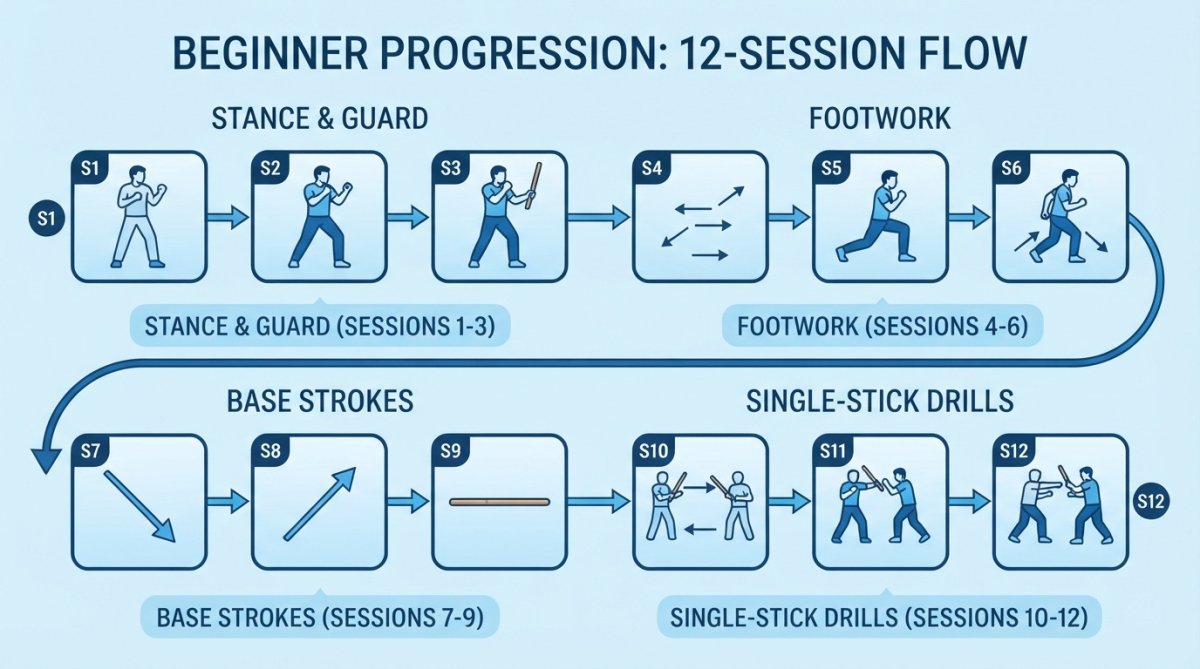
A simple progression for the first two weeks looks like this:
| Session Block | Focus | Goal |
|---|---|---|
| Sessions 1 to 3 | Stance and guard | Hold a balanced position for 60 seconds |
| Sessions 4 to 6 | Footwork | Step forward, back, and side to side smoothly |
| Sessions 7 to 9 | Base strokes | Repeat strokes with correct angle and rhythm |
| Sessions 10 to 12 | Single-stick drills | Combine footwork with simple strike sequences |
Keep your knees soft, your weight centered, and your guard close to your face. Most beginners drift toward a wide, upright stance, which makes them easy to hit and slow to recover.
Stick Fighting Solo Drills: Base Strokes and Simple Combinations
Base strokes are the foundation of stick fighting. They are the basic angled strikes that every other technique builds on. Practice each stroke slowly at first, focusing on the path of the stick and the position of your wrist and elbow.
Start with a short sequence and repeat it:
- Step forward and strike diagonally across the body
- Recover to your guard position
- Step back and strike along the opposite angle
- Return to stance and reset
Once the strokes feel steady, link two or three together into a simple combination. Speed comes after accuracy. A clean, slow combination is worth far more than a fast, sloppy one.
Watch your recovery. Many beginners strike well but forget to return to guard, which leaves them open.
Stick Fighting Safety Equipment and Partner Practice Rules
Safety equipment matters as soon as you begin partner work, and the right gear depends on the drill. For light, controlled partner drills, beginners commonly start with padded training sticks, hand protection, a mouthguard, and eye protection. As contact increases, add a padded helmet or fencing mask and forearm guards. Never use a real blade, a live-edged weapon, or a metal trainer for partner drills, training sticks should be wood, rattan, or padded synthetic, and they should be stored separately from any real blades in the home.
Partner practice should follow a clear, staged progression rather than jumping straight into free sparring:
- Stage 1, Cooperative drills: one partner strikes a named angle slowly while the other blocks or evades, with no resistance and no speed.
- Stage 2, Alternating drills: partners take turns attacking and defending at a set, slow rhythm, stopping to reset after each exchange.
- Stage 3, Light resistance: the defender begins to move and counter at controlled speed, still with agreed targets and no head contact.
- Stage 4, Supervised sparring: only with an instructor present, full protective gear, and clearly stated intensity limits.
Before every partner session, agree on the intensity level out loud and name the targets that are off-limits, typically the head, throat, and joints. Use a stop signal that either partner can call at any time, and honor it immediately without debate. Consent is ongoing: a partner who agreed to light contact five minutes ago can withdraw it, and the drill stops. A good partner tells you when a strike is too hard, and you should do the same.
This is also where stick training and blade training must be kept distinct. Blade concepts, angles, footwork, and control, can be practiced safely with a stick or a dull trainer, but live-blade practice belongs only under direct instructor supervision with a established safety protocol. Beginners should treat every blade as live, keep it sheathed and stored apart from training gear, and never practice blade draws or cuts alone at home.
Watch out: The most common partner-work error is creeping intensity. A drill that starts slow often speeds up without anyone deciding to, so reset the pace verbally every few minutes and stop the drill when form or control breaks down. Responsible practice keeps you training for years instead of months.
How Long It Takes to Learn Stick Fighting and How to Track Progress
Most beginners need several months of steady practice before they feel comfortable with basic drills. Real skill development takes longer. Many students practice for a year or more before their movement feels automatic under light pressure.
Track progress with simple checkpoints rather than feelings:
- Can you hold your stance for a full minute without losing balance?
- Can you complete a base stroke sequence without pausing?
- Can you recover to guard after every strike?
- Can you maintain control during light partner drills?
Write these answers down every few weeks. Progress often looks slow day to day but becomes clear when you compare notes over a season of training.
Choosing Your Next Step: Finding a Qualified Instructor
Finding a qualified instructor is one of the most important decisions a beginner makes. Look for someone who teaches a clear progression, emphasizes safety, and explains why each drill matters. Ask how students are assessed and how partner intensity is controlled.
Ask any instructor you consider:
- What does the first month of training include?
- How do you handle injuries and fatigue?
- What safety equipment do you require?
- How do you measure student progress?
If you are ready to try it, you can book a trial class to see how the beginner curriculum works in person. You can also read Stick and Blade Training Benefits: A 2026 Guide for an overview of what the training offers, or learn the basics of Arnis if you want a foundation before your first session.
Frequently Asked Questions
Why is Krav Maga not taken seriously?
Krav Maga is often criticized in martial arts circles because its curriculum is built for stress inoculation and fast self-defense rather than long-term technical refinement, and its tournament presence is limited. Judging any system depends on the instructor and the training methods used.
What should beginners learn first in stick and blade training?
Beginners should start with stance, guard position, and footwork before touching a striking pattern. Next comes the basic set of single-stick base strokes, practiced slowly and with correct distance. Defensive blocks and simple two-strike combinations come after that. Starting with fundamentals keeps movement safe and makes later drills easier to absorb. Practice each element in short sessions of 15 to 20 minutes, focusing on control before speed.
Can you learn stick fighting at home?
You can learn the fundamentals at home, including stance, footwork, base strokes, and solo drills, as long as you have enough open floor space and use a training stick made for practice. Home practice cannot replace partner work, where you learn timing, distance, and response to a live opponent. Use home sessions to build movement patterns, then join a supervised class for partner drills and sparring-style exercises.
How long does it take to learn basic stick fighting?
Most beginners can learn the basic stances, footwork, and base strokes within the first several weeks of consistent practice, typically two to three sessions per week. Reliable control of simple combinations usually takes a few months, and the time needed to apply techniques under pressure with a partner takes longer. Progress depends on practice frequency, quality of instruction, and how consistently you train. Tracking your drills in a simple log can show measurable improvement over time.