 How-to
Is Deliberate Practice Worth It for Beginners?
Quick Summary
Deliberate practice is worth it for beginners who want reliable skill, not just more repetitions. It means practicing one specific flaw with clear goals and feedback, which can yield cleaner technique in less total time, though it feels harder and more uncomfortable at first.
- Focus on one target skill at a time, such as a wrist escape.
- Keep sessions short, around 20 to 30 minutes of focused work.
- Film one rep per session to create a simple feedback loop.
- Run a two-week test, comparing your first and last clips, before committing.
- Expect frustration early, and treat missed sessions as data rather than failure.
Table of Contents
- What Deliberate Practice Means in Plain Terms
- Deliberate Practice vs. Regular Practice
- What the Research Says About Its Payoff
- Why Beginners Find It Uncomfortable and How to Push Through
- Deliberate Practice Examples for Self-Defense and Motor Skills
- A Beginner Deliberate Practice Routine You Can Start This Week
- How Long to Practice a Skill Each Day as a Beginner
- Booking Your First Trial Class to Test the Method
- Frequently Asked Questions
Is Deliberate Practice Worth It for Beginners?
Last Updated: November 2, 2026
Deliberate practice is a training method built around focused, goal-driven repetition with feedback. Deliberate practice is a training method used in many skill-building settings to help beginners build reliable skills. The real question for a new student is simple: does the extra effort pay off? This guide walks through what the research supports, where it falls short, and how to start without getting overwhelmed. Applying these structured habits to specialized disciplines like those practiced by Tactical Trash Pandas ensures that even the most rigorous training routines remain grounded in measurable improvement.
What Deliberate Practice Means in Plain Terms
Deliberate practice is practice that targets a specific weakness, uses clear goals, and includes feedback. It is different from simply doing a skill many times.
Think of two people who each practice a front kick for 30 minutes. One repeats it while chatting. The other focuses on hip rotation, checks the form on video, and fixes one flaw at a time. Only the second is doing deliberate practice.
For beginners, that usually means:
- One target at a time: Pick a single skill, like a wrist escape.
- Slow, clean reps: Quality matters more than speed early on.
- Feedback: A coach, a mirror, or video shows what to fix.
- Rest between sessions: Focus wears down, so short sessions work better.
Deliberate Practice vs. Regular Practice
Regular practice means doing a skill because it is on the schedule. Deliberate practice means doing it with a plan to improve one thing.
Most beginners drift into regular practice. They run through the same drills each class and feel busy without getting much better. The shift is small but important: ask, "What exactly am I fixing today?"
A quick comparison:
| Feature | Regular Practice | Deliberate Practice |
|---|---|---|
| Goal | Get through the drill | Fix a specific flaw |
| Attention | Often drifts | Sustained and focused |
| Feedback | Occasional | Built in and frequent |
| Session length | Often long | Short and intense |
| Best for | Maintaining skills | Building new skills |
What the Research Says About Its Payoff
Researchers have reviewed this topic extensively, and the evidence suggests deliberate practice explains only part of the differences in performance between people.
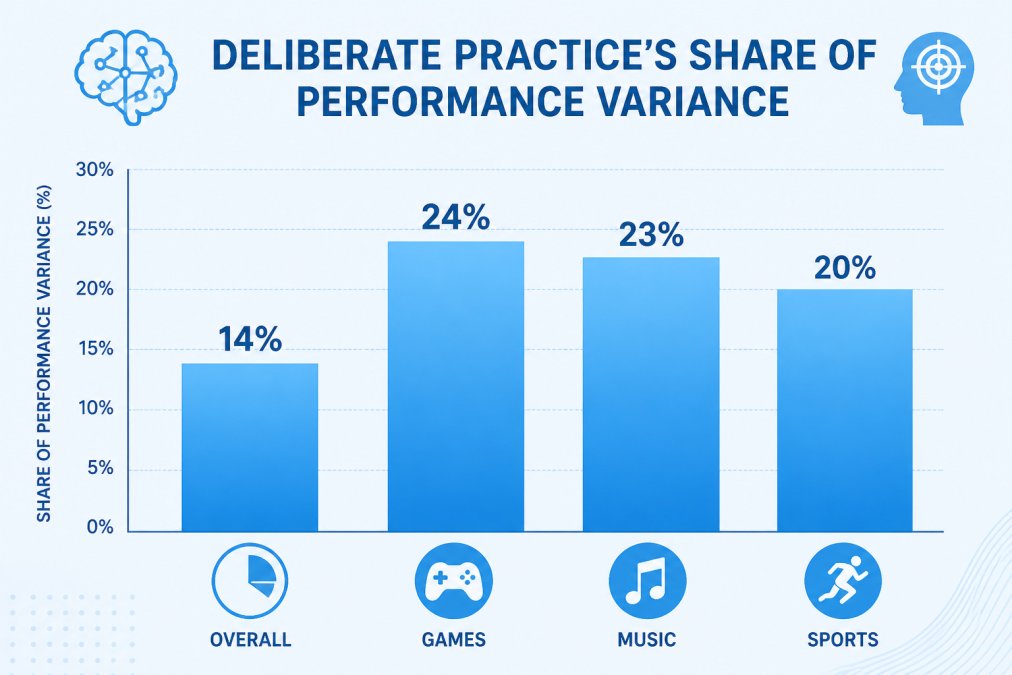
That number sounds low, and it is often misread. It does not mean deliberate practice is only 14% useful. It means that across a mixed group of people, differences in how much deliberate practice they did explained about 14% of why some performed better than others. For a single beginner working on a single skill, the share that matters is the share you can control. You cannot change your genetics or your prior experience. You can change how you practice.
The Beginner ROI: Time In vs. Skill Out
Most guides skip the question the keyword actually asks: is the extra effort worth it? Here is a plain cost-benefit breakdown for a beginner.
| Input | Regular practice | Deliberate practice |
|---|---|---|
| Time per session | 60 minutes of mixed drilling | 20-30 minutes of focused work |
| Mental effort | Low to moderate | High |
| Feedback | Occasional coach correction | Built-in check every few reps |
| Typical result after 4 weeks | Same rough technique, more reps | One or two clean, reliable techniques |
| Risk | Boredom, plateau | Frustration, early burnout |
The trade-off is real. Deliberate practice asks for less total time but more focus per minute. For a beginner, that usually means shorter sessions that feel harder. The payoff is not faster progress on everything. It is faster progress on the one thing you chose to fix.
Where the Evidence Is Strongest and Weakest
The evidence is strongest for domains with clear, measurable performance, such as sports and music (Deliberate practice and performance in music, games, sports, education, and professions). It is weaker when applied to complex, less measurable skills, and self-defense is harder to measure in a lab. Much of what is known comes from research outside martial arts, so it is reasonable to apply the principles while staying modest about the exact numbers.
A Simple Worth-It Test for Beginners
Before committing weeks to the method, run a two-week test:
- Pick one skill you can measure, such as a wrist escape or a stance shift.
- Practice it deliberately for 20 minutes, three times a week.
- Film the first and last session.
- Compare the two clips side by side.
If the second clip shows cleaner mechanics and less hesitation, the method is paying off for you. If not, adjust the goal or the feedback source before deciding it does not work. The test costs nothing but time, and it answers the worth-it question with your own evidence rather than someone else's average.
Why Beginners Find It Uncomfortable and How to Push Through
Deliberate practice is hard. It asks you to notice your mistakes and keep working on them, which can feel frustrating. Many beginners quit because progress feels slow. But the discomfort is not just about effort. For beginners, it is often psychological, and most guides ignore that.
The Beginner-Specific Barriers
Three barriers show up again and again in new students:
- Imposter syndrome: Focusing on flaws can feel like proof you do not belong. A beginner who films a sloppy kick may read it as "I am not built for this" rather than "this is the next thing to fix."
- Comparison fatigue: Watching advanced students or online clips makes your own slow reps feel pointless. The gap between where you are and where you want to be feels like evidence against you.
- Burnout risk: Deliberate practice is mentally tiring. Beginners often stack it on top of a full schedule and quit when the fatigue compounds.
These are not character flaws. They are predictable responses to focused self-scrutiny, and they can be managed.
A Low-Cost Self-Coaching Framework
Not everyone has a professional coach. Here is a do-it-yourself framework that requires only a phone and a notebook:
- Film one rep per session. Use your phone, prop it against a bag, and record a single technique from the side.
- Pick one flaw. Watch the clip once and name the single most obvious issue. Do not list five.
- Drill only that flaw for 15 minutes. Slow, clean reps. No speed until the flaw is gone.
- Re-film and compare. Put the first and last clip side by side. This is your feedback loop.
- Log it. Write the skill, the flaw, and one observation. The log becomes your coach over time.
This framework uses a camera and a written record in place of live coaching. It is not as good as live feedback, but it is more focused than unfocused repetition.
How to Push Through Without Quitting
- Keep sessions to 20 to 30 minutes of focused work.
- Track one measurable goal per week, not five.
- Celebrate small technical wins, not just big milestones.
- Pair deliberate practice with low-pressure regular practice so the hard work does not become the whole experience.
- Tell a training partner what you are working on. Saying it out loud makes the flaw feel like a project rather than a verdict.
Watch out for the moment when self-scrutiny turns into self-criticism. The goal is to notice a flaw and fix it, not to prove you are bad at the skill. If the inner voice shifts from "what do I fix next" to "why am I not good enough," stop the session and return to regular practice for a day.
Deliberate Practice Examples for Self-Defense and Motor Skills
Here is how the method looks in practice:
- Wrist escape: Practice one grab escape, slowly, with the coach checking your hip and elbow position. Repeat until the movement feels stable, then add speed.
- Stance and footwork: Spend five minutes moving forward and back with a focus on balance, filmed from the side.
- Stick or blade concepts: Start with basic angles and footwork before adding partner drills.
Each example has one clear goal, a feedback source, and a stopping point. For a closer look at how complex techniques become easier to remember under stress, see making complex self-defense skills easier to remember under stress. That structure is what separates deliberate practice from simply putting in time.
A Beginner Deliberate Practice Routine You Can Start This Week
Try this simple routine for seven days:
- Warm up (5 minutes): Light movement, joint rotations.
- Focus block (15 minutes): Choose one technique. Repeat slowly, checking form after each rep.
- Feedback check (5 minutes): Film yourself or ask for a correction.
- Cool down (5 minutes): Stretch and note one thing to improve next time.
Keep a short log. Write the skill, the flaw you worked on, and one observation. Over a few weeks, the log shows your progress.
How Long to Practice a Skill Each Day as a Beginner
For most beginners, 20 to 45 minutes of focused practice per day is a sensible target. Longer sessions tend to lose focus, so it often works better to split practice into two short blocks.
Consistency matters more than length. Three focused 30-minute sessions per week can beat one long, tiring session. Adjust based on how sharp you feel. If your form breaks down, stop and rest.
Booking Your First Trial Class to Test the Method
The best way to decide whether deliberate practice is worth it for you is to try it. A trial class lets you experience the structured approach firsthand.
book a martial arts trial class to test the method in person. Come with your questions about time commitment, and bring your own sense of what you want to improve.
For a deeper look at applying the method to martial arts, read how to apply deliberate practice to martial arts. If you are worried about staying consistent through the uncomfortable early weeks, improving martial arts retention covers practical steps that help beginners stick with training.
Frequently Asked Questions
Is deliberate practice worth it for beginners?
For most beginners, yes, but mainly because it makes early effort more efficient rather than because it guarantees fast results. Research reviews suggest deliberate practice explains only part of the differences in performance between people, leaving much of the difference to other factors. The payoff is strongest when you pick specific, measurable targets, get immediate feedback, and repeat weak points with full attention. Beginners who try it for a few weeks and track their progress will usually know quickly whether the effort is paying off for them.
What is deliberate practice in simple terms?
Deliberate practice is focused, goal-directed training aimed at a specific weakness, with feedback that tells you whether you improved. It differs from simply repeating a skill you already do well. The work is usually uncomfortable because it sits just beyond your current ability. Researchers who study expert performance describe it as the main type of practice that builds skill over time, though the review evidence shows it does not explain everything about how people get good.
How long should a beginner practice each day?
Most beginners do better with shorter, focused sessions than with long, tiring ones, since sustained concentration is hard to maintain. Sessions of 20 to 45 minutes, practiced most days, are a practical starting point for many people, and you can extend them as your attention improves. Consistency matters more than session length in the first months. If your concentration drops and your technique starts to slip, stop the session rather than reinforcing mistakes.
How can beginners avoid burnout while practicing?
Limit each session to a clear goal, take short breaks between repetitions, and alternate demanding work with easier review days. Because deliberate practice requires heavy concentration, a schedule that ignores recovery tends to fail within a few weeks. Track how you feel after sessions as well as how you perform. If motivation drops for several days in a row, reduce the session length and keep the routine rather than abandoning it entirely.